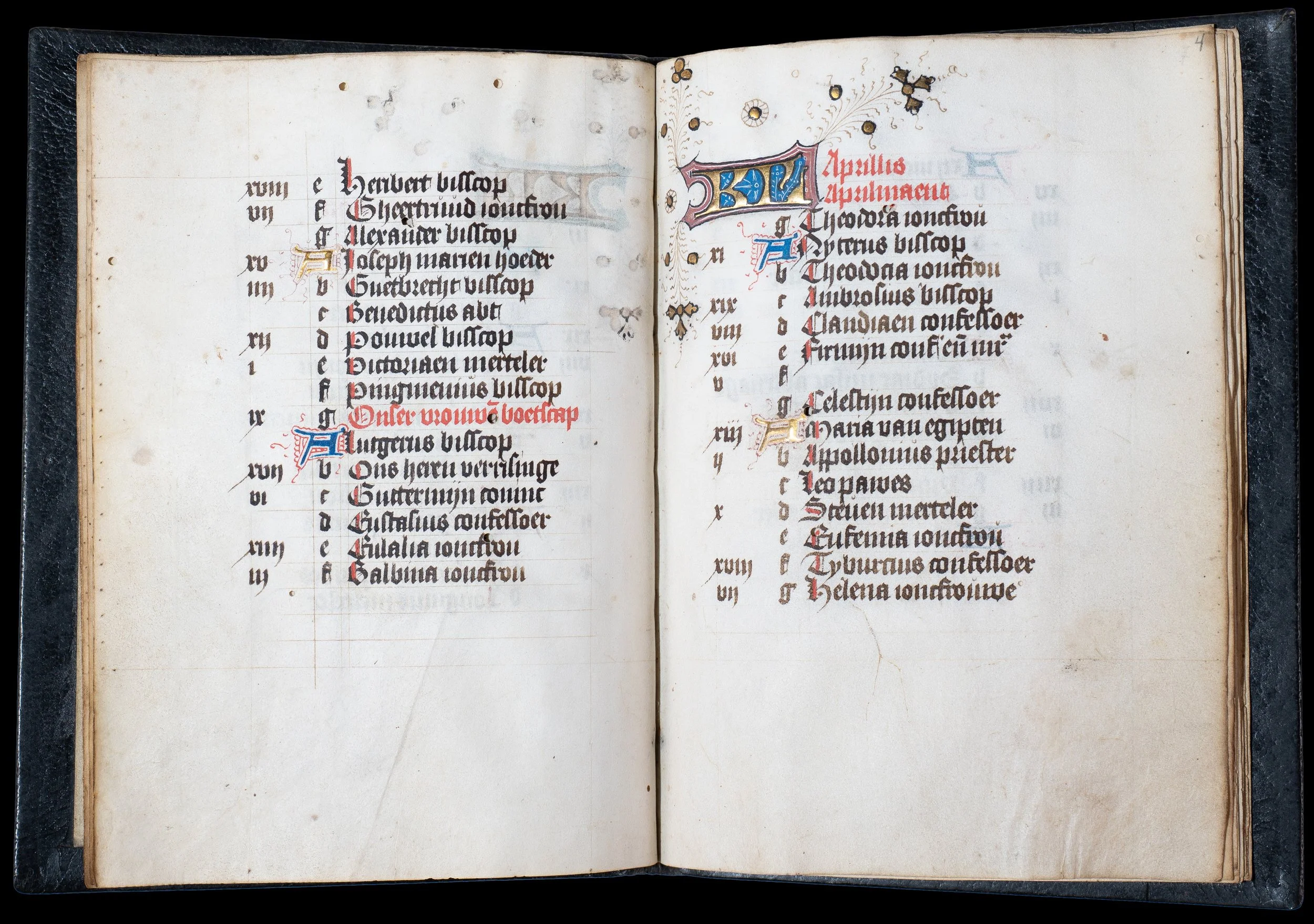
Calendar from a Book of Hours (Use of Utrecht)
In Middle Dutch, illuminated manuscript on parchment
Northern Netherlands, probably Utrecht, c. 1425–1450
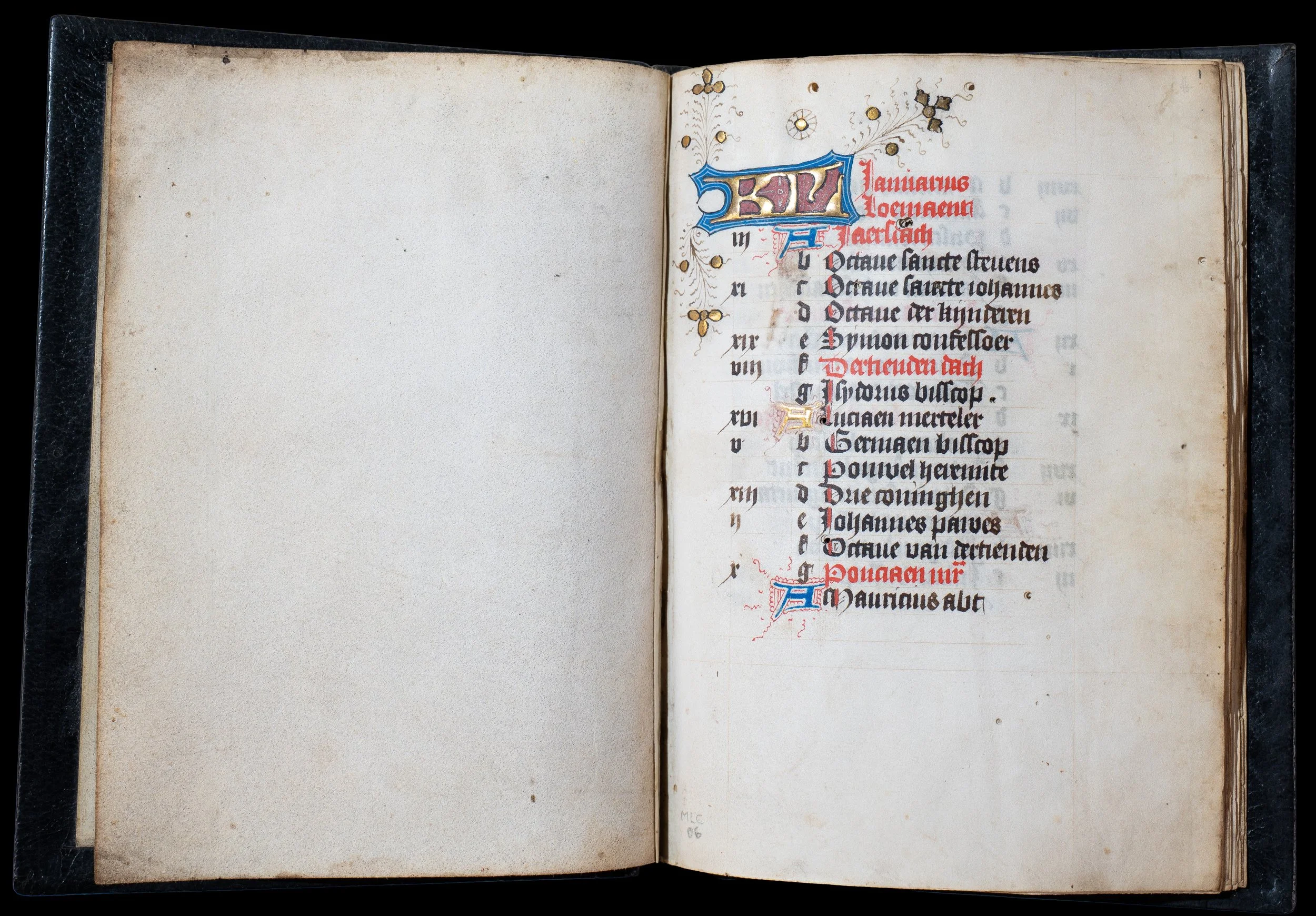
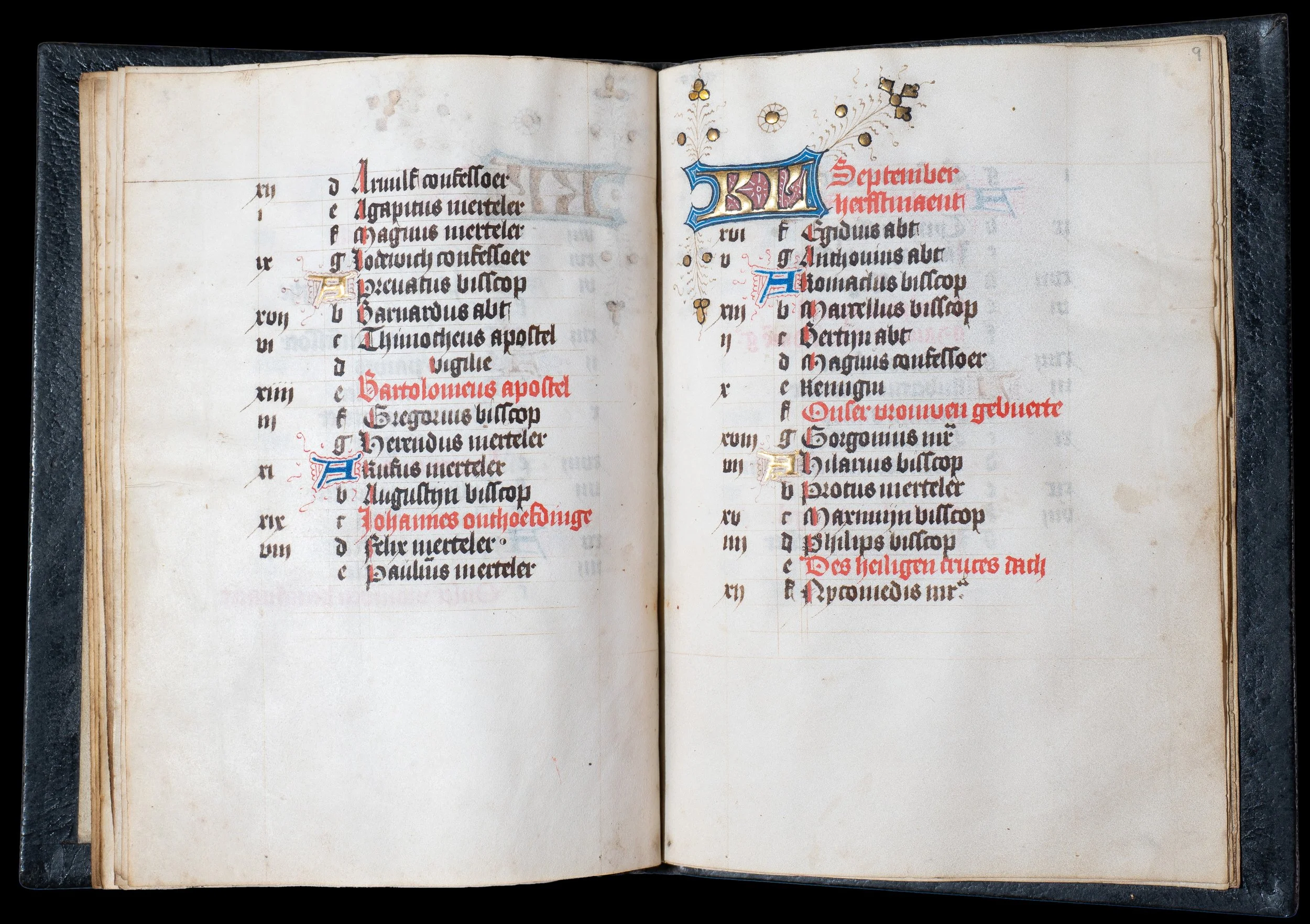
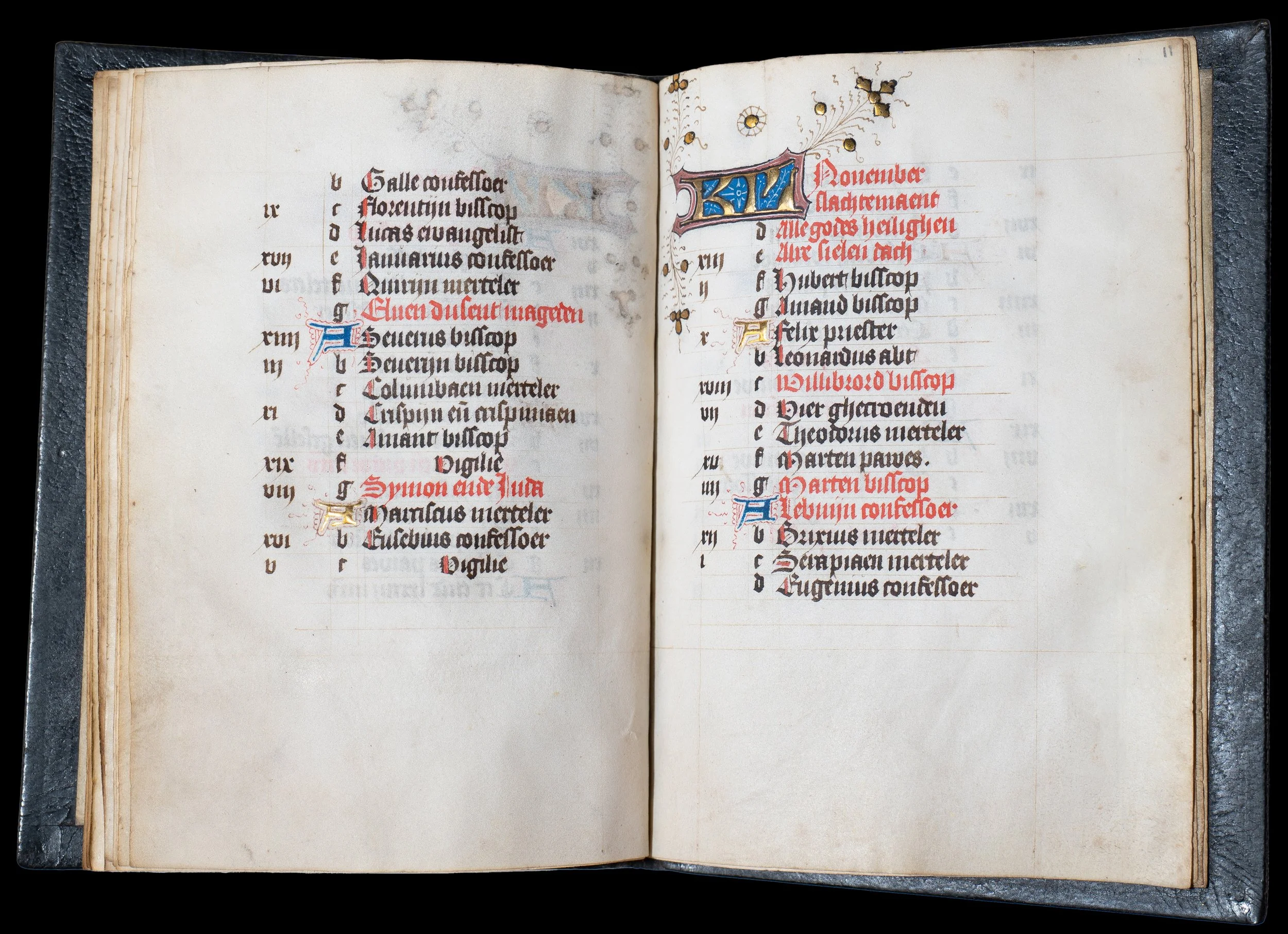
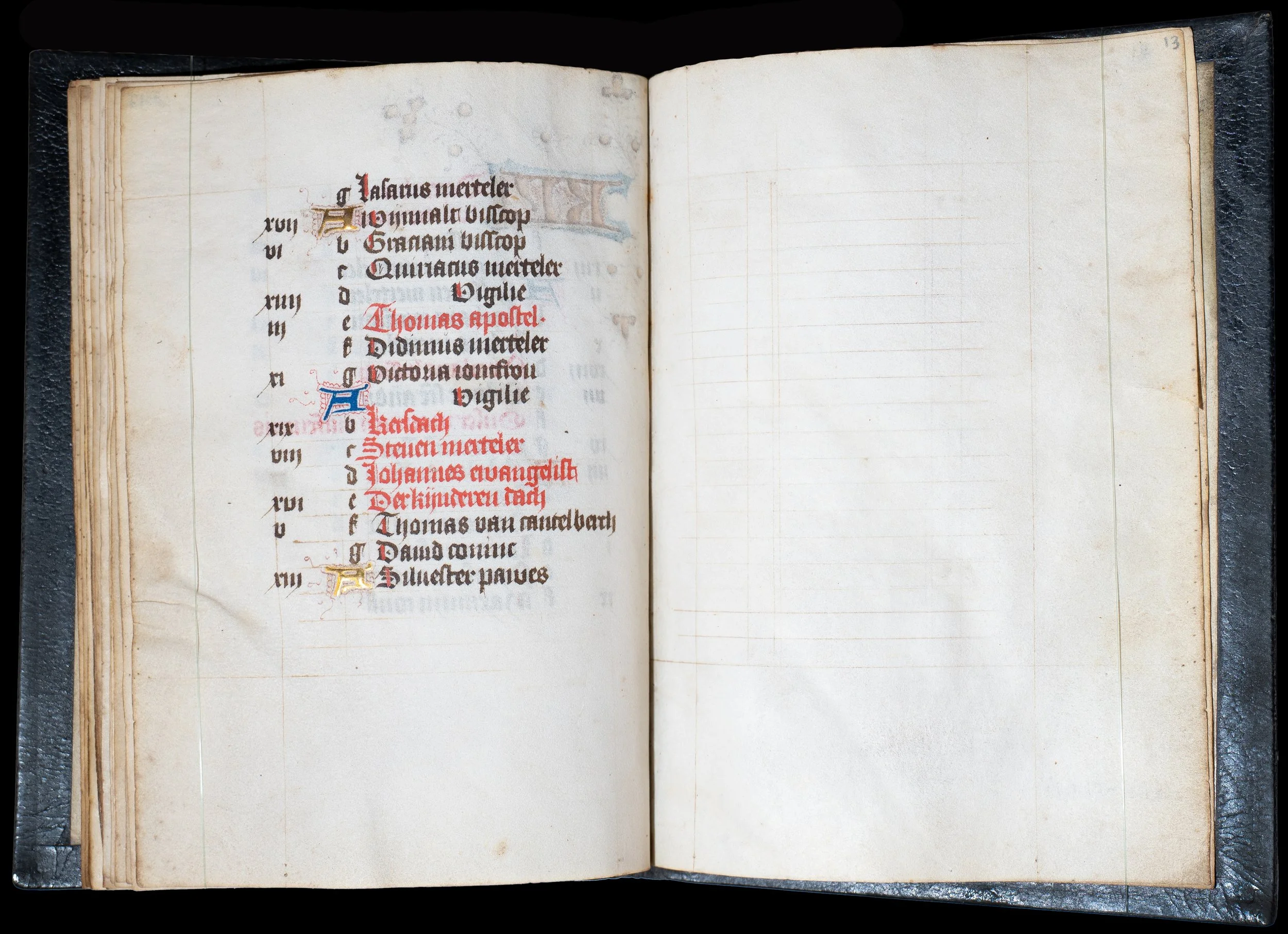
i + 12 + i leaves, ruled in ink, written in Gothic textualis in seventeen lines per page in brown and red ink; two-line KL initials in burnished gold on red grounds with blue borders and pen-drawn flourishing of geometric and foliate forms, accented with liquid gold. Bound in modern black leather over boards, the spine lettered in gilt capitals “16th Century Manuscript Calendar.”
Dimensions: 147 × 110 mm.
PRICE: $6,500
This manuscript preserves the complete calendar from a fifteenth-century Book of Hours written in Middle Dutch. The leaves are executed in a clear and regular Gothic bookhand, with feast days highlighted in red and decorative initials combining gold, color, and penwork ornament. The survival of the entire calendrical section as a coherent unit is of particular importance, as it allows for the identification of the regional liturgical tradition of the parent manuscript. The calendar is written in the vernacular rather than Latin, reflecting the widespread use of Middle Dutch devotional texts in the northern Netherlands during the fifteenth century. Such translations are closely associated with the spiritual movement known as the Devotio Moderna, inspired by the teachings of Geert Groote. Books of Hours in Dutch became especially popular among lay readers seeking a more personal and accessible form of devotion. The selection and hierarchy of saints in the calendar clearly indicate that the parent manuscript followed the Use of Utrecht. Several saints closely associated with the diocese and its missionary history are entered prominently in red, including Saint Willibrord (7 November), Saint Pontianus (14 January), Saint Odulf of Utrecht (11 June), Saint Boniface (4 June), and Saint Lebuinus (24 June and 12 November, including the translation of his relics). Their prominence firmly situates the manuscript within the liturgical tradition of Utrecht.
Other leaves from the same manuscript are known, including illuminated examples now preserved in institutional and private collections. A related leaf in the Dunedin Public Library is published in M. Manion, V. F. Vines, and C. de Hamel, Medieval and Renaissance Manuscripts in New Zealand Collections (London, 1989), p. 100, providing important evidence for the reconstruction of the original codex.
Calendars were an essential component of medieval manuscripts, including Books of Hours, Psalters and Breviaries, providing the primary means of structuring the year before the widespread use of mechanical clocks. Rather than numbering days, medieval calendars identified each date by the feast celebrated on that day, embedding the passage of time within the cycle of the liturgical year. They also preserve elements of the ancient Roman calendrical system, in which each month was organized around three fixed points—the Kalends, the Nones, and the Ides with intervening days counted backwards from these markers.
PROVENANCE:
1. Produced in the Netherlands, c. 1425–1450, as part of a vernacular Book of Hours written for the Use of Utrecht.
2. The parent manuscript remained intact until the mid-twentieth century, when it was acquired by Folio Society (often referred to in the trade as Folio Fine Art) and subsequently dismembered in the 1960s, with individual leaves dispersed on the market.
3. Acquired in 1965 by Martin Colker, noted for his work on medieval manuscripts and humanist texts.
4. Later in a private collection in Belgium.
LITERATURE:
Manion, Margaret M., Vera F. Vines, and Christopher de Hamel. Medieval and Renaissance Manuscripts in New Zealand Collections. London: Philip Wilson Publishers, 1989, p. 100.
Wieck, Roger S. Time Sanctified: The Book of Hours in Medieval Art and Life. New York: George Braziller, 1988.
Gunhouse, Glenn. The Book of Hours: A Medieval Bestseller (Hypertext Book of Hours). https://www.medievalist.net/hourstxt/home.htm.
Wieck, Roger S. The Medieval Calendar. New York: The Morgan Library & Museum, 2017.