German Artist
King David in Prayer
Written in Latin, a miniature from illuminated Gradual, Introit for the Mass on the First Sunday of Advent, Ad te levavi animam meam… To you, O Lord, I lift up my soul…
Germany, Rhineland, circa 1480–1490
Historiated initial “A”, 120 × 118 mm.
Tempera, ink and gold on parchment
PRICE: $10,500
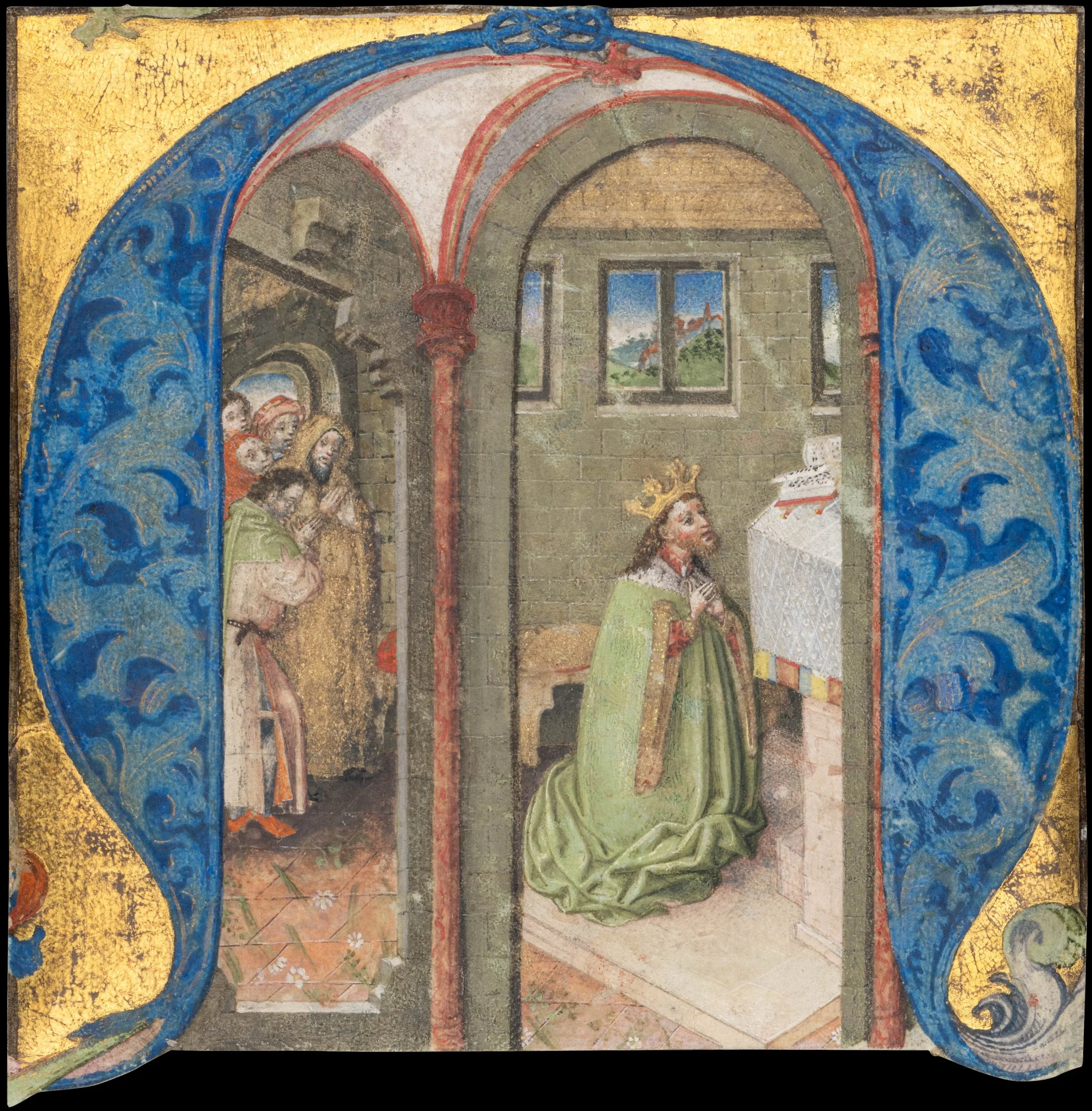
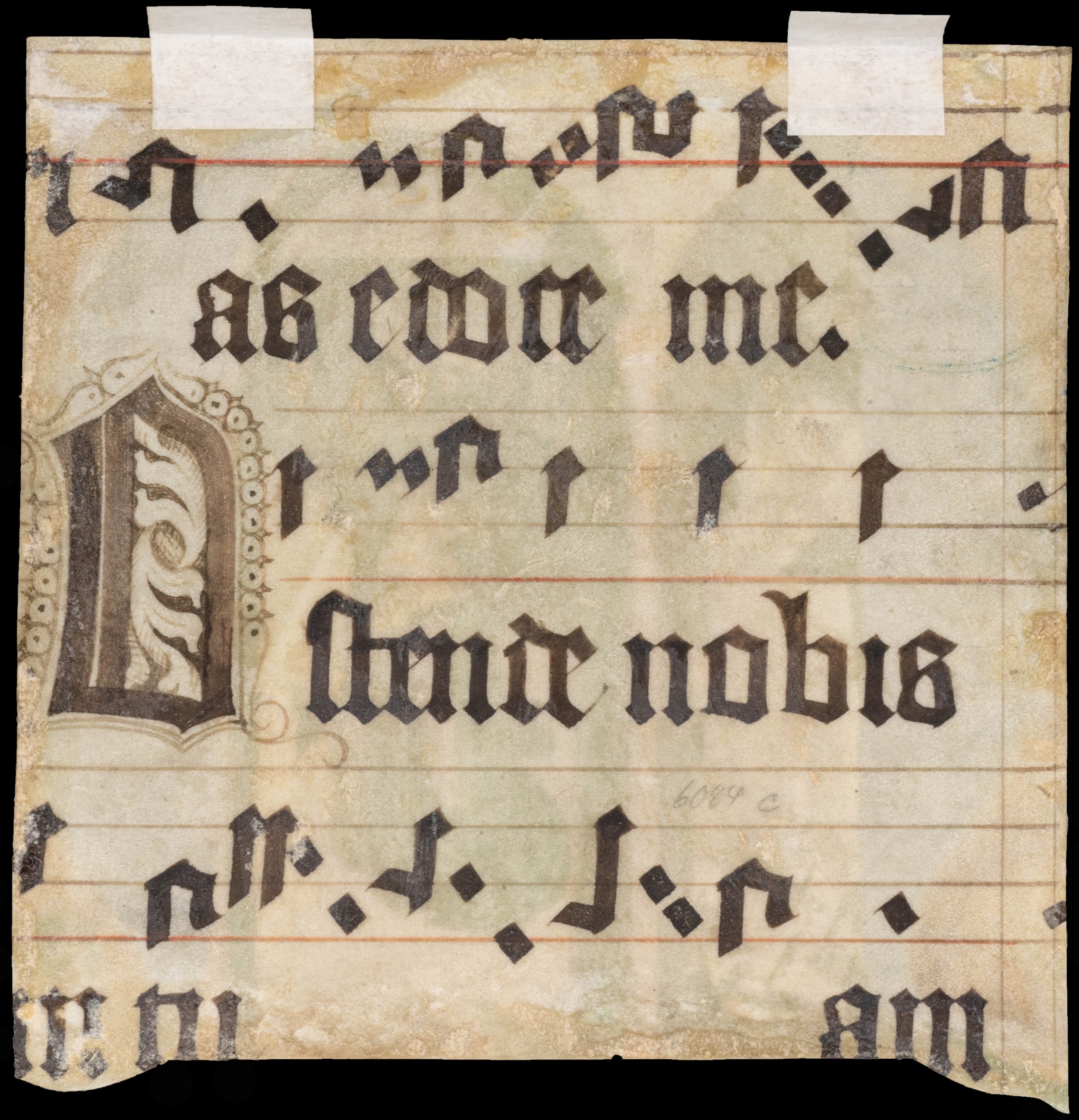
This exquisitely painted miniature shows King David in prayer within a large initial A introducing the Introit Ad te levavi animam meam (Psalm 24/25:1), the opening chant for the First Sunday of Advent. The verso text, Ostende nobis, Domine, misericordiam tuam… further confirms the fragments origin in a Gradual, the choirbook for the Mass. This chant begins the liturgical year and sets the penitential and anticipatory tone of the Advent season.
The scene unfolds within a carefully articulated interior. David, crowned and draped in a voluminous green mantle edged in gold, kneels on a raised step before a white-clothed altar, his hands crossed in a gesture of humble devotion. Behind a stone arcade to the left, a small group of onlookers gather in prayer, gazing into the sacred space. A rear window opens onto a distant landscape, showcasing the artist’s refined command of space and perspective. The initial is set against a rich blue ground animated with scrolling foliage and framed by a burnished gold border. The cool palette of blues, greens and soft reds is characteristic of late fifteenth century Rhineland illumination. Rhythmic folds of drapery and delicately modeled flesh tones suggest a painter attuned to volume and form, blending manuscript conventions with early Northern Renaissance naturalism, especially from the Netherlands. Though anonymous, the artist was clearly well-trained, producing works of high quality and quiet expressive force.
This leaf was very likely produced in the Rhineland, a region stretching from Cologne northward which is an area dense with monastic communities and urban centers. Although precise localization remains elusive, stylistic features suggest an affinity with a group of choirbooks made for the Benedictine Abbey of St. Ludger in Werden, Germany. The remnants of that rich monastic library are now preserved in the Düsseldorf Universitäts und Landesbibliothek. Several of the grand musical manuscripts produced in the Werden scriptorium, such as MS-D-21, MS-D-23, MS-D-24, and MS-D-26, survive with some historiated initials and leaves excised over time. While this miniature comes from a Gradual rather than an Antiphonal, it may nonetheless have originated at St. Ludger or been painted by an artist active there. One particular manuscript, MS-D-21, shares striking stylistic affinities with the present work. It appears the Werden volumes were illuminated by several artists over time. The King David miniatures also reveals the influence of early Netherlandish painting which stands as a testament to the cultural proximity and artistic exchange between the Low Countries and the Rhineland.
PROVENANCE:
Switzerland, Beinwil am See, Antiquariat Dr. Walter Eichenberger, with their inventory 6084c.
Switzerland, Private Collection.
LITERATURE:
Müller, Monika E., Die mittelalterlichen Handschriften und Fragmente der Signaturengruppe D in der Universitäts- und Landesbibliothek Düsseldorf, 2 vols., eds. Irmgard Siebert and Anne Liewert, Wiesbaden: Harrassowitz, 2015.
Exh. cat. Herbst des Mittelalters. Spätgotik in Köln und am Niederrhein, Kunsthalle Köln, Cologne: 1970.
Hemfort, Elisabeth. Monastische Buchkunst zwischen Mittelalter und Renaissance: Illuminierte Handschriften der Zisterzienserabtei Altenberg und die Kölner Buchmalerei 1470–1550, Bergisch Gladbach: Laufen Verlag, 2001.
View our selection of illuminated miniatures and manuscript leaves for sale →