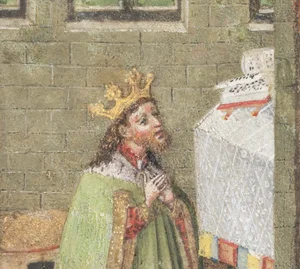
Manuscripts on Screen: Medieval Books in Film
Medieval manuscripts are most often encountered in libraries, museums, and private collections. Yet they also turn up—sometimes unexpectedly—on screen. There is something inherently cinematic about the manuscript: an object that suggests secrecy, authority, knowledge, and discovery—something written, preserved, and waiting to be revealed.
Over the years, I’ve noticed that a number of films—some well known, others less so—return to this idea. In them, manuscripts are not just background objects, but central to the story: sources of knowledge, mystery, and sometimes real danger. Several of these are films I’ve come back to for years, and a few are among my all-time favorites.
What follows is a small selection of films in which the manuscript, or the world around it, plays an important role.
The Secret of Kells (2009)
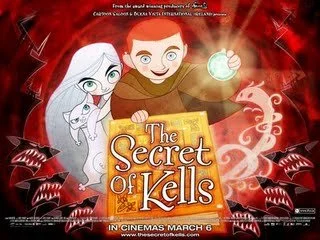
Few films engage so directly with manuscript culture as The Secret of Kells, which takes the making of the Book of Kells as its central theme. Its visual language draws heavily on nature and the supernatural—echoing the world of Insular illumination—translating the geometry, color, and ornament of the manuscript into animation. The result is less a historical reconstruction than an imaginative interpretation of how such a book might have been conceived and created.
It is a pleasure to watch—whether alone or with family—and one I return to often. Produced in Ireland by Cartoon Saloon, the film carries a particular resonance: much like the Book of Kells itself, it has become something of a modern cultural emblem, reflecting Ireland’s artistic heritage through a contemporary lens. Highly Recommended!
Andrei Rublev (1966)
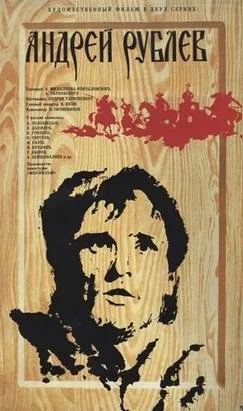
In Andrei Rublev, manuscripts appear within the broader context of monastic life. Monks write and preserve texts, but the film’s focus lies on the making of sacred images, particularly icons. Together, they evoke a world in which the written and the painted coexist as parallel forms of devotion and expression.
I first saw the film years ago in Chicago at the Gene Siskel Film Center, on the big screen, knowing very little about it—only that it was considered one of the greatest films ever made, and perhaps the greatest of Russian cinema. I was completely taken aback by its beauty and its tragedy. It captures something essential about artistic creation: a life of movement and observation, where the artist—like the monk—moves through the world as both participant and witness, reflecting the full range of human experience. The manuscripts they produce, like the icons they paint, emerge as quiet records of that lived encounter. It is a masterpiece of cinema!
The Name of the Rose (1986)
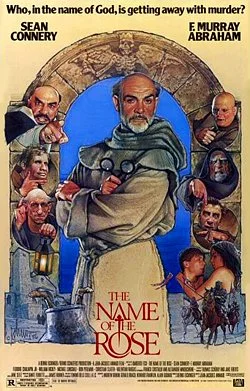
Perhaps the most direct cinematic engagement with medieval manuscripts, The Name of the Rose centers on a monastic library where books are guarded, hidden, and feared. The manuscript becomes an object of knowledge and danger—its contents capable of shaping belief and provoking violence. The film captures both the physical presence of books and the intellectual weight they carried in the medieval world.
I first watched the film before reading the remarkable novel by Umberto Eco. In this case, the adaptation does the book justice—which is not often the case. The film offers a vivid view into monastic life: the order of the monks, the structure of the abbey, and above all the presence of a vast and mysterious library at its center. The performances are exceptional, grounding the film’s intellectual tension in something deeply human. Without giving too much away, it is a film that rewards both viewing and reading—the two deepen one another.
The Ninth Gate (1999)
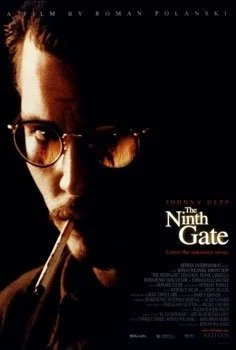
The Ninth Gate brings the world of rare books into a modern setting, following a dealer tasked with comparing copies of a mysterious and dangerous volume. Questions of authenticity, provenance, and subtle variation drive the narrative. Who wrote this mysterious book? The book itself becomes an object of obsession, echoing—if in exaggerated form—the concerns of the manuscript and rare book trade.
It’s a film full of surprises—entertaining, a little devious, and one I remember discovering at my local video rental shop (when those still existed). It came recommended by one of those handwritten staff notes—usually the mark of a serious film enthusiast—and it did not disappoint. Johnny Depp is at his best here, and the ending is particularly memorable.
The Saragossa Manuscript (1965)
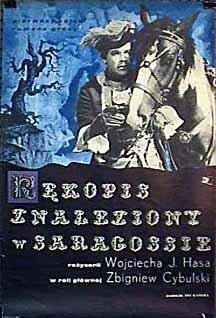
Structured as a series of stories discovered within a manuscript, The Saragossa Manuscript is based on the early 19th-century novel by Jan Potocki. The film opens during the Napoleonic Wars, when two opposing officers find a mysterious book in an abandoned inn and begin reading it together. It recounts the adventures of an earlier soldier, Alfonso van Worden, whose journey through Spain becomes increasingly entangled with strange encounters—princesses, mystics, bandits, and spirits—each unfolding into further stories.
I first came across it at the Harold Washington Library in Chicago, where you could check out seven DVDs at a time—an incredible resource. I was intrigued by the title, and even more so when I learned that filmmakers like Martin Scorsese and Francis Ford Coppola played a key role in restoring and bringing the film back to wider audiences.
A Polish production from 1965, it remains a singular and deeply unusual film—one that rewards patience and curiosity, and is well worth seeking out.
Monty Python and the Holy Grail (1975)
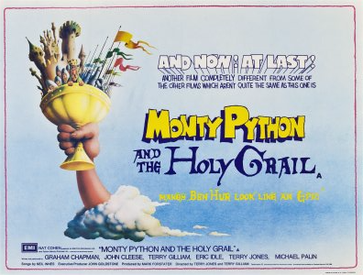
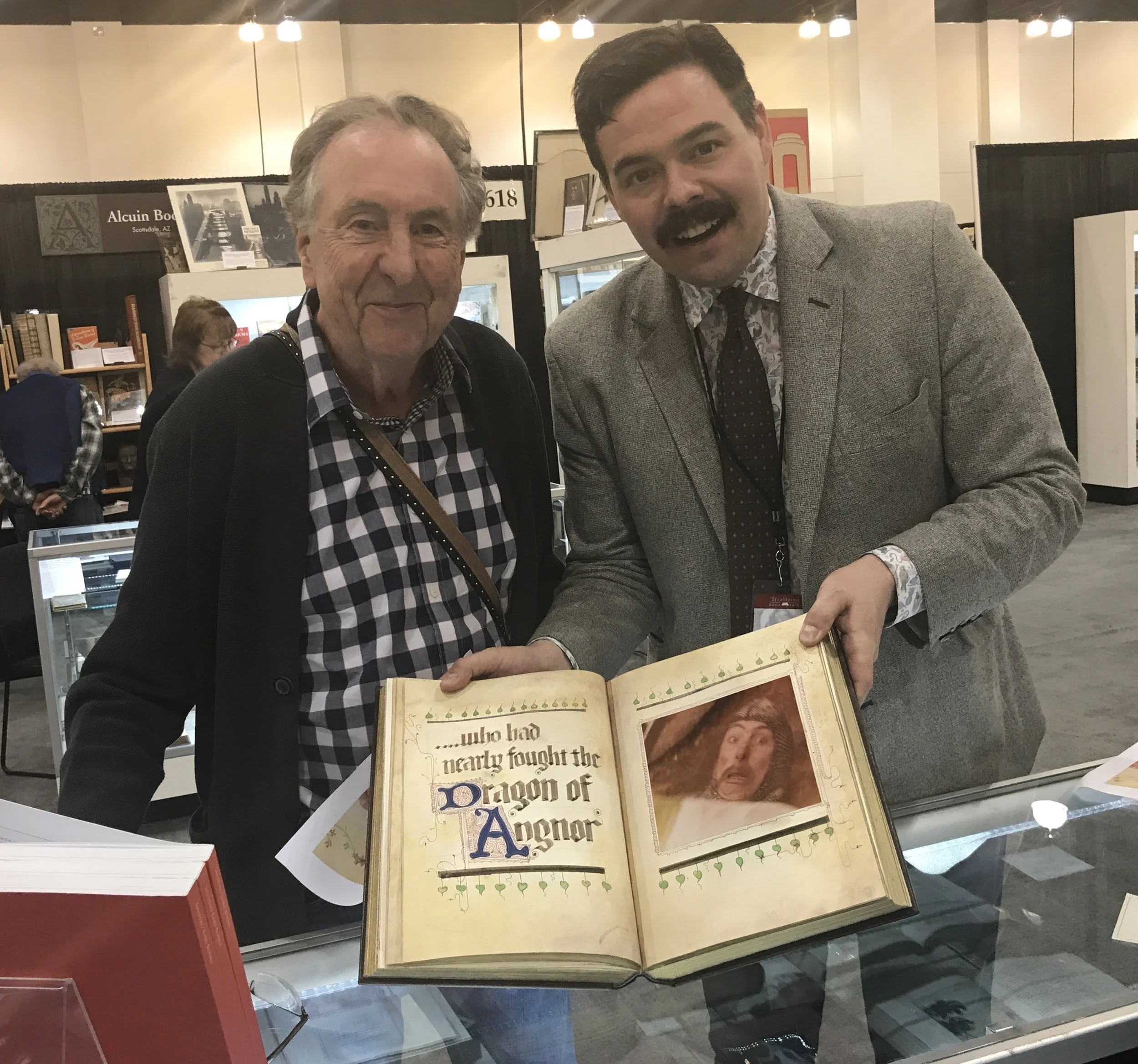
Though best known for its humor, Monty Python and the Holy Grail draws directly on the visual language of medieval manuscripts. Terry Gilliam’s animated sequences echo the forms of marginalia and illumination, reworking them into something playful and absurd. It is a rare example of manuscript imagery entering popular culture in a way that is both recognizable and influential. The story itself is even framed through a fabricated medieval manuscript—known as the Book of the Film—created as a prop and woven into the visual world of the movie.
I actually had the opportunity to handle the Book of the Film and show it to Eric Idle years ago at the California Book Fair (thanks again, Bernie). It was a real thrill, as the film has been one of my favorites since I was a teenager. I remember first watching Monty Python’s Flying Circus late at night on PBS in Wisconsin, wondering what this strange and hilarious show was. That early encounter stayed with me, and made the later experience of seeing the manuscript prop in person all the more meaningful.
Army of Darkness (1992)
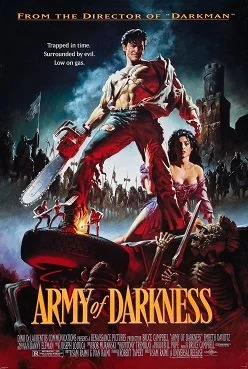
In Army of Darkness, the medieval book becomes something entirely different: an object of magic and danger. The so-called Necronomicon, with its animated pages and grotesque presence, exaggerates the idea of the manuscript as a powerful and unpredictable force. While far removed from historical reality, it reflects a persistent association between old books and hidden knowledge.
A true cult classic, and one I might never have discovered had my wife—then my girlfriend—not brought it over one night. Bruce Campbell is something of a legend, and the film fully embraces its campy tone. It’s a blend of humor and action set in a loosely imagined medieval world, built around the familiar tension of good versus evil—and a thoroughly unlikely hero. It does not disappoint, especially the unforgettable scenes with the Necronomicon.
FIN
These films, in very different ways, remind us that manuscripts are not only historical objects, but enduring symbols—of knowledge, belief, and imagination. I would encourage you to seek out one you may not know—whether to rent, buy, or perhaps even catch at a local cinema. You never know what you might discover. Enjoy.
The manuscripts that inspired many of these cinematic portrayals remain tangible survivals of the Middle Ages. Explore our current inventory of medieval and Renaissance illuminated manuscripts.