A richly illuminated Bruges Book of Hours for the English market, with five miniatures by the Masters of the Gold Scrolls and a remarkable later French addition associated with Antoine de Lonhy, preserving extensive evidence of its continued devotional use and an apparent long-standing association with the Damas family in France.
Book of Hours (Use of Sarum)
In Latin and French, illuminated manuscript on parchment
Bruges, Flanders c. 1450; with substantial additions in France, late fifteenth and early sixteenth century
Five miniatures by the Masters of the Gold Scrolls, (sub-group, the Master of Berlin, Kunstbibliothek, Ms. Grisebach 4) and one miniature in the style of Antoine de Lonhy (fl. circa 1446–1490)
PRICE: $58,000
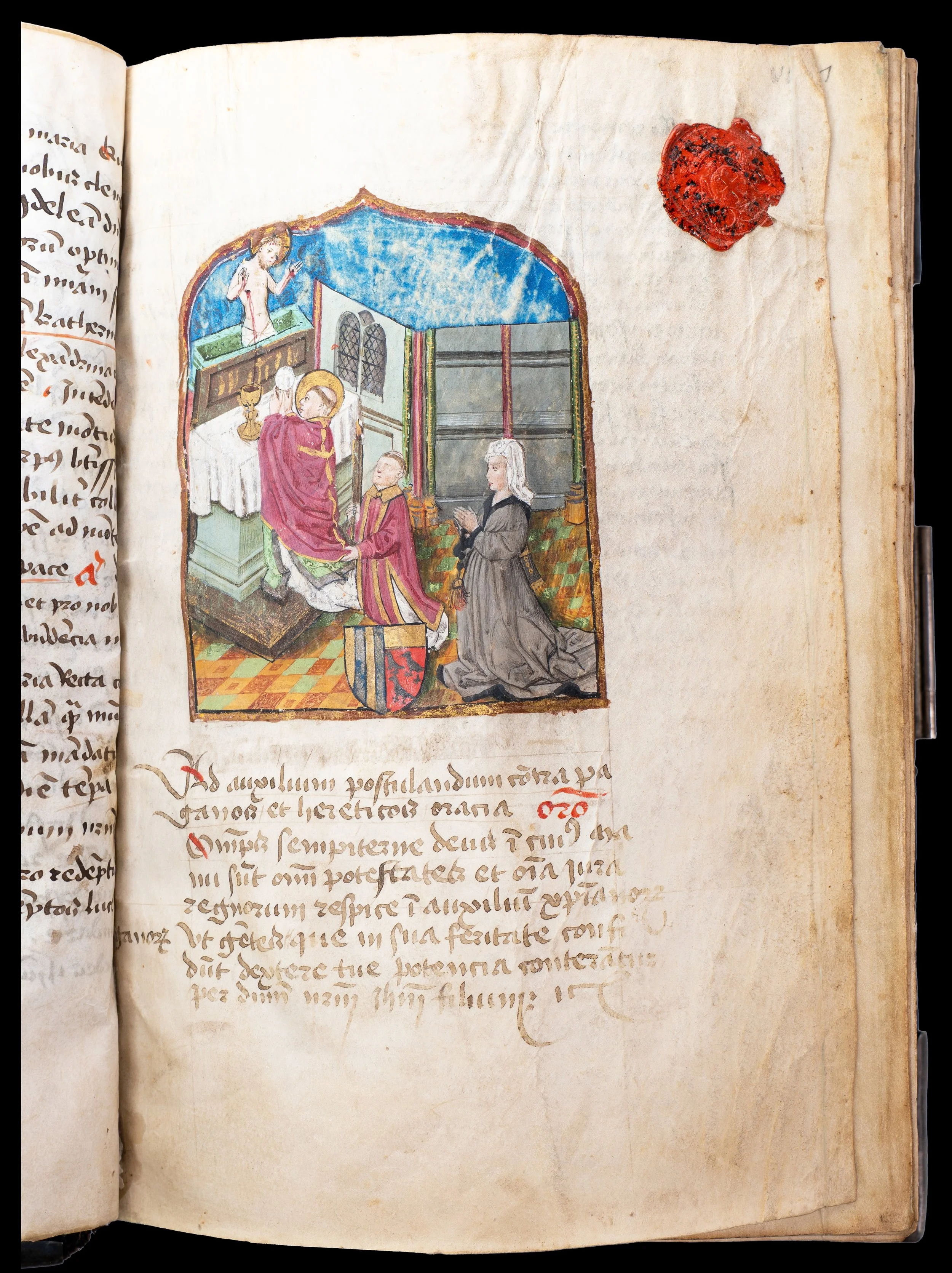
The manuscript preserves unusually vivid evidence of its production, circulation, and continued use over several centuries. Made in Bruges around 1450 for the English market, it was richly illuminated with a cycle of miniatures by the Masters of the Gold Scrolls, of which five survive. After passing to France, the manuscript was extensively personalized with new texts, prayers, and illumination, including a miniature of the Mass of Saint Gregory depicting a kneeling female patron, belonging to the immediate artistic milieu of Antoine de Lonhy, and possibly to the artist himself. The painted arms beside the patron remain unidentified; a previous tentative reading has associated one half of the impaled shield with the arms of the Guinot family of Saint-Grégoire, near Rennes in Brittany, although the identity of the patron awaits further heraldic study.
These additions reflect the changing devotional needs of the manuscript’s owners. Particularly revealing are two versions of the Obsecro te, one formulated for a female supplicant and another for a male, showing that the book was adapted for different users during its early French history. An early ownership inscription on a former flyleaf appears most likely to read “I. Damas,” perhaps I(ehan) (Jehan/Jean) Damas, although the reading of the initial remains uncertain.
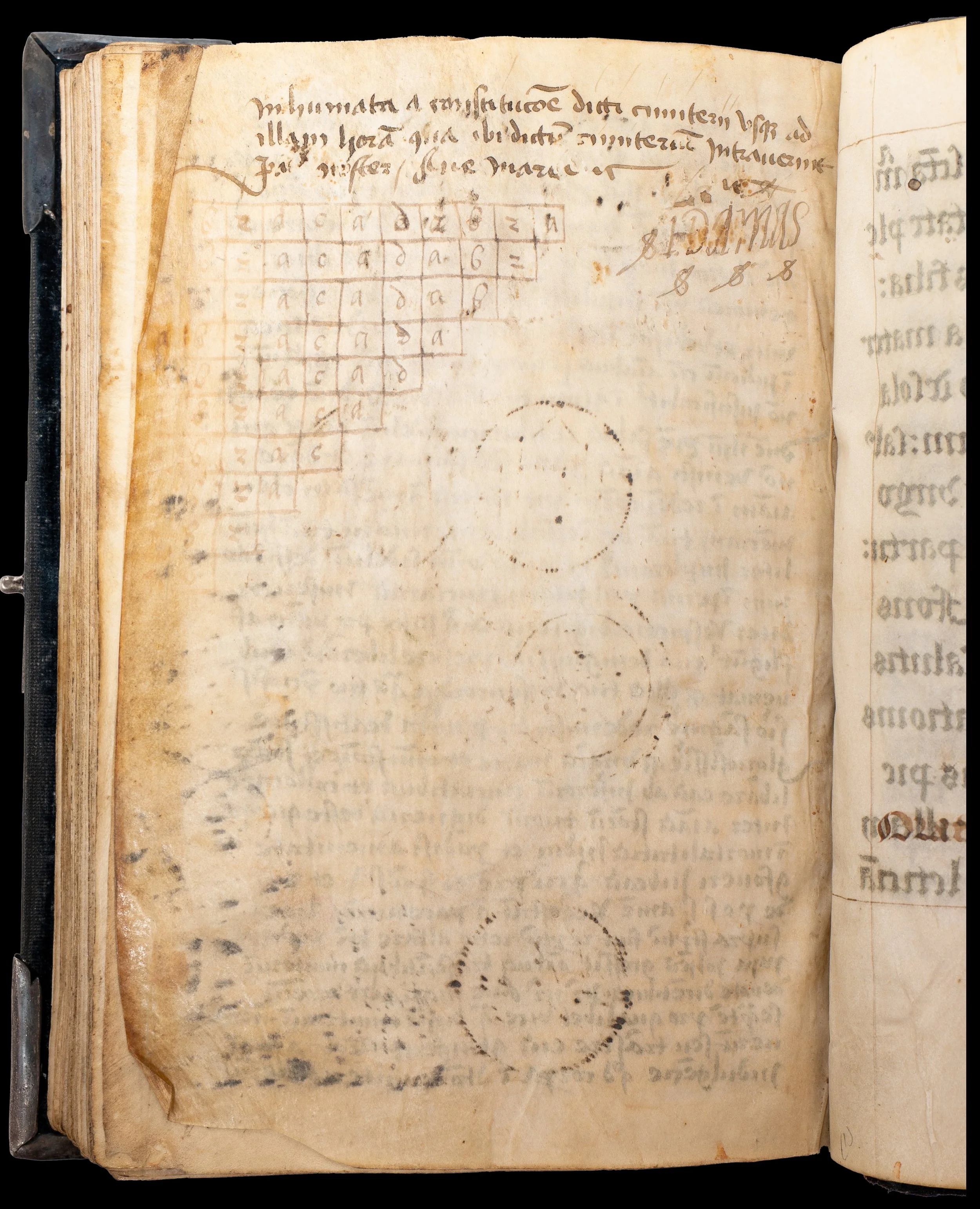
Other traces bring these early owners still closer. French devotional and protective prayers were added, calculations entered into the book, and offsets from former pilgrimage badges show that devotional objects were once kept between its pages, perhaps carried back from visits to shrines. A much later, probably eighteenth-century red-wax armorial seal appears to bear the heraldry of the Damas family and, together with the earlier inscription, raises the intriguing possibility of a long or recurring association with the family, although continuous Damas ownership cannot yet be demonstrated. Together, these traces evoke a literate and deeply devotional milieu in which the manuscript continued to be read, written in, carried, and adapted over generations.
The Masters of the Gold Scrolls: The Grisebach Subgroup
The five surviving miniatures from the original campaign of illumination belong to the Masters of the Gold Scrolls (Maîtres aux Rinceaux d’or), the name given to a large and stylistically varied group of illuminators active principally in Bruges during the first half of the fifteenth century, c. 1415–1455. The group takes its name from one of its most characteristic features: backgrounds enlivened with delicate scrolling designs in liquid gold, often set against saturated fields of red, blue, or violet. Strongly outlined figures, compact compositions, patterned interiors, brilliant color, and the adaptation of established pictorial models are likewise characteristic of the style.
Within this broad tradition, Gregory T. Clark attributes the present manuscript to a particularly refined subgroup centered around a Book of Hours now in Berlin (Kunstbibliothek, MS Grisebach 4). The same workshop was responsible for a Middle Dutch Book of Hours in Munich (Bayerische Staatsbibliothek, Cod. germ. 83), as well as manuscripts and dispersed leaves including Besançon, Bibliothèque municipale, MS 50; the Book of Hours formerly offered by Les Enluminures (BOH 171); a Book of Hours sold at Christie’s in 2018 (lot 48); and two leaves now at McGill University Library (MS 189). Particularly close to the present manuscript, and possibly illuminated by the same hand, is a Book of Hours in the University of Chicago Library (MS 344).
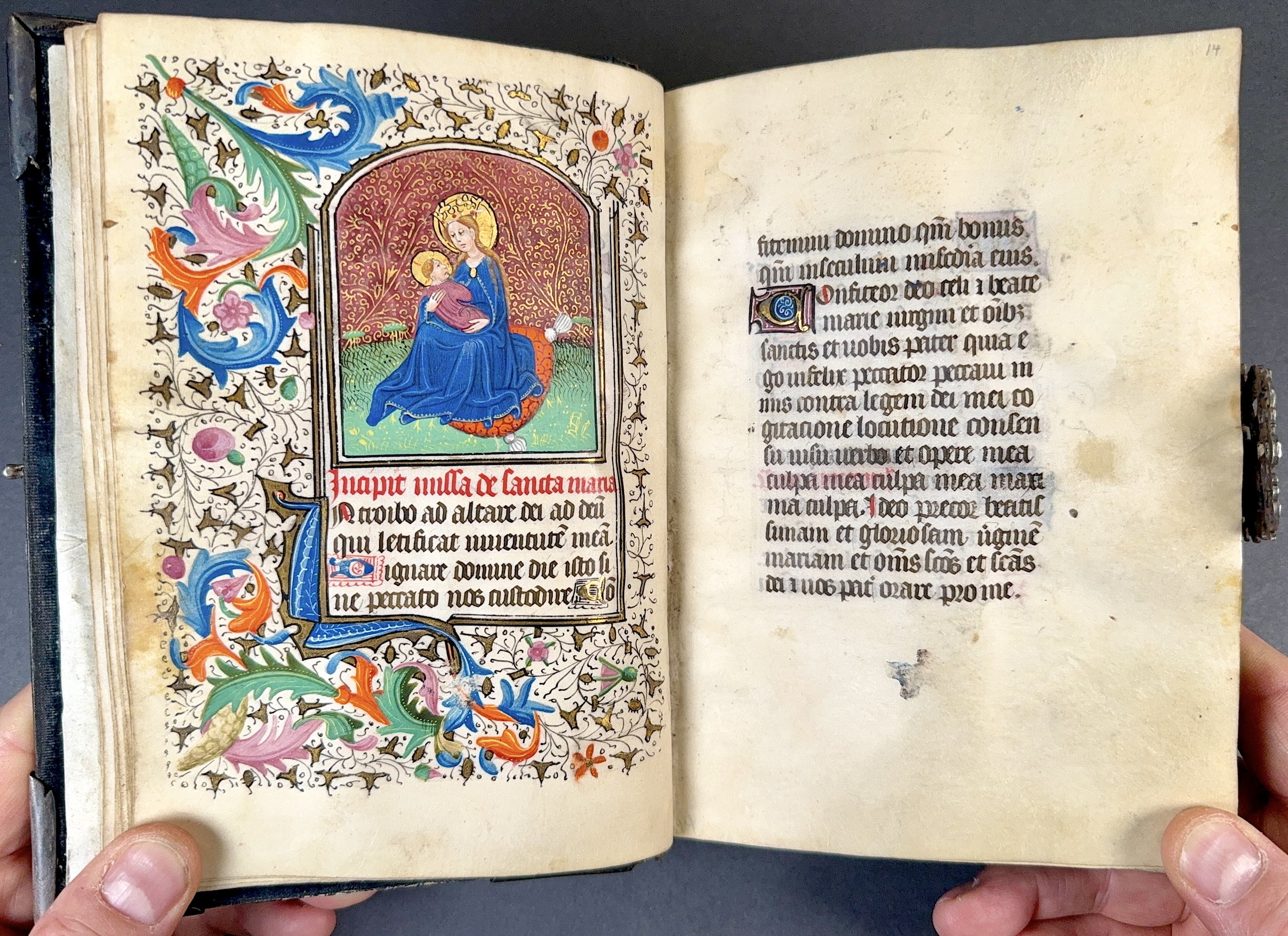
These comparisons place the original production of the manuscript in Bruges around 1450. Its calendar follows the Use of Sarum, indicating that it was produced for the English market. Five miniatures from this original decorative cycle survive:
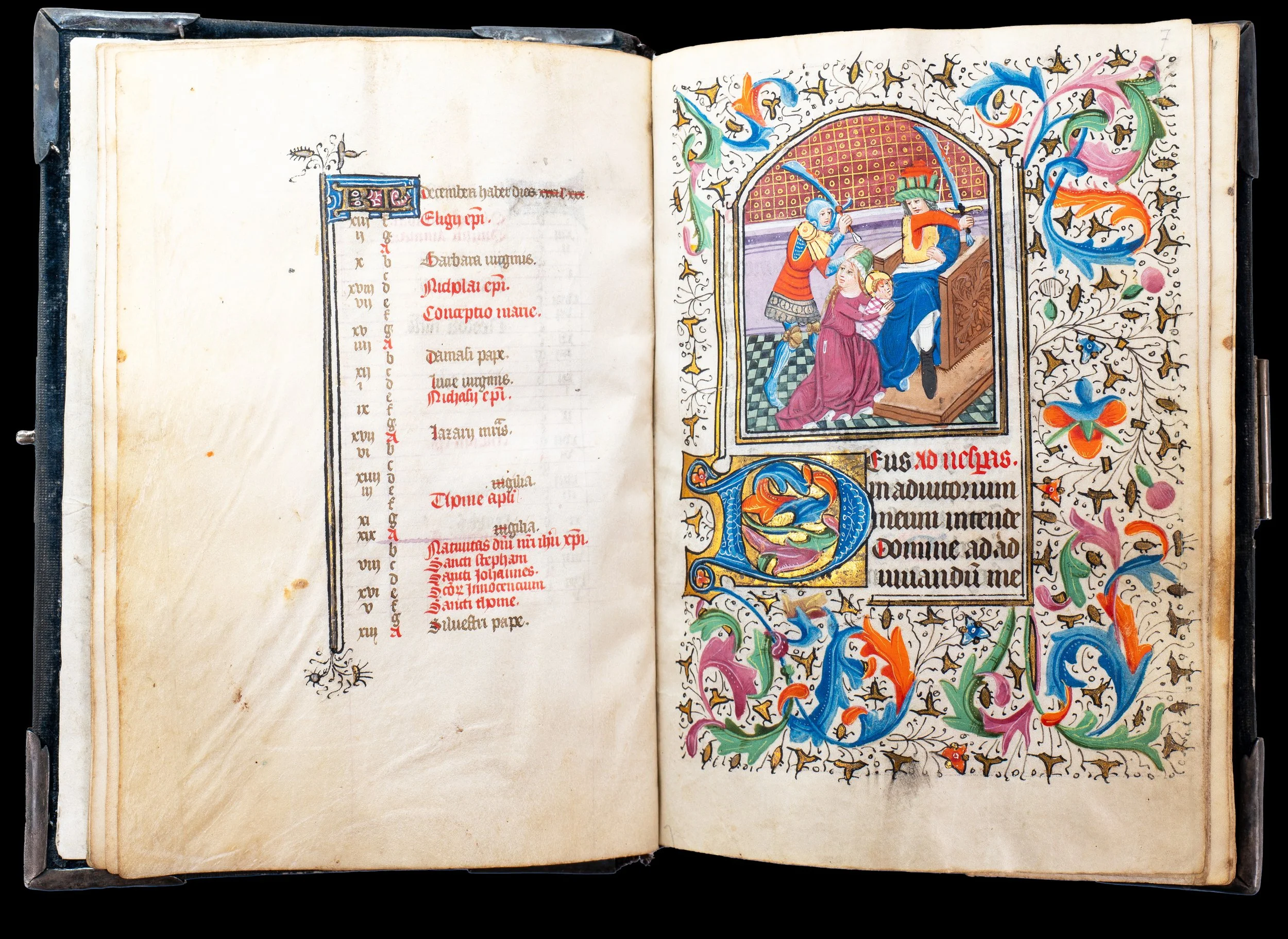
f. 7, Massacre of the Innocents, for Vespers
f. 13v, Virgin and Child, for the Mass of the Virgin
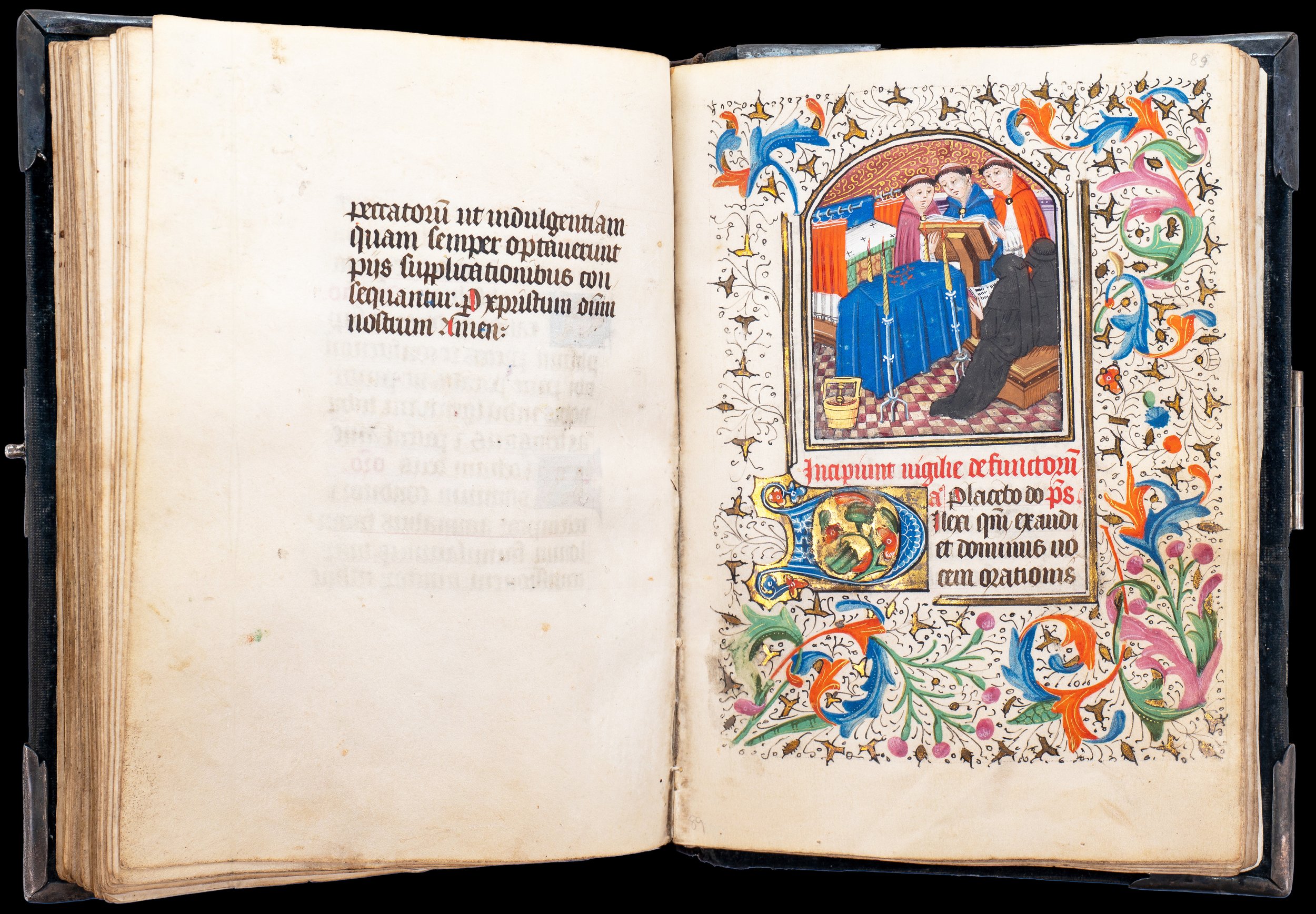
f. 38v, Funeral Mass, for the Office of the Dead
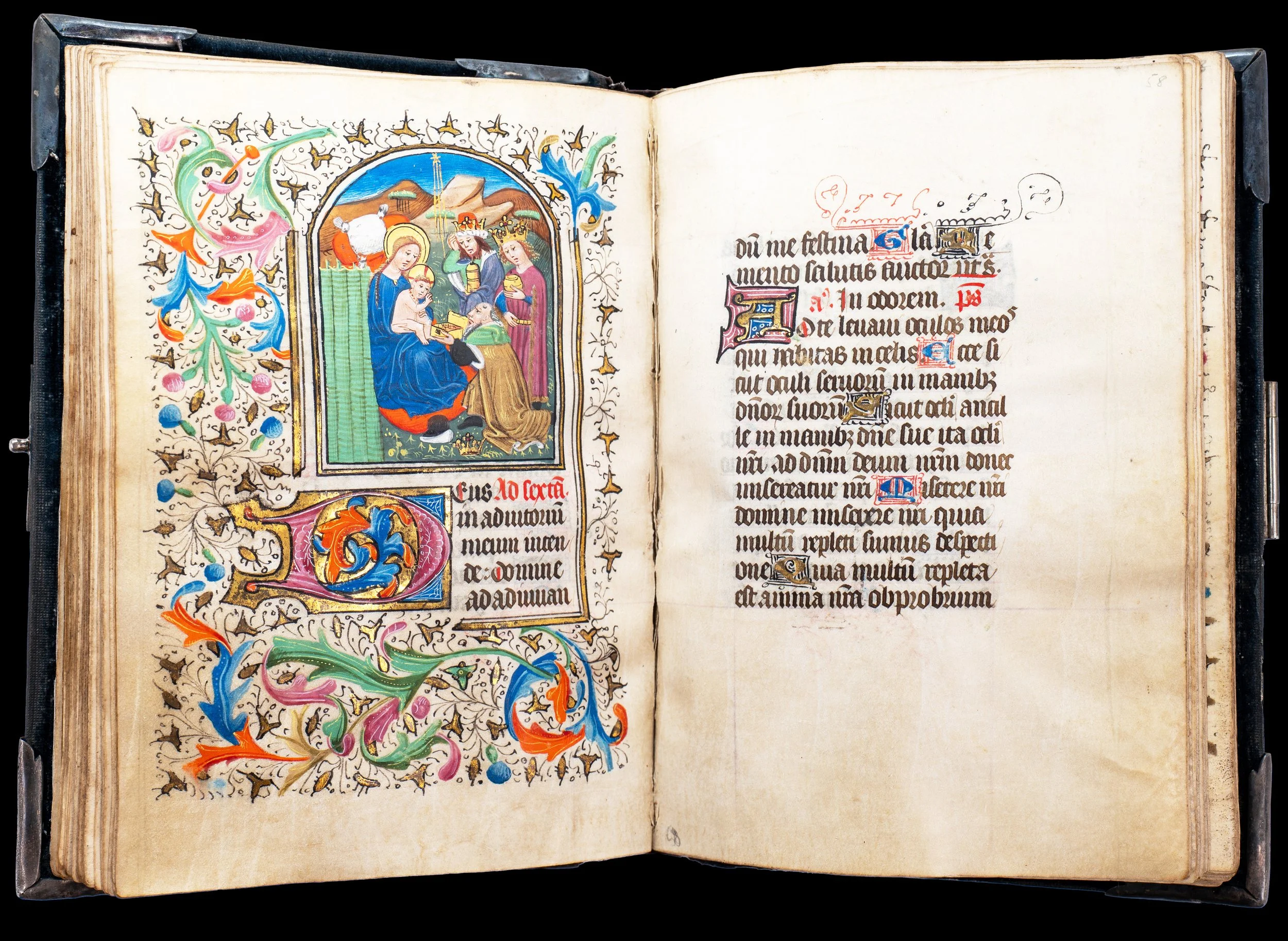
f. 57v, Adoration of the Magi, for Sext
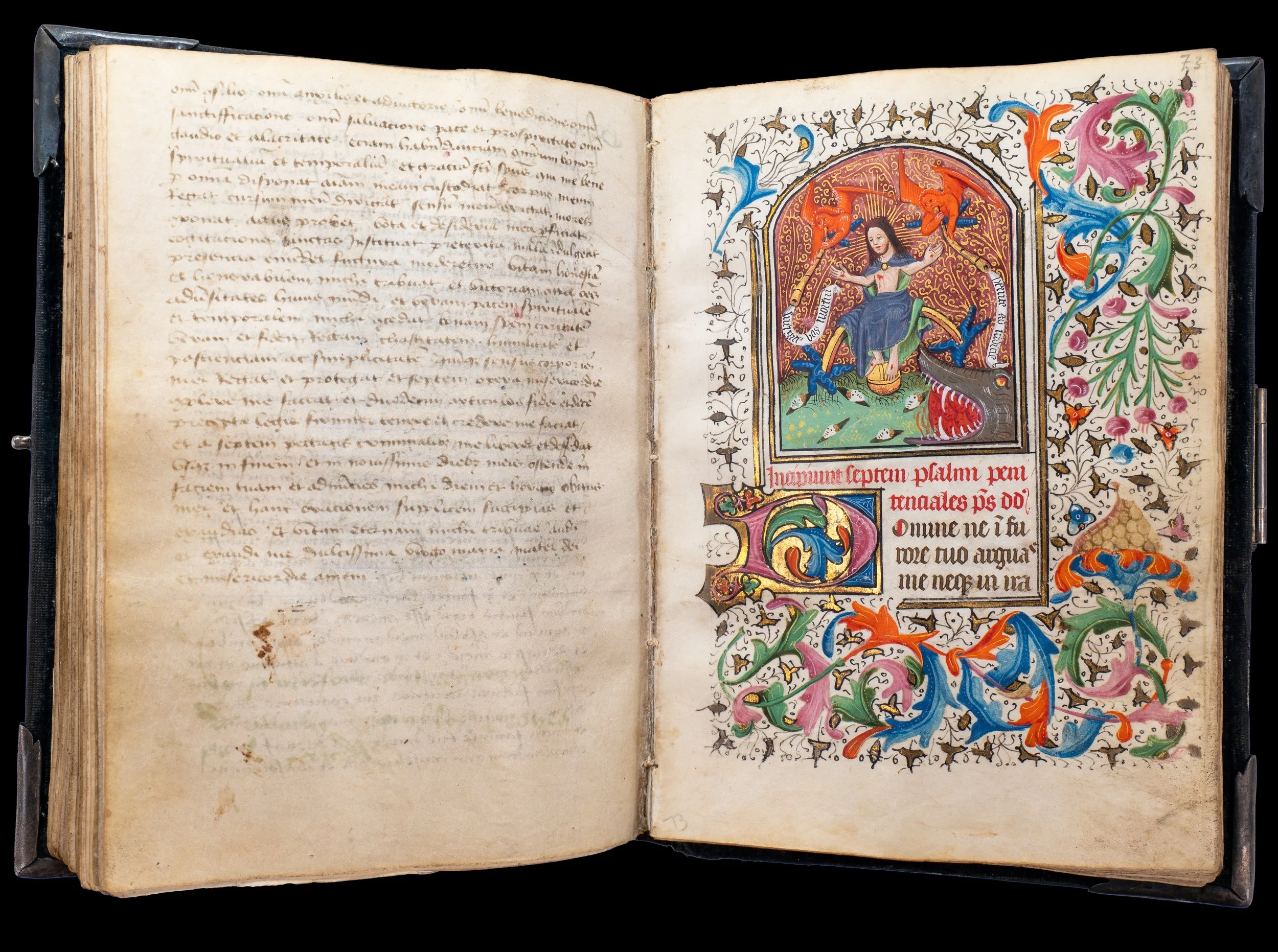
f. 73, The Resurrection, for the Seven Penitential Psalms
The original decorative programme was considerably more extensive. The manuscript has suffered losses, particularly within the Hours of the Virgin: Prime and Compline are entirely lacking, while most of the remaining Hours are imperfect. At least six miniatures belonging to the original Hours of the Virgin can therefore be inferred to be missing, together with a miniature that presumably introduced the Hours of the Cross. The five surviving miniatures nevertheless preserve a substantial and remarkably fresh group of illuminations from this refined Bruges workshop.
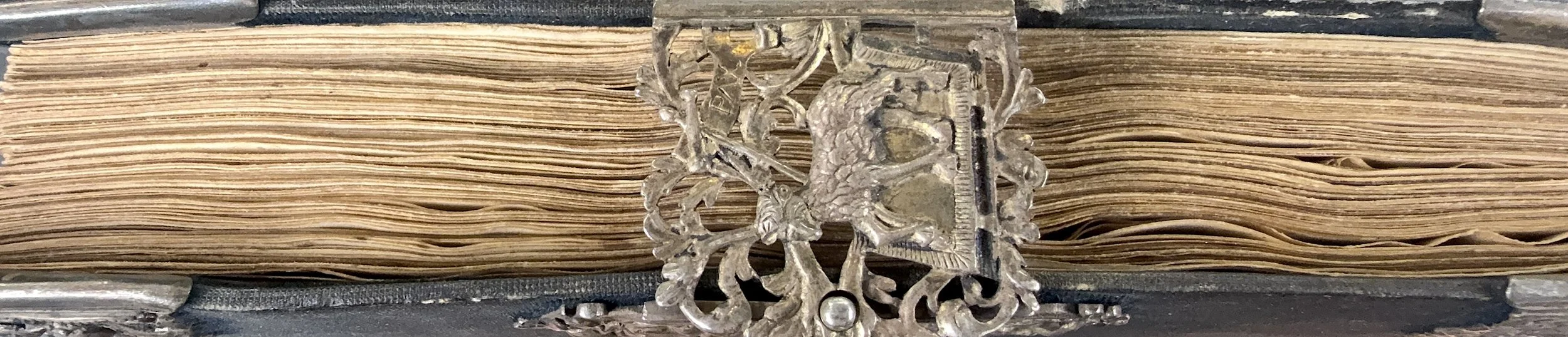
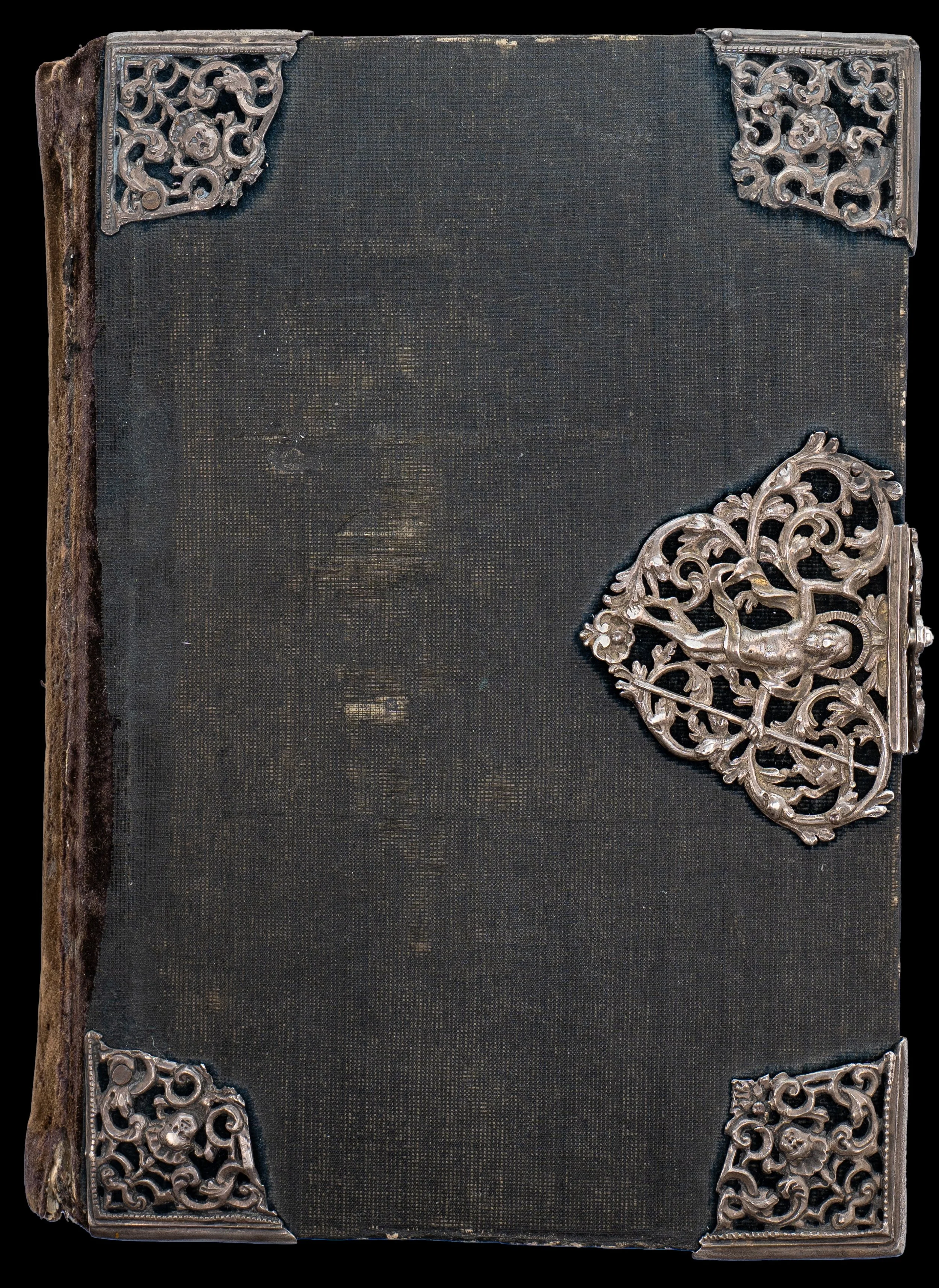
193 × 134 mm, [vi] + 124 leaves, on parchment, foliated i–vi and 1–124 in modern pencil in both the upper right and lower left margins, lacking an unknown quantity of leaves and miniatures, collation: impracticable owing to numerous lacunae indicating the loss of leaves, bifolia, and probably entire gatherings, written in textualis formata in brown ink, with supplementary texts added in several contemporary late-Gothic bâtarde, cursiva, and semitextualis hands (ff. iv–v, f. vi, f. 72, f. 117v, f. 118, ff. 119v–123v, and f. 124), justification: 90 × 65 mm, capitals stroked in red, rubrics in red, one-line initials alternating in burnished gold on blue penwork grounds and in blue on red penwork grounds, occasionally elevated by flourishes extending into the margins, calendar initials in burnished gold on blue and rose grounds, with descending gold baguettes issuing burnished gold ivy-leaf sprays, two-line initials in burnished gold on alternating rose and blue grounds with white filigree infill, occasionally accompanied by descending gold baguettes terminating in ivy-leaf sprays, four large initials of four and five lines high, in rose and blue with white tracery on burnished gold grounds, with infill of colored scrolling acanthus, marking the principal textual divisions, these accompanied by FIVE HALF-PAGE MINIATURES set within burnished gold cusped arches and accompanied by full borders of densely scrolling black penwork vines bearing sprays of blue, green, pink, and orange acanthus leaves and stylized flowers, interspersed with burnished gold ivy leaves and bezants, ONE THREE-QUARTER PAGE MINIATURE, of slightly later date, bearing heraldic device and framed within a burnished gold ogee-cusped arch outlined in red and black. Nineteenth-century binding over pasteboards covered in black silk velvet, now extensively worn except on the spine and beneath metalwork, covers fitted with four pierced silver corner pieces and an elaborate silver clasp depicting the Agnus Dei beneath the Banner of the Resurrection within scrolling foliate openwork, flat spine without raised bands. Housed in a twentieth-century red cloth clamshell box with the spine label, "HORAE / BRUGES / CIRCA 1440.” The parchment remains generally sound but is occasionally stiff with pronounced cockling in places, moderate soiling and staining to the leaves, with occasional rubbing to initials and marginal decoration, offsets from former pilgrimage badges visible on f. 118v, five painted miniatures remain in exceptionally fresh condition, retaining brilliant color, crisp execution, and excellent preservation, additional miniature with significant rubbing and wear to the background, with minor modern interventions and restoration.
TEXT
The Hours of the Virgin are incomplete, with several losses readily identifiable from the surviving text. Vespers ends imperfectly at the Magnificat, while Matins and Lauds begin imperfectly within Psalms 94 and 92, respectively. A further lacuna between ff. 54v and 55 has resulted in the loss of Prime and the beginning of Terce, which resumes imperfectly in Psalm 119. Similarly, None begins imperfectly near the end of Psalm 128, indicating another loss following Sext. Compline is also lacking from the surviving cursus.
Much of the supplementary material is markedly apotropaic in character. An opening sequence, entered in an informal early sixteenth-century hand, invokes a range of protective agents, notably the Arma Christi and the Three Magi (Gaspar, Balthasar, and Melchior) whose names possessed well-established protective and quasi-talismanic associations in later medieval devotional culture. Similarly, the prayer for protection against pagans and heretics (“contra paganos et hereticos”) accompanying the image of the Mass of Saint Gregory likewise probably carried protective or talismanic efficacy.
The texts are arranged as follows:
ff. i–iii: Supplemental sixteenth-century apotropaic prayer in French for protection and a good death. It addresses the second death (la mor seconda) and invokes a host of protective agents including the Arma Christi (nails, lance, crown), the Passion, the Virgin, Saint John, the Magi (Gaspard, Baltazar, and Melchior), Saint Longinus, Saint Adrian, Saint Benedict, the Three Children in the Fiery Furnace, and Daniel.
ff. iv–v: Supplemental prayers and suffrages to the Virgin, the Apostles, and various saints, including Symphorianus, Anthony, Sebastian, Theobald, Dionysius, Eutropius, Ursinus, Mary Magdalene, and Catherine, together with prayers for protection and peace (Da pacem Domine), executed in a professional late fifteenth-century cursiva.
f. vi: (recto) Supplemental prayer for aid against pagans and heretics (rubric: Ad auxilium postulandum contra paganos et hereticos); (verso) the Passion according to Saint John (John 19:1ff.; incipit: In illo tempore. Apprehendit Pilatus Iesum et flagellavit…).
ff. 1–6v, Calendar (Use of Sarum), including characteristic Sarum feasts: Brigid of Kildare (1 February); George (23 April); Dunstan, Archbishop of Canterbury (19 May); Augustine of Canterbury (26 May); Samson of Dol (28 July); Oswald, King of Northumbria and Martyr (5 August); Remigius (1 October); Edmund, King and Martyr (20 November); and Thomas Becket, Archbishop of Canterbury (29 December).
ff. 7–10v, Vespers from the Hours of the Virgin, ending imperfectly at the Magnificat.
ff. 11–13, Short Hours of the Cross, beginning imperfectly.
ff. 13v–24v, Mass of the Virgin.
ff. 25–41v, Matins from the Hours of the Virgin, beginning imperfectly at Psalm 94, Venite exsultemus Domino, with variable psalmody according to the days of the week.
ff. 42–54v, Lauds from the Hours of the Virgin, beginning imperfectly in Psalm 92, Dominus regnavit.
ff. 55–57, Terce from the Hours of the Virgin, beginning imperfectly in Psalm 119, Ad Dominum cum tribularer.
ff. 57v–63v, Sext from the Hours of the Virgin.
ff. 64–71v, None from the Hours of the Virgin, beginning imperfectly near the end of Psalm 128, Saepe expugnaverunt me, with seasonal variants for Advent.
f. 72, Supplemental prayers in a late fifteenth-century bâtarde script, including Obsecro te, adapted for a female supplicant (famulae tuae).
ff. 73–84, Seven Penitential Psalms.
ff. 84v–88v, Litany and concluding prayers, including Saint Eligius (Éloi; Eligius of Noyon, c. 588–660), a saint of particular popularity in France and the Low Countries.
ff. 89–117, Office of the Dead.
f. 117v: Supplemental prayers in a late fifteenth-century bâtarde script: (1) a sequence of mortuary collects, beginning Deus, qui nos patrem, Quaesumus Domine, and Deus veniae largitor; (2) an intercessory devotion, beginning Pie et exaudibilis; and (3) a Passion meditation, beginning Domine denique.
f. 118: Supplemental prayers for the dead, beginning Salvete nos omnes animae fideles, quarum corpora hic et ubique requiescunt in pulvere, Christus qui vos redemit suo pretioso sanguine dignetur…, concluding on the verso alongside a table of dominical letters. (for similar prayer see: Innsbruck, Universitäts- und Landesbibliothek Tirol, Cod. 402, f. 278).
ff. 119–123: Supplemental prayer Obsecro te in a late fifteenth-century textualis formata for a male supplicant (famulo tuo).
f. 124: Supplemental remedies and healing charms in French for ailments of the eyes (“Pour le mal des yeux”) and sunstroke(?) (“le coup de soleil”).
A Later French Addition: The Artistic Milieu of Antoine de Lonhy
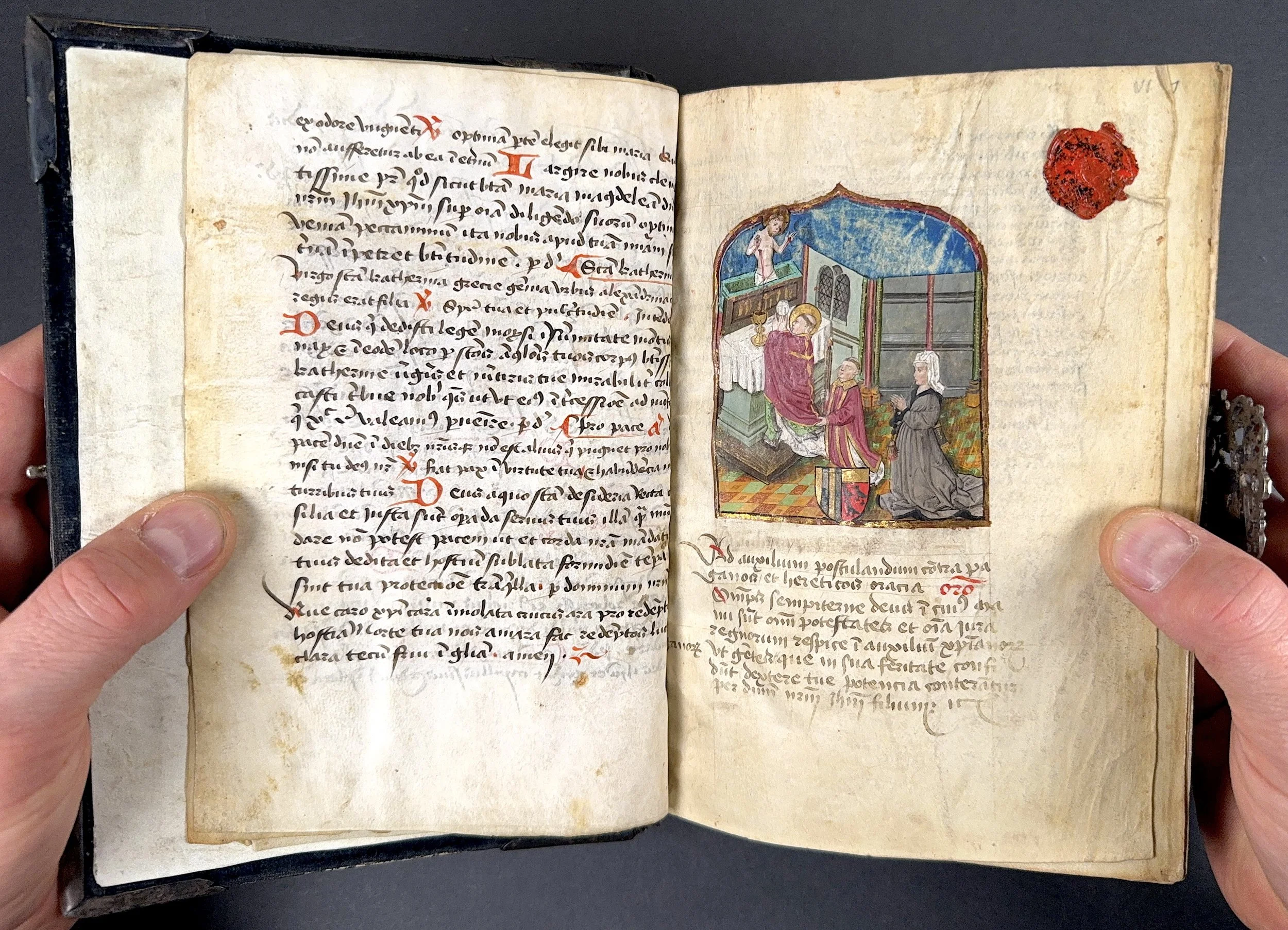
Of particular interest is the miniature of the Mass of Saint Gregory on f. vi, added to the front of the manuscript after its original production. It depicts a female donor kneeling in devotion beside an impaled coat of arms and therefore documents an early owner who deliberately personalized and augmented an already existing Book of Hours. The heraldry presumably records a marital alliance and may ultimately permit the identification of the woman, although her identity remains unresolved.
Stylistically, the miniature belongs to the artistic milieu of Antoine de Lonhy and may possibly be attributed to the artist himself, although subsequent overpainting, particularly to the faces, obscures some of the evidence necessary for a secure attribution. Lonhy was one of the most distinctive and itinerant artists of the mid-fifteenth century, documented in Burgundy from 1446 to 1454 before working in Toulouse and subsequently in Piedmont. His activity encompassed manuscript illumination, panel painting, stained glass, and designs for other media.
The present miniature finds close comparisons among works associated with Lonhy, including New York, Morgan Library & Museum, MS M.196; Turin, Museo Civico d’Arte Antica, inv. 399; and Paris, Bibliothèque nationale de France, NAL 3209. Particularly characteristic are the substantial, almost sculptural figures, emphatically articulated draperies, distinctive facial types, and densely constructed composition. These affinities place the miniature within Lonhy’s immediate artistic orbit and raise the possibility of his direct participation.
Its addition to a manuscript originally produced in Bruges for the English market marks an important second stage in the book’s history. Together with the French texts subsequently entered into the volume and the evidence for its changing male and female users, the miniature provides a valuable indication of the manuscript’s early circulation and continued personalization in France.
PROVENANCE
1. Produced in Bruges for the English market, c. 1450, with the calendar for the Use of Sarum.
2. Unidentified female French patron, later fifteenth century. Folio vi contains a Passion narrative from the Gospel of Saint John and a prayer for protection against pagans and heretics, accompanied by a miniature of the Mass of Saint Gregory depicting a female patron kneeling in devotion beside an impaled shield. As this frontispiece was added several decades after the production of the core manuscript, the woman depicted likely represents a subsequent owner or patron through whom the Book of Hours passed, rather than its original commissioner. The arms have previously been tentatively read as: dexter, Paly of six Or and Azure; sinister, Gules, three martlets Argent, a chief Or, the latter having been compared with the arms of the Guinot (or Guynot) family of Rennes and Saint-Grégoire. This identification remains tentative, and the patron is presently unidentified.
The miniature is found within a packet of apotropaic and devotional texts that appears to have been deliberately assembled and joined to the core manuscript. These include an early sixteenth-century prayer in French for protection and a good death, written in an informal hand (ff. i–iv), as well as an unusual series of suffrages to saints including Symphorianus (Autun), Ursinus (Bourges), and Eutropius (Saintes), executed in a professional late fifteenth-century cursiva.
3. Damas family (?), late fifteenth or early sixteenth century. An early ownership inscription on a former flyleaf appears most likely to read “I. Damas,” perhaps I(ehan) (Jehan/Jean) Damas. Abrasion around the initial, however, leaves open the possibility of an H–J ligature, and the individual represented by the inscription has not yet been identified. The inscription nevertheless provides evidence for an early association of the manuscript with the Damas family, potentially contemporary with some of the French additions described here.
4. Female owner or user, late fifteenth century. An Obsecro te added on f. 72 is specifically adapted for a female supplicant (famulae tuae) and written in a late fifteenth-century bâtarde script, apparently contemporary with, and perhaps by the same hand as, the Passion narrative from the Gospel of Saint John added to the verso of f. vi.
5. Male owner or user, late fifteenth century. A second Obsecro te, added on ff. 119–123, is adapted for a male supplicant (famulo tuo) and written in a late fifteenth-century textualis formata. The different scripts and gendered forms of these two prayers provide compelling evidence that the manuscript was personalized for both female and male users during its early French history. Either may belong to the period of early Damas ownership recorded by the inscription, although their precise relationship remains uncertain.
6. Further evidence of early use. Calculations entered into the manuscript and offsets left by former pilgrimage badges provide additional evidence of its active use. The latter show that devotional objects were once preserved between its leaves, while the annotations and additions testify to a manuscript that continued to be read, written in, carried, and adapted by its owners.
7. Damas family (?), later ownership. A considerably later circular seal in red wax, somewhat abraded and chipped, is applied to the outer margin of the folio bearing the Mass of Saint Gregory miniature. The surviving impression comprises a central cross accompanied by two lions and surmounted by a crown and appears to correspond with the heraldic tradition of the Damas family. Its relationship to the much earlier I. Damas inscription remains uncertain, but the presence of two apparently Damas-related marks separated considerably in date raises the possibility of a long or recurring association of the manuscript with the family, although continuous ownership cannot presently be demonstrated,
8.Private Collection, Switzerland
LITERATURE
Unpublished. For related literature see:
Avril, François. “Le maître des Heures de Saluces: Antoine de Lonhy.” Revue de l’Art 85 (1989): 9–34.
Bousmanne, Bernard, and Thierry Delcourt, eds. Miniatures flamandes, 1404–1482, Brussels and Paris, 2011, esp. 140–42.
Cardon, Bert. “Gold Scrolls Group.” In The Dictionary of Art, vol. 20, 681–82. London/New York: Grove, 1996.
Cardon, Bert, Robrecht Lievens, and Maurits Smeyers. “Typologische Taferelen uit het Leven van Jezus: A Manuscript from the Gold Scrolls Group (Bruges, ca. 1440) in the Pierpont Morgan Library, MS Morgan 649: An Edition of the Text, a Reproduction of the Manuscript and a Study of the Miniatures.” Corpus of Illuminated Manuscripts, vol. 1, 119–204, Leuven: Peeters, 1985.
Castaño, Mireia. “Un somptueux missel toulousain enluminé par Antoine de Lonhy.” In Peindre à Toulouse aux XVe et XVIe siècles, ed. Frédéric Elsig, 71–81, 228–229. Cinisello Balsamo: Silvana Editoriale, 2020.
Castelnuovo, Guido. “Antoine de Lonhy e il principato di Savoia nel Quattrocento. Uno sguardo d’insieme (ca. 1420–ca. 1490).” In Il Rinascimento europeo di Antoine de Lonhy, ed. Simone Baiocco and Vittorio Natale, 66–79. Genoa: SAGEP, 2021.
Chancel, Béatrice de. “Le maître des Heures de Saluces: Antoine de Lonhy.” Bulletin Monumental 149, no. 4 (1991): 436–438.
Dogaer, Georges. Flemish Miniature Painting in the 15th and 16th Centuries. Amsterdam: B. M. Israël, 1987, esp. pp. 27–31.
Farquhar, James Douglas. “Manuscript Production and Evidence for Localizing and Dating Fifteenth-Century Books of Hours: Walters MS 239.” Journal of the Walters Art Gallery 45 (1987): 44–88.
Finke, Ulrich, ed. Katalog der mittelalterlichen Handschriften und Einzelblätter in der Kunstbibliothek, Berlin, 1967.
Gifford, Melanie. “Pattern and Style in a Flemish Book of Hours: Walters MS 239.” Journal of the Walters Art Gallery 45 (1987): 89–102.
Lorentz, Philippe. “Une commande du chancelier Nicolas Rolin au peintre Antoine de Lonhy (1446): la vitrerie du château d’Authumes.” Bulletin de la Société de l’Histoire de l’Art français (1994): 9–13.
Orr, Michael T. “The Hours of Elizabeth the Queen: Evidence for Collaboration between English Illuminators and an Artist from the Gold Scrolls Group.” In Flanders in a European Perspective: Manuscript Illumination around 1400 in Flanders and Abroad, ed. Maurits Smeyers and Bert Cardon, 619–33. Leuven: Peeters, 1995.
Romano, Giovanni. “Sur Antoine de Lonhy en Piémont.” Revue de l’Art 85 (1989): 35–44.
Romano, Giovanni. “Antoine de Lonhy, ‘a tempo’.” In Il Rinascimento europeo di Antoine de Lonhy, ed. Simone Baiocco and Vittorio Natale, 18–29. Genoa: SAGEP, 2021.
Smeyers, Maurits. “Pre-Eyckian Manuscripts: Mass Production and Workshop Practices I.” In Le dessin sous-jacent dans la peinture, ed. Roger van Schoute and Hélène Verougstraete-Marcq, 59–74. Colloque IX, Document de travail 27. Louvain-la-Neuve: Université Catholique de Louvain, 1991.
Smeyers, Maurits. Flemish Miniatures from the 8th to the mid-16th Century: The Medieval World in Parchment. Louvain, 1999.
Van Bergen, Saskia. “The Production of Flemish Books of Hours for the English Market.” In Manuscripts in Transition: Recycling Manuscripts, Texts, and Images, ed. Brigitte Dekeyzer and Jan van der Stock, 271–84. Leuven: Peeters, 2005.
Winkler, Friedrich. Die flämische Buchmalerei des XV. und XVI. Jahrhunderts. Leipzig: E. A. Seemann, 1925, esp. pp. 25–27.
We thank Gregory T. Clark and Peter Bovenmyer for consulting on this entry.