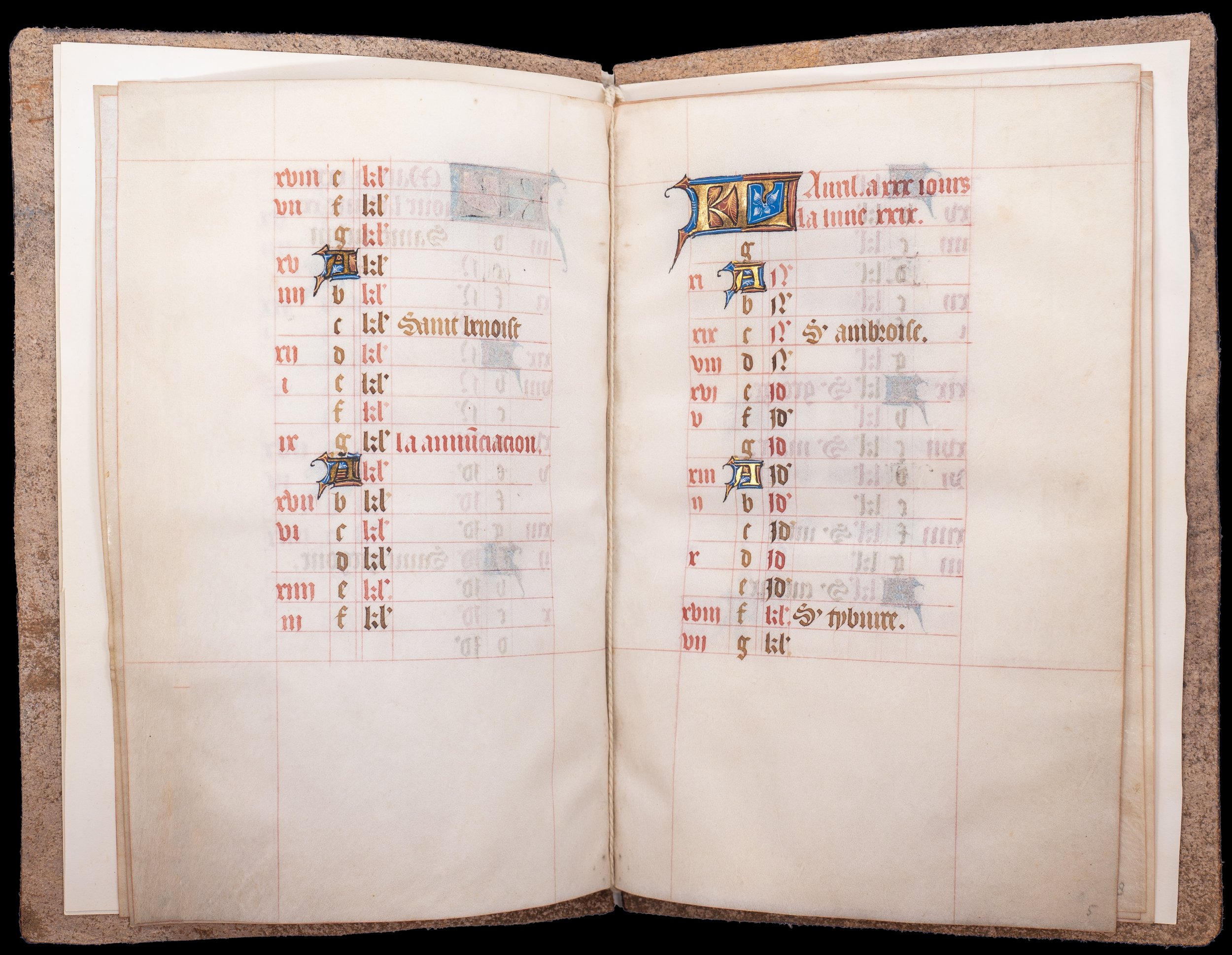
Calendar from a Book of Hours (Use of Bourges?)
In French, illuminated manuscript on parchment
France, perhaps Bourges or Orléans, c. 1440–1470
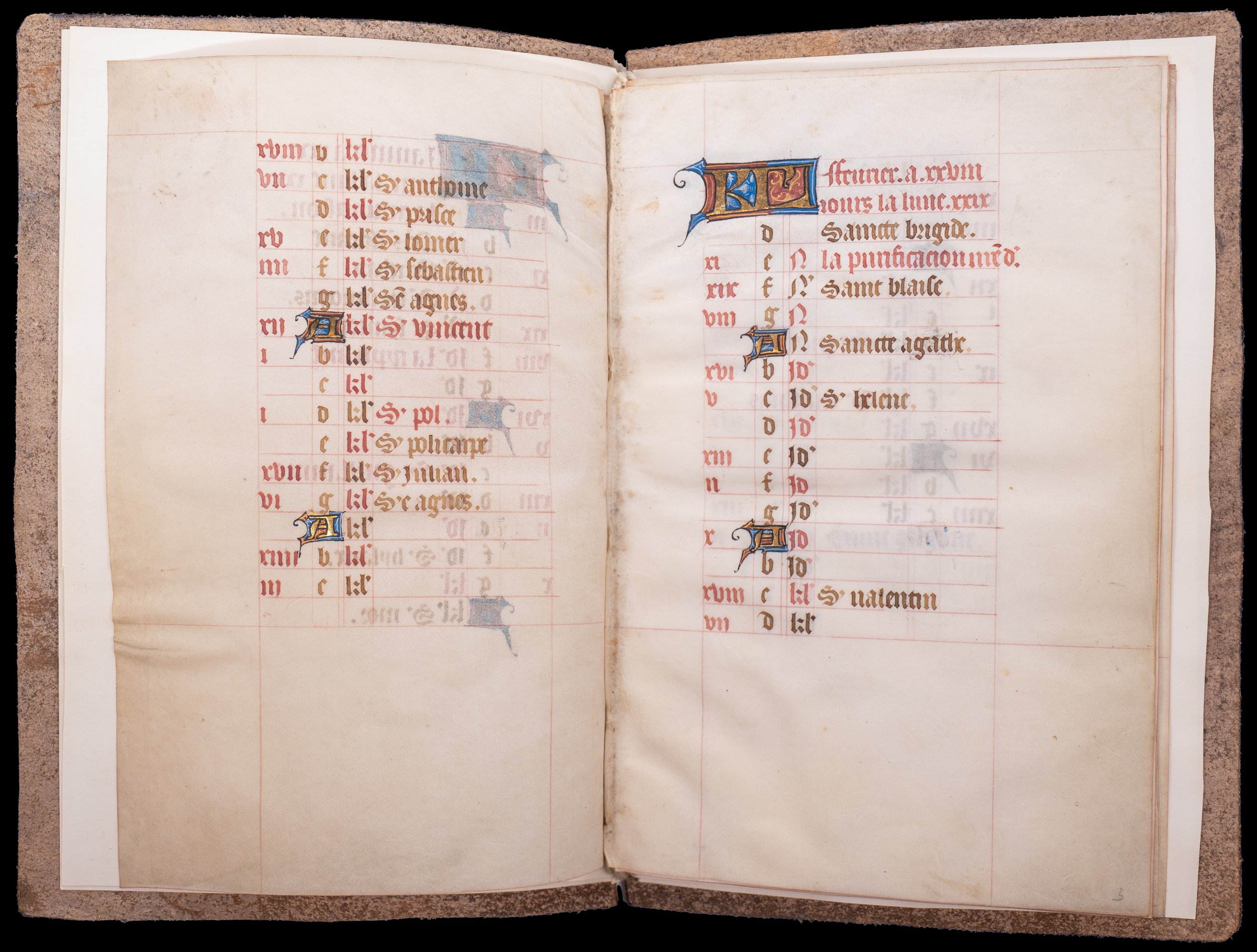
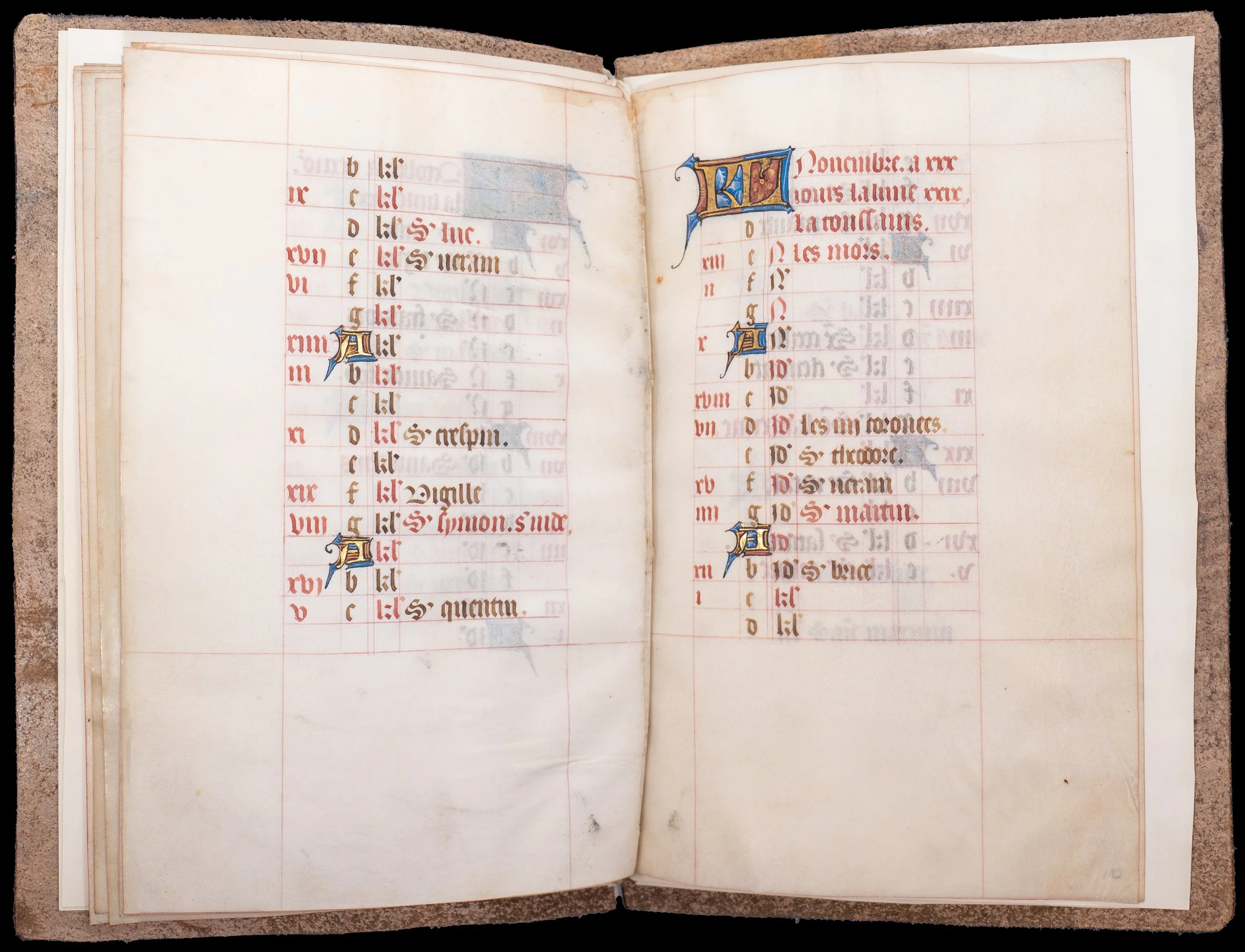
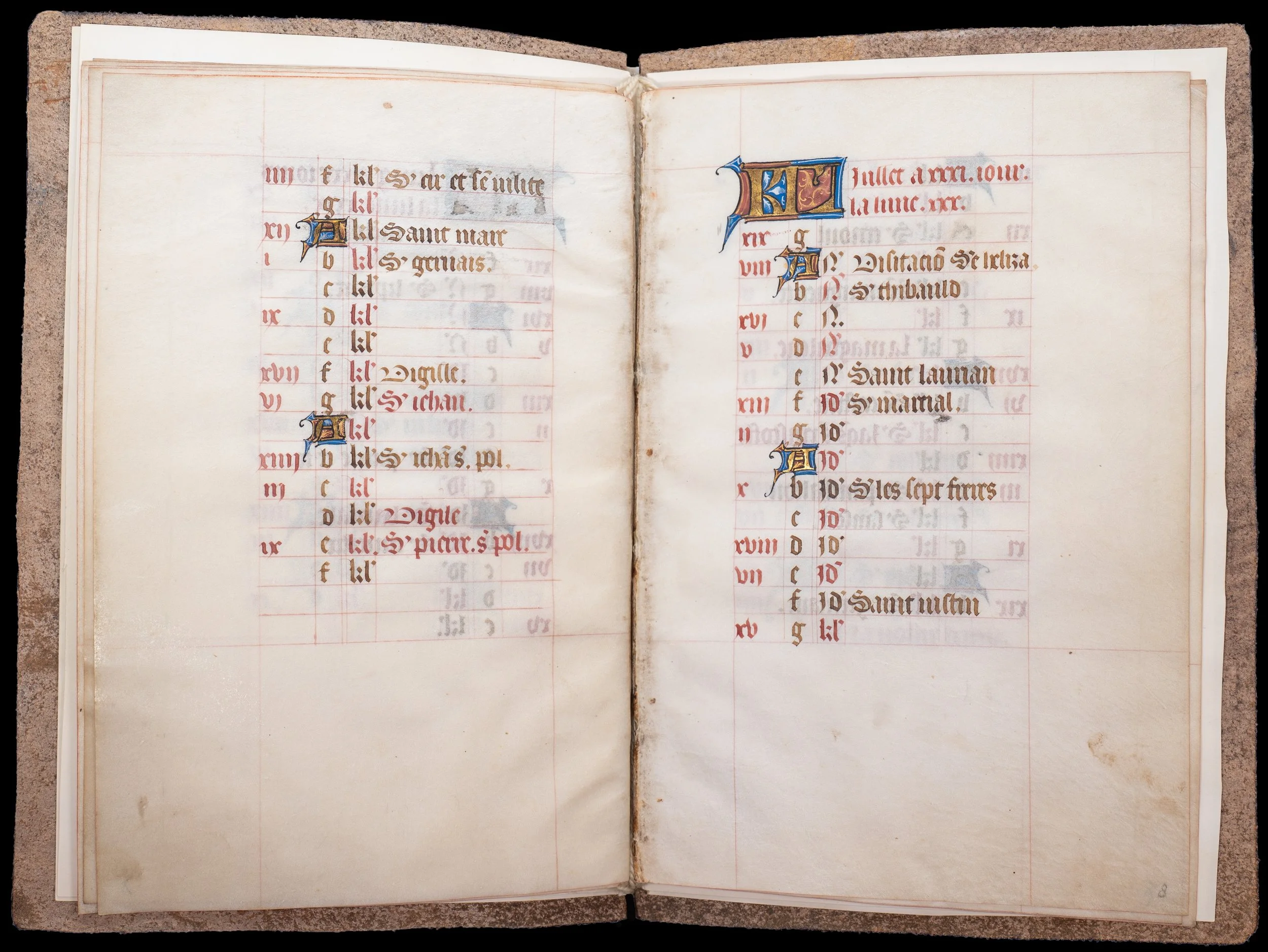
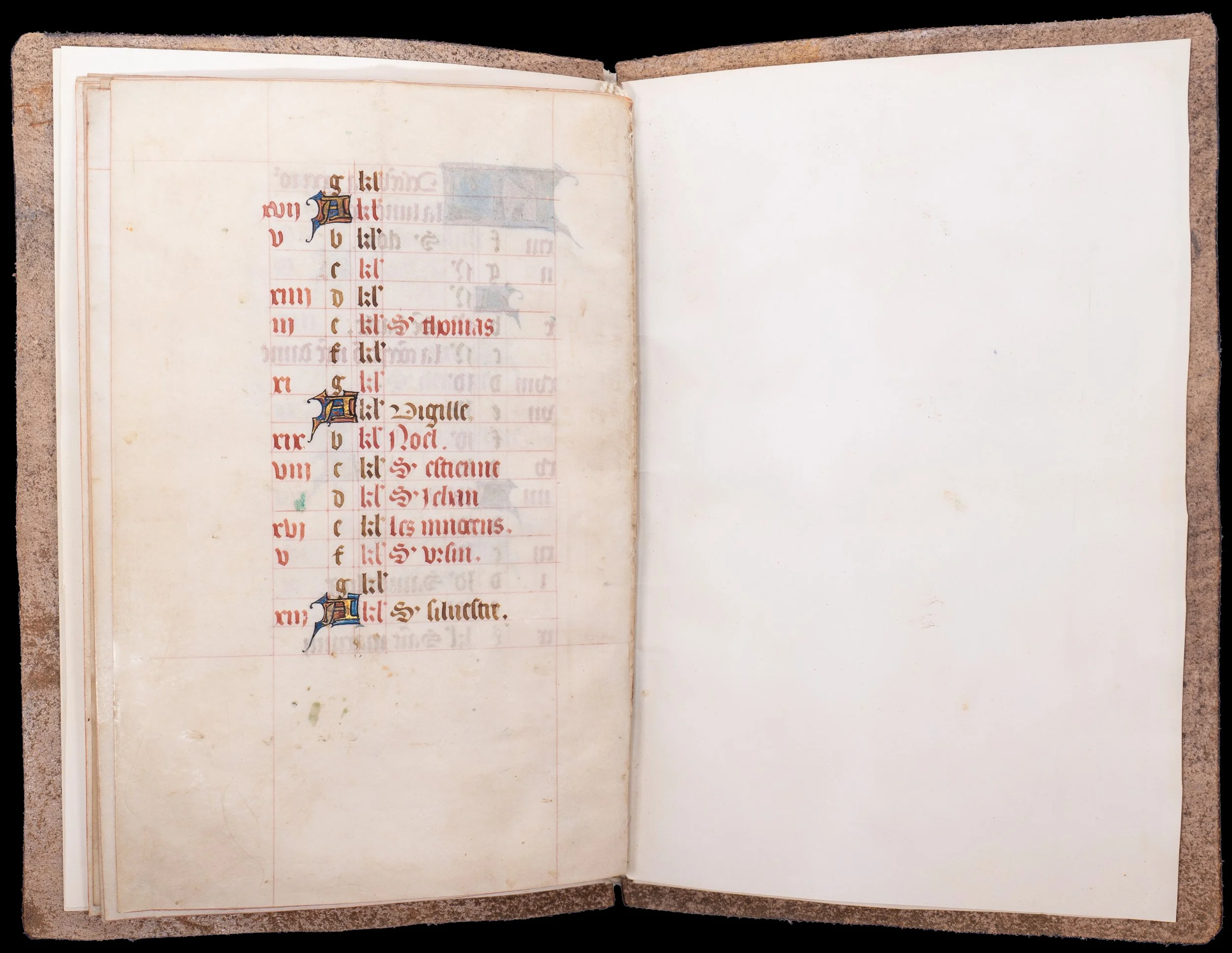
i + 12 + i leaves, ruled in ink, written in Gothic textualis in black and red ink; feast days and major celebrations rubricated in red, with KL initials in burnished gold on alternating blue and red grounds with pen flourishing. Bound in a brown leather cover with exposed stitching.
Dimensions: 200 x 130 mm.
PRICE: $5,000
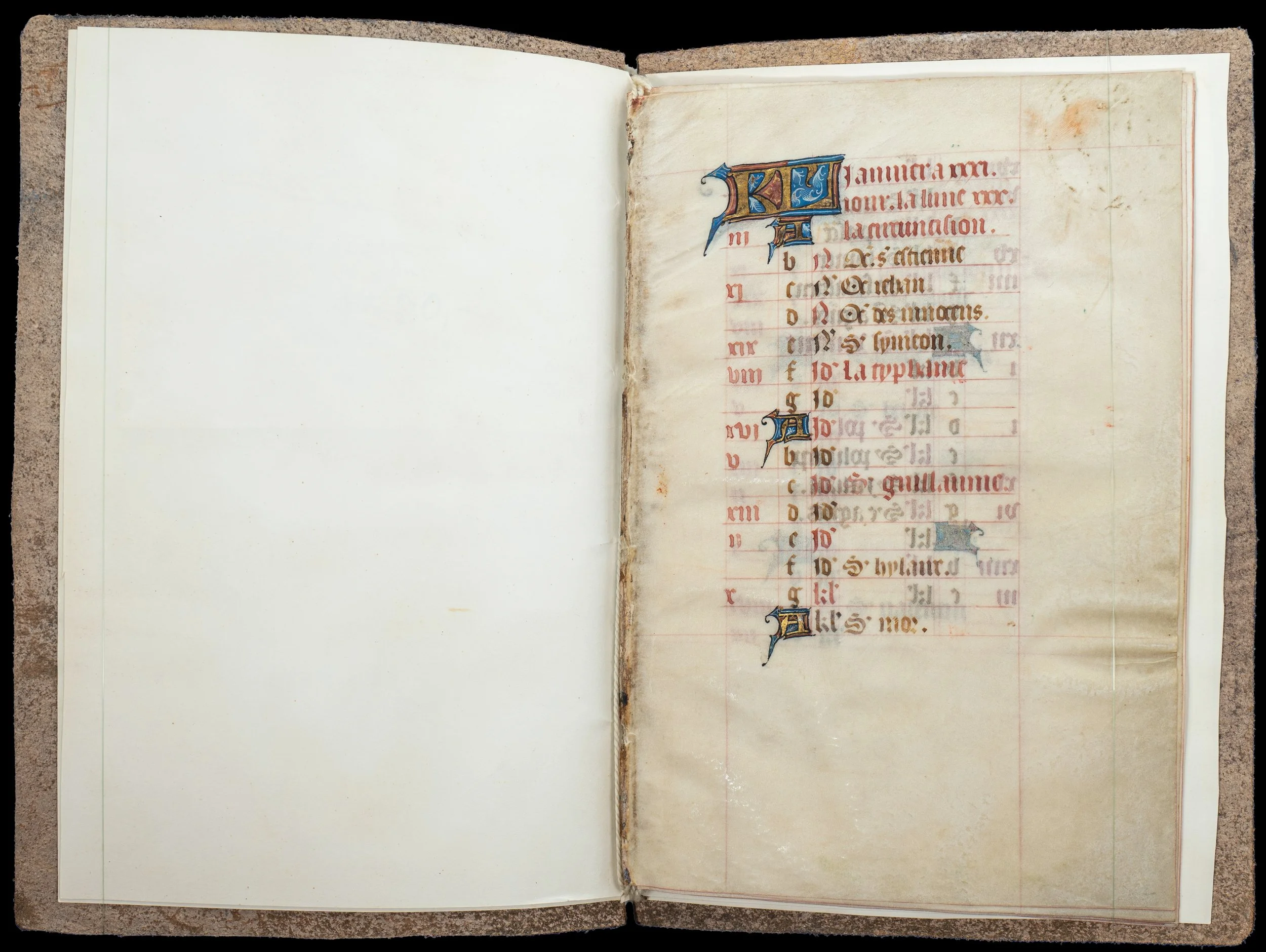
This manuscript preserves the complete calendar from a fifteenth-century French Book of Hours. Written in the vernacular rather than Latin, the calendar reflects the popularity of devotional manuscripts, especially the often coined “bestseller” the Book of Hours among lay patrons in later medieval France. The survival of the entire calendrical section as a coherent unit is especially important. The calendars often provide the clearest evidence for identifying the regional and liturgical affiliations of the lost parent manuscript.
Calendars formed one of the essential components of Books of Hours by structuring the liturgical year through the cycle of saints’ feasts and important feast days celebrated hildaiy within the Christian caledar. Before the widespread use of mechanical clocks, calendars provided the primary framework through which time itself was organized and experienced. Entries were arranged according to the traditional Roman system of Kalends, Nones, and Ides, while feast days connected the rhythms of daily life to local religious memory, regional cults and the wider Christian world.
This calendar follows a broadly Parisian or northern French structure of observed feast days while preserving a remarkable concentration of saints and commemorations associated particularly with Bourges and Orléans, cities southwest of Paris in the Loire region. Two important Bourges saints — Saint Guillaume of Bourges (10 January) and Saint Ursinus of Bourges (29 December) — are prominently rubricated in red. In medieval calendars, so-called “red-letter days” were feast days written in red ink rather than black, indicating celebrations of elevated importance such as major feasts, local patrons, diocesan saints, or observances of special liturgical rank. The modern English expression “red-letter day,” meaning an especially important or memorable occasion, ultimately derives from this medieval practice. The prominence of Guillaume and Ursinus is especially significant, as both saints are repeatedly associatedwith Bourges-related Books of Hours and liturgical traditions.
Other saints closely associated with Orléans include Saint Euverte (7 September) and Saint Aignan (17 November), both bishops intimately connected with the city’s ecclesiastical history, though in this calendar they are written in black rather than red. Additional regional saints throughout the calendar further reinforce a devotional geography centered in the Loire region rather than in Paris alone. Most notable, however, is the entry on 8 May, written in French as “la feste d’Orléans,” commemorating the liberation of Orléans in 1429 during the campaigns of Joan of Arc. Research into the calendrical surveys of Victor Leroquais has revealed that this rare feast also appears in a documented Book of Hours identified as “à l’usage d’Orléans,” confirming that the observance formed part of the devotional culture of the Orléans region during the fifteenth century.
Unfortunately, the parent manuscript itself is no longer known, and only the calendar survives. The absence of the Hours of the Virgin, the Litany of Saints, and the Office of the Dead — the sections most critical for determining the precise liturgical use of a Book of Hours — prevents a definitive localization of the manuscript. Nevertheless, the calendar preserves unusually strong regional indicators, combining Parisian structure with clear Orléans and Bourges affiliations, offering rare insight into the devotional landscape of fifteenth-century central France.
PROVENANCE:
1. Produced in France, perhaps the Loire Valley, c. 1440–1470, as part of a French Book of Hours.
2. Private collection, Germany.
LITERATURE:
Leroquais, Victor. Les livres d’heures manuscrits de la Bibliothèque nationale. Paris, 1927.
Wieck, Roger S. Time Sanctified: The Book of Hours in Medieval Art and Life. New York: George Braziller, 1988.
Wieck, Roger S. The Medieval Calendar. New York: The Morgan Library & Museum, 2017.
Gunhouse, Glenn. The Book of Hours: A Medieval Bestseller (Hypertext Book of Hours). https://www.medievalist.net/hourstxt/home.htm.
Explore our collection of illuminated manuscripts for sale →