Giovanni Pietro Birago (active c. 1471–1513)
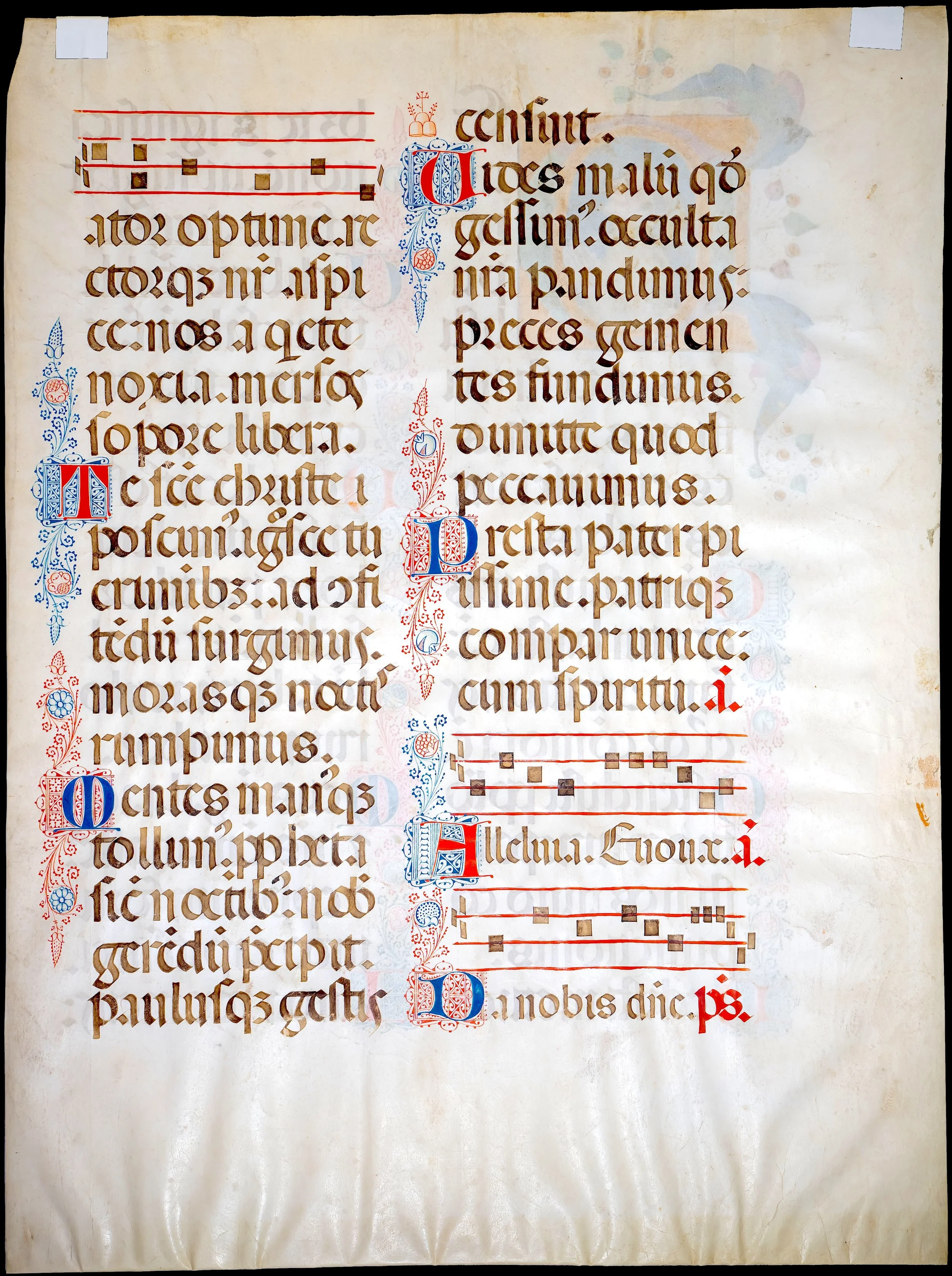
Written in Latin, leaf from an Olivetan Psalter-Antiphonary, opening Psalm 59 (60), Deus, repulisti nos, et destruxisti nos; iratus es, et misertus es nostri (“O God, you have rejected us and broken us down; you have been angry, and yet you have had mercy upon us”)
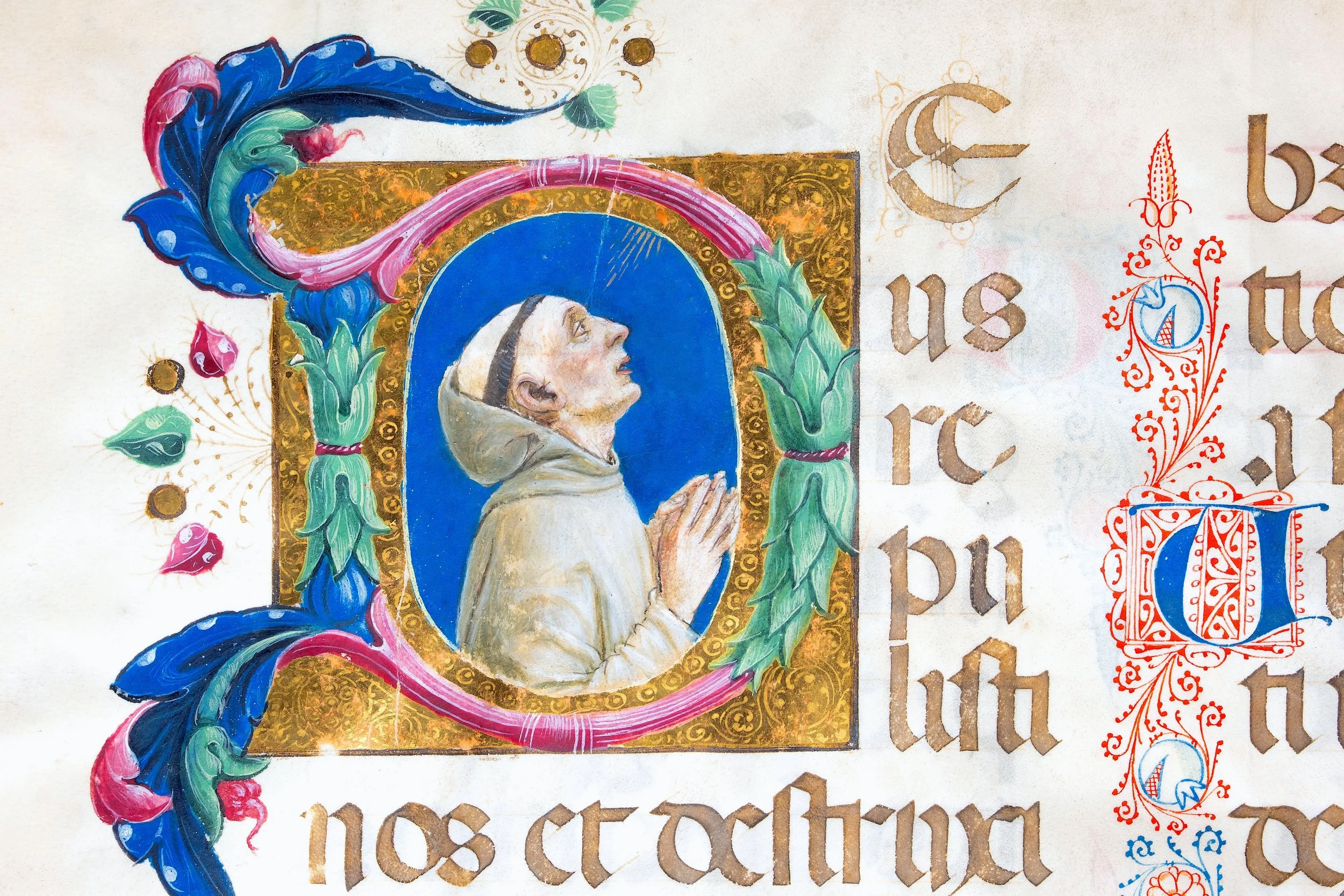
A Singing Olivetan Monk
Italy, Brescia, possibly for the Olivetan Abbey of San Nicolò di Rodengo, circa 1470–1480
Overall dimensions: 600 × 450 mm
Historiated initial “D” 106 × 104 mm
Tempera, ink, and gold on parchment
PRICE: $18,000
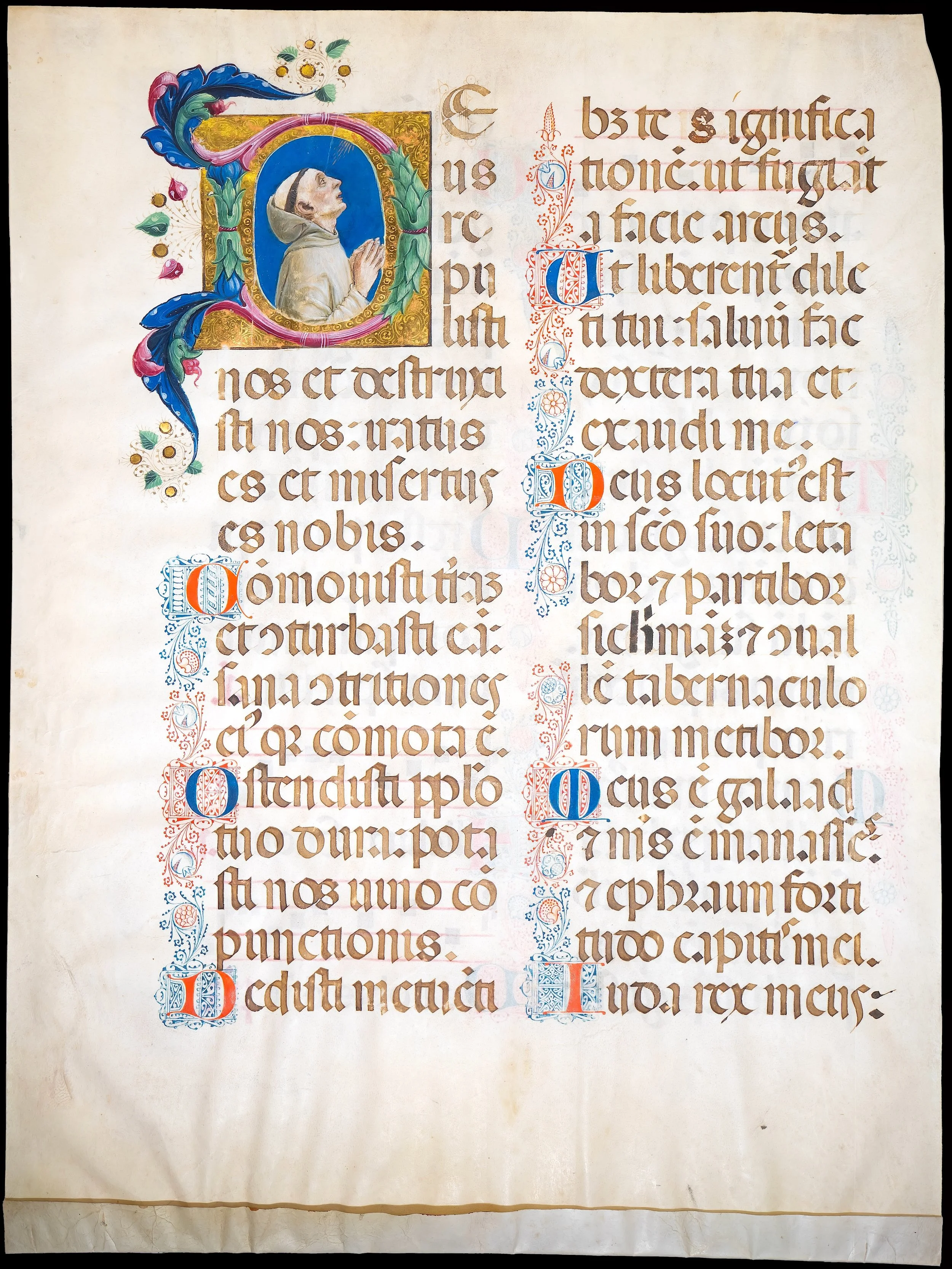
This magnificent choirbook leaf opens Psalm 59 (60), Deus, repulisti nos, et destruxisti nos; iratus es, et misertus es nostri (“O God, you have rejected us and broken us down; you have been angry, and yet you have had mercy upon us”). The text is introduced by a monumental historiated initial D, set against a burnished and tooled gold ground. The initial is composed of richly colored acanthus ornament in green, crimson and ultramarine, terminating in elegant scrolling foliage with gold spheres, highlighted with delicate pen flourishing. Enclosed within the initial is the bust of a tonsured Olivetan monk, shown in profile and clothed in a simple white habit. Set against a rich blue background, the monk raises his head toward the divine light descending from the upper right corner of the initial, his hands joined in supplication and his mouth open as if singing the Psalm.
The illumination is the work of Giovanni Pietro Birago (active c. 1471–1513), one of the foremost illuminators of Renaissance Lombardy. The attribution can be traced to Ulrike Bauer-Eberhardt’s reconstruction of a substantial group of dispersed choirbook leaves and cuttings in her 1984 catalogue of the Italian miniatures in the Staatliche Graphische Sammlung, Munich. Bauer-Eberhardt attributed the Munich fragments (cat. 18/1–18/16) to Birago through comparison with his documented work in the choirbooks of Brescia Cathedral, and associated with the same manuscript a nearly complete leaf now in the Kupferstichkabinett, Berlin (Inv. 12930), as well as related material in the Victoria and Albert Museum, including Cutting 278.4. She further established that the parent Antiphonary was made for an Olivetan monastery through the repeated appearance of the Olivetan emblem—the three hills surmounted by a cross—in the marginal decoration of the surviving leaves. On the basis of their shared script, decoration, and style, she concluded that the surviving leaves and cuttings originated in the same Antiphonary. Her study thus laid the foundation for the reconstruction of the dispersed manuscript and its place within Birago’s early career.
In 2004, Jonathan J. G. Alexander returned to this material in his study of Birago’s detached choirbook initials from the Duomo Vecchio in Brescia. Explicitly citing Bauer-Eberhardt’s reconstruction of the Munich group, Alexander placed the fragments within Birago’s early period and proposed that they “probably” originated from the corali of Brescia Cathedral. His suggestion significantly strengthened the association of the dispersed group with Birago’s early activity in Brescia, but left its Olivetan character unresolved: the Cathedral choirbooks were not produced for an Olivetan or other monastic community. Alexander’s observations therefore provide important evidence for the Brescian context and early date of the fragmented Olivetan manuscript without establishing its original institutional destination.
Beatrice Alai, in her 2019 catalogue of the Italian miniatures in the Kupferstichkabinett, Berlin, dated the closely related Berlin leaf (Inv. 12930) to the early 1470s, placing it within Birago’s youthful Brescian activity. Alai also records the suggestion of Gnaccolini and Alexander that the dispersed fragments may have belonged to a lost series of choirbooks made by Birago early in his career, perhaps for the Dominican convent of San Domenico in Brescia. This proposed destination, however, does not account for the Olivetan identity of the manuscript established by Bauer-Eberhardt through the repeated presence of the Olivetan emblem in the marginal decoration of several surviving fragments.
More recent research by Laura Paola Gnaccolini in 2020 has considerably refined the chronology and circumstances of Birago’s Brescian activity. The extraordinary series of eighteen choirbooks for the Duomo Vecchio was already partly transcribed by 1466, with their illumination apparently undertaken from around 1469. Birago’s securely documented activity in the series begins in 1471, making the years 1471–1474 the firmest period for his work on the Cathedral corali. The latest dates associated with his hand fall in 1474, and in the following year the Cathedral commissioners entrusted two choirbooks to another Milanese illuminator, Dominico da Milano. Gnaccolini therefore suggests that Birago’s documented activity on the Cathedral choirbooks had probably come to an end by 1475.
This increasingly precise understanding of Birago’s early activity in Brescia raises anew the question of the Olivetan community for which the dispersed manuscript was originally made. As a reformed Benedictine congregation, the Olivetans ordered their daily observance around the Opus Dei, with the Psalms and accompanying antiphons sung communally in choir throughout the day and night. A monumental Psalter-Antiphonary, such as the manuscript reconstructed here, was an instrument at the very center of the community’s religious life.
Approximately fifteen kilometers west of Brescia stood the Olivetan monastery of San Nicolò di Rodengo. Originally a Cluniac foundation, San Nicolò was entrusted by Pope Eugenius IV to the Olivetan congregation in 1445 for the reform of the monastery. The arrival of the congregation inaugurated a period of renewal that included the restoration of its liturgical life and, over the following decades, substantial artistic and architectural patronage. The Olivetans were thus established in the diocese of Brescia approximately a generation before the proposed date of the present manuscript.
The possibility that the dispersed Birago Psalter-Antiphonary might have been intended for San Nicolò di Rodengo remains a hypothesis, and no documentary evidence presently establishes such a provenance. Nevertheless, the monastery provides a compelling historical context for evidence that has previously proved difficult to reconcile. An origin in the Brescia Cathedral corali does not readily account for the manuscript’s Olivetan identity; San Nicolò, by contrast, was an established Olivetan community within the immediate Brescian territory during precisely the period of Birago’s activity there. It thus provides a plausible setting in which the Brescian and Olivetan evidence might be understood together.
The surviving records provide further evidence for the artistic and liturgical renewal underway at San Nicolò during the period of Birago’s activity in the Brescian region. Major work on the monastery was underway by 1478; in 1480 a new wooden choir was commissioned from Cristoforo Rocchi, followed in 1481 by a lectern for the choir. By 1485, San Nicolò was demonstrably commissioning the illumination of choirbooks. Angelo Maria Camassei, the eighteenth-century historian of the monastery, records from its archives that in March of that year the monks had their choirbooks ornamented by Ambrogio da Milano with nobili ed eccellenti miniature (“noble and excellent miniatures”), for which he was paid thirty ducats. Simona Iaria has suggested that these choirbooks were probably written by monks of the monastery itself. Although this episode cannot presently be connected with the dispersed Birago manuscript, it demonstrates that the production and embellishment of liturgical books formed part of the artistic renewal of San Nicolò in the closing decades of the fifteenth century.
Birago’s early activity in Brescia marks the beginning of a career that would eventually bring him into the orbit of the Sforza court in Milan. There he emerged as one of the leading illuminators of the late Quattrocento, working for members of the ruling dynasty on both manuscripts and luxury printed books. Among his most celebrated commissions are the sumptuous frontispieces added to presentation copies of Giovanni Simonetta’s Sforziada, as well as the extraordinary Book of Hours commissioned by Bona Sforza around 1490 (London, British Library, Add. MS 34294). These later works reveal the increasing refinement of the monumental figure style, luminous color, and elaborate ornamental vocabulary already apparent in his Brescian work. The present leaf belongs to an important formative moment in that development and, through the substantial corpus of surviving related leaves, offers an exceptional opportunity to consider Birago’s early activity within the larger context of choirbook production in fifteenth-century Brescia.
SISTER LEAVES AND FRAGMENTS
Munich, Staatliche Graphische Sammlung, cat. 18/1–18/16
Berlin, Kupferstichkabinett, Inv. 12930
London, Victoria and Albert Museum, Cuttings 278.4 and 278.5
Minneapolis, University of Minnesota, Elmer L. Andersen Library, MS 40
Philadelphia, Free Library of Philadelphia, Lewis E M 46:12
Berlin, Kunstbibliothek, Inv. 4014, 6–7
Private collections and the art market. Several additional leaves and cuttings identified in the literature with the dispersed manuscript are recorded in private collections and on the art market, including a complete leaf with the Penitent King David in the Water, its lower portion folded, a historiated initial with King David, an initial with an Olivetan monk, a leaf formerly with Maggs Bros. (cat. 1340, no. 34), and material in the Zeileis Collection.
PROVENANCE
1. Inscribed on the folded lower edge with an early signature or inscription, apparently “A. Millidly” [reading uncertain].
2. Germany, private collection.
3. Switzerland, private collection.
LITERATURE
Ulrike Bauer-Eberhardt, Die italienischen Miniaturen des 13.–16. Jahrhunderts. Staatliche Graphische Sammlung München, Munich, 1984, cat. 18/1–18/16, pp. 47–52.
Jonathan J. G. Alexander, “Giovan Pietro da Birago, Illuminator of Milan: Some Initials Cut from Choir Books,” in David S. Areford and Nina A. Rowe, eds., Excavating the Medieval Image: Manuscripts, Artists, Audiences: Essays in Honor of Sandra Hindman, Aldershot, 2004, pp. 225–246.
Laura Paola Gnaccolini, “Birago, Giovan Pietro,” in Milvia Bollati, ed., Dizionario biografico dei miniatori italiani. Secoli IX–XVI, Milan, 2004, pp. 104–110.
Laura Paola Gnaccolini, “I corali del Duomo Vecchio di Brescia: per le fonti di Giovan Pietro Birago e gli sviluppi della sua attività giovanile,” in Testi, melodie, colori, Bergomum, CXIV (2020), published 2022, pp. 209–220, illustrations pp. 98–102.
Beatrice Alai, Le miniature italiane del Kupferstichkabinett di Berlino, Florence: Polistampa, 2019, cat. 80, pp. 289–290.
Maria Luisa Gatti Perer and Mario Marubbi, eds., Tesori miniati. Codici e incunaboli dei fondi antichi di Bergamo e Brescia, Milan, 1995, pp. 162–166.
Giorgio Picasso, “Momenti di storia olivetana a Rodengo,” in San Nicolò di Rodengo. Un monastero di Franciacorta tra Cluny e Monte Oliveto, Brescia, 2002, pp. 103–114.
Maurizio Tagliabue, “Materiali per la storia di Rodengo nel periodo olivetano (secoli XV–XVIII),” in San Nicolò di Rodengo, 2002, pp. 115–140.
Andrea Breda, “Il sito e le strutture edilizie dell’abbazia tra Medioevo e primo Rinascimento,” in San Nicolò di Rodengo, 2002, pp. 141–164.
Pier Virgilio Begni Redona, “La pittura nei secoli XV–XVIII,” in San Nicolò di Rodengo, 2002, pp. 211–280.
Angelo Maria Camassei, La forza dell’archivio. Dominio e giurisdizione del monastero di San Nicolò di Rodengo nel “libro” di un abate archivista del Settecento, ed. Simona Iaria, Quaderni di Brixia Sacra, 1, Brescia: Fondazione Civiltà Bresciana, 2009.