Master of Philippe de Gueldres (active, Paris, circa 1500-1510)
Resurrection of Christ
France, Paris, c. 1500–1510
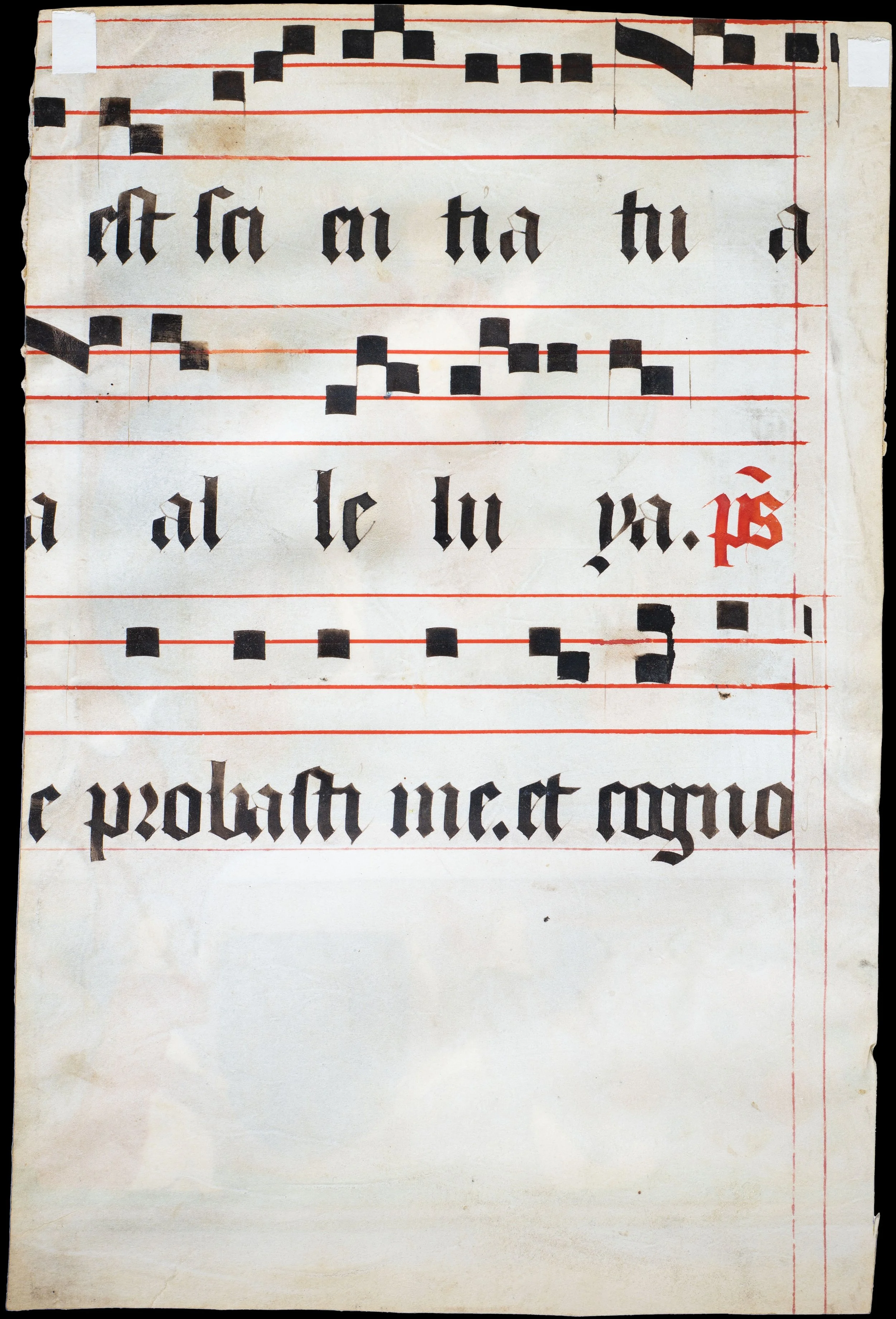
Written in Latin, a fragment from an illuminated Gradual made for Abbey of Saint-Victor, Introit for the Mass of Easter Sunday, Resurrexi et adhuc tecum sum (“I have risen, and I am still with you”)
Overall dimensions: 280 x 186 mm.
Tempera, gold and ink on parchment
PRICE: $25,000
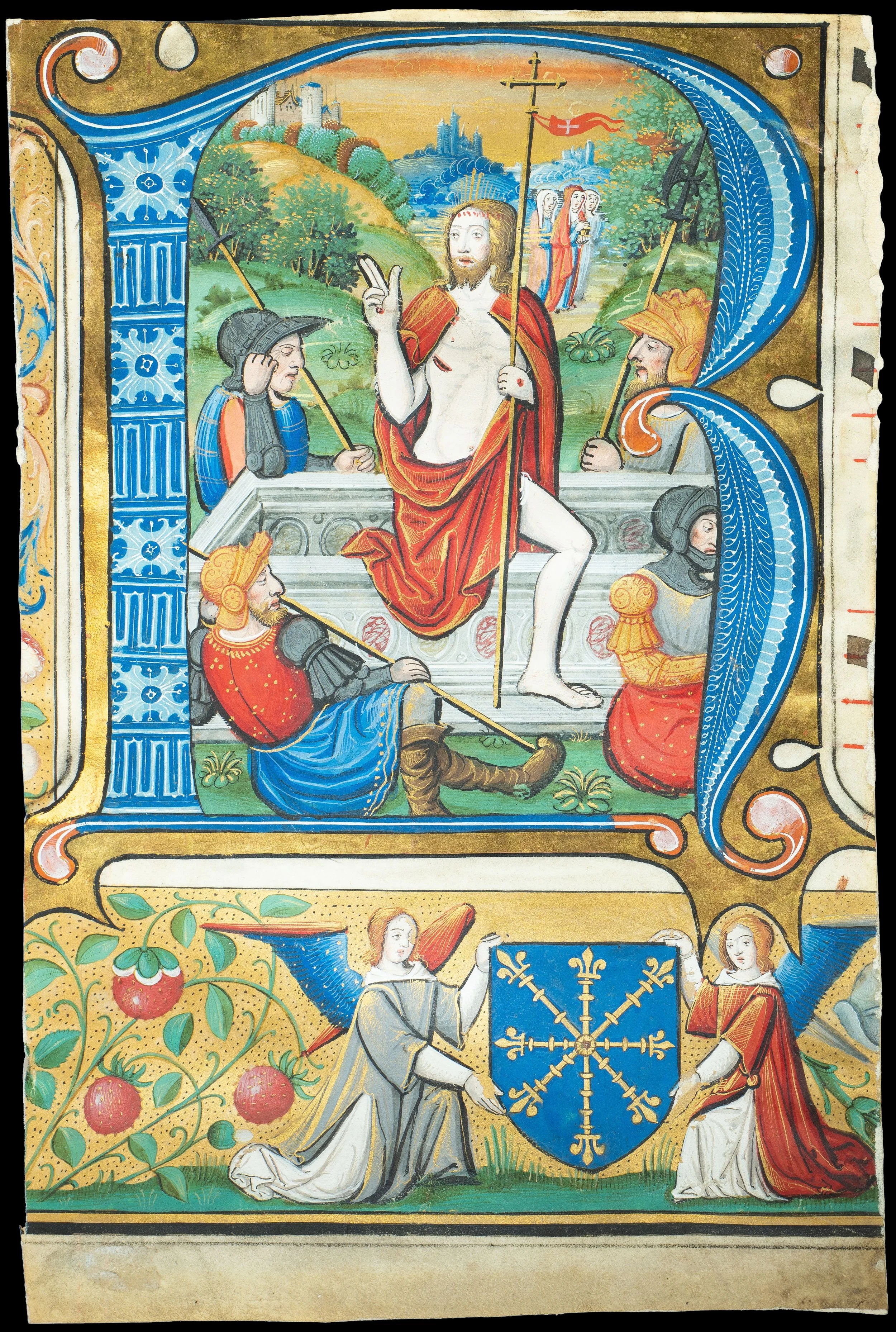
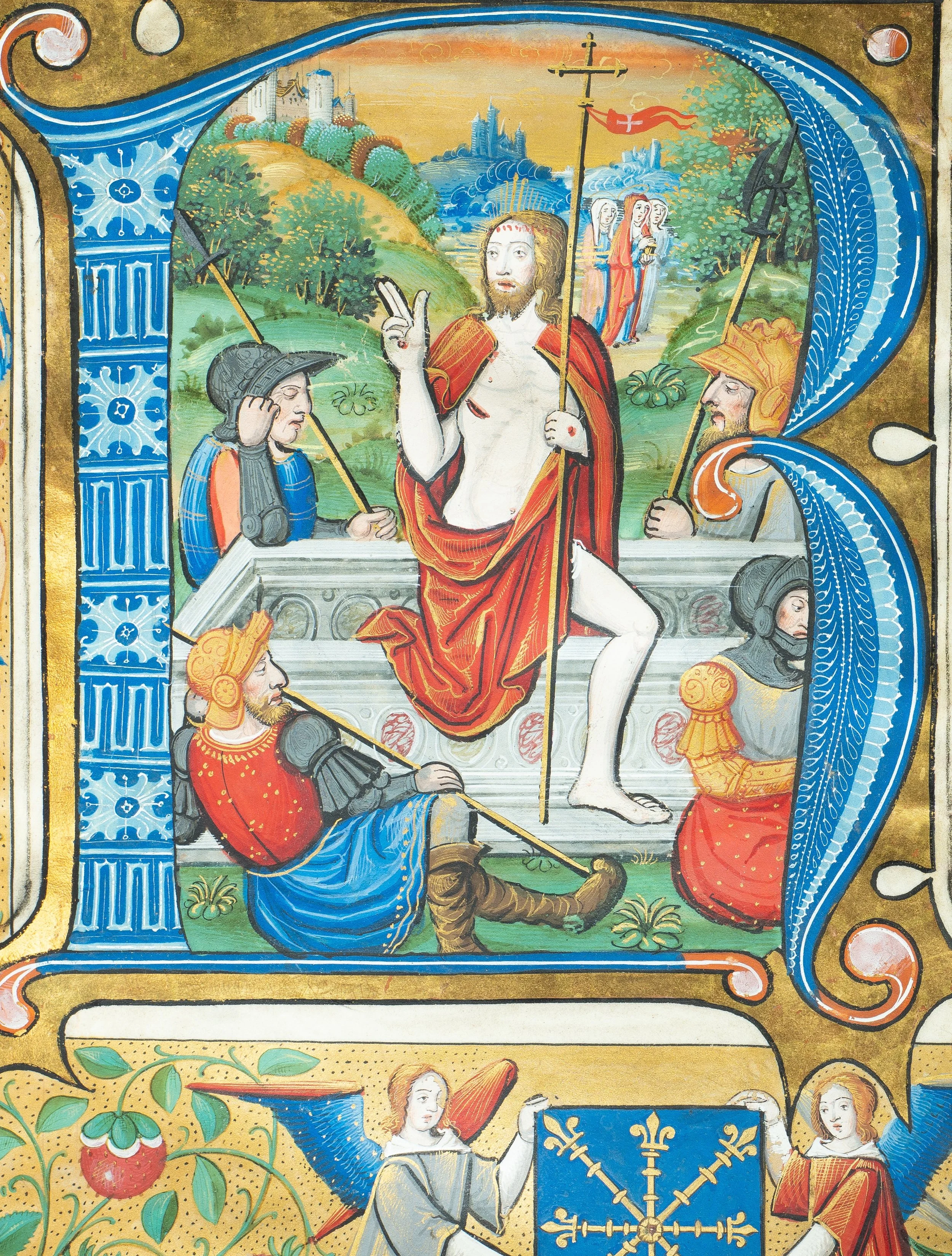
This magnificent historiated initial R, depicting the Resurrection of Christ, is among the finest surviving remnants of a monumental illuminated gradual produced in Paris during the opening decade of the sixteenth century for the celebrated Abbey of Saint-Victor. Painted on an imposing scale for use upon the choir lectern, the initial introduced the Introit for the Mass of Easter Sunday, Resurrexi et adhuc tecum sum (“I have risen, and I am still with you”), one of the most important chants of the entire liturgical year. Within the initial, Christ rises triumphantly from the open sarcophagus, his right hand raised in blessing as he steps forward in serene majesty. The artist contrasts Christ’s calm, monumental presence with the animated reactions of the Roman soldiers below, who lie asleep. In the background, the Three Marys approach the tomb. Mary Magdalene is distinguished by her ointment jar, while beyond them Jerusalem rises. The composition masterfully compresses moments of the Resurrection narrative into a single unified image.
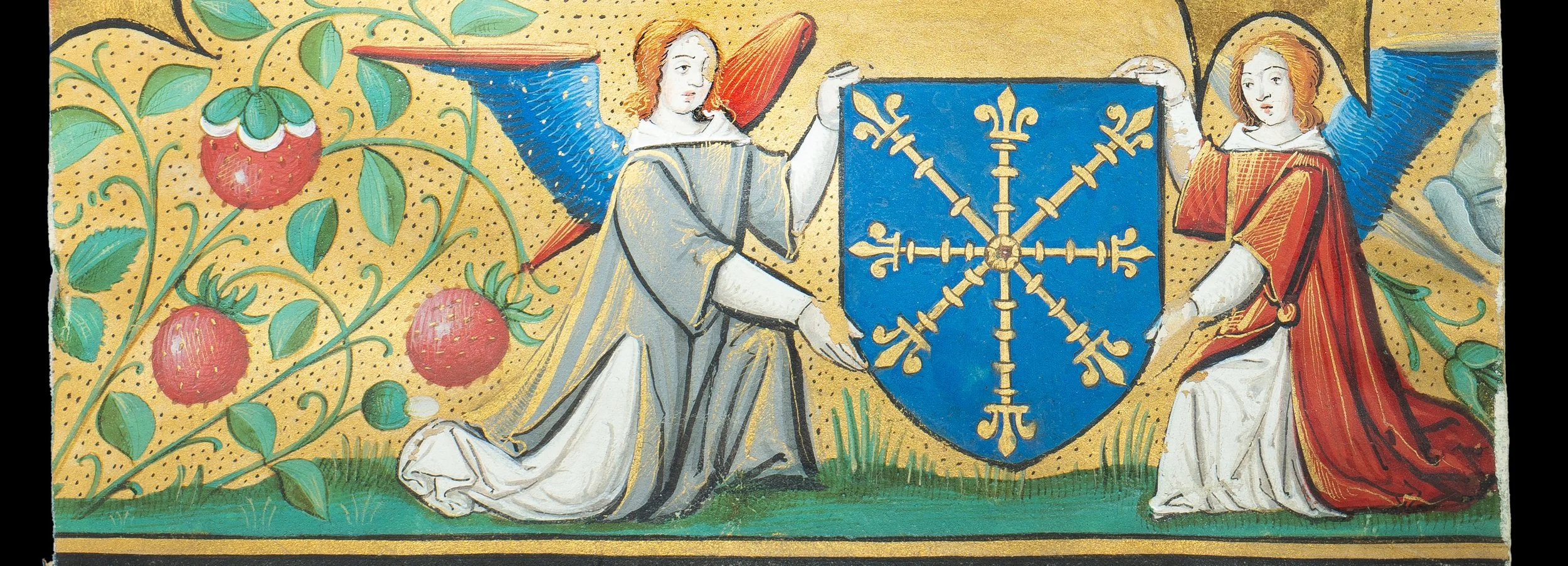
The lower margin displays the arms of the Abbey of Saint-Victor, supported by two graceful angels. Blazoned azure with eight fleur-de-lys scepters, these distinctive arms firmly identify the manuscript’s original owner. Founded in 1113, the Abbey of Saint-Victor became one of the most renowned Augustinian houses of medieval Europe. It was celebrated equally for its theological school, distinguished scholars and remarkable library. Although a portion of its medieval library survives today in the Bibliothèque nationale de France and the Bibliothèque Mazarine, the great Renaissance liturgical choirbooks commissioned for its choir were largely dispersed or destroyed.
The illumination of the present Gradual is attributable to the Master of Philippe de Gueldres, one of the leading illuminators active in Paris during the beginning of the sixteenth century. The artist takes his modern name from his work in the Vie de Christ, a French translation of Ludolph of Saxony’s Vita Christi, made in 1506 for Philippe (Philippa) de Gueldres (1464–1547), Duchess of Lorraine (Lyon, Bibliothèque municipale, MS 5125). First distinguished as an independent artistic personality by John Plummer, the Master was once associated with Bourges because of stylistic affinities with the work of Jean Colombe, and subsequently, with Rouen. François Avril and Nicole Reynaud situate his mature career firmly in Paris, where he collaborated with other Parisian illuminators, including Jean Pichore, and supplied illustrations for deluxe books produced by the celebrated publisher Antoine Vérard. His patrons belonged to the highest circles of French court and ecclesiastical society and included, in addition to the Duchess of Lorraine, King Louis XII and Cardinal Georges d’Amboise. Among his most important liturgical commissions were the monumental Graduals made for Louis XII and Anne of Brittany for the Sainte-Chapelle in Paris. These choirbooks were subsequently dismantled and dispersed, a fate strikingly similar to that of the Saint-Victor Gradual from which the present miniature derives.
Of particular importance is the Master’s continuing relationship with the Abbey of Saint-Victor itself. The Gradual was not his only commission for this important Parisian Augustinian house. An illuminated Missal made for Saint-Victor, now Paris, BnF, MS lat. 14818, is likewise attributed to the Master, providing further evidence of his association with the abbey. Another richly illuminated Missal from Saint-Victor, BnF, MS lat. 14448, belongs to the same broader milieu of Parisian illumination and merits comparison with the work of the Master and his contemporary Jean Pichore. BnF, MS lat. 14448 prominently incorporates the arms of the abbey supported by two kneeling angels, providing particularly striking visual testimony to its institutional provenance and a close parallel for the same heraldic device preserved beneath the present Resurrection fragment. Taken together, these manuscripts and the dispersed Gradual attest to the rich tradition of illuminated liturgical book production at Saint-Victor and provide compelling evidence for the Master’s sustained relationship with the abbey around the turn of the sixteenth century.
At least six historiated initials can presently be associated with the dispersed Saint-Victor Gradual. A group of four fragments appeared together in the sale of the collection of renowned bibliophile, Ambroise Firmin-Didot, in Paris in 1884, lot 73: the Presentation in the Temple, the Resurrection (the present miniature), the Trinity, and Saint Michael Slaying the Dragon. The Trinity reappeared with Les Enluminures (Catalogue 9, no. 34). A fifth initial, depicting Saint Victor, was sold at Sotheby’s, London, 23 June 1992, lot 25. A sixth fragment, depicting the Last Supper, appeared at Christie’s, London, 15 November 2006, lot 9, and may likewise have formed part of the same monumental choirbook.
Other important manuscripts attributed to the Master include a Book of Hours now at the Huntington Library (HM 1101), as well as manuscripts in Paris (BnF, MSS fr. 54, 702 and 2678–2679) and Vienna (ÖNB, Cod. 2565 and Cod. 2582). His oeuvre encompasses both secular and devotional manuscripts, although much of his surviving work is found in secular commissions for courtly and aristocratic patrons.
Provenance:
1. Abbey of Saint-Victor, Paris.
2. Collection of Ambroise Firmin-Didot (1790–1876).
3. Paris, Hôtel Drouot, Collection Ambroise Firmin-Didot, 10–14 June 1884, lot 73.
4. France, Private Collection
5. Published: Les Enluminures, Chicago and Paris, published in Catalog 8: Symbolism and the Medieval World, # 33, 1999
6. Published: Les Enluminures, Chicago and Paris, published in Catalog 15, France 1500: The Pictorial Arts at the Dawn of the Renaissance, # 2010
7. USA, Private Collection
Literature:
Avril, François, and Nicole Reynaud. Les manuscrits à peintures en France, 1440–1520. Paris, 1993, pp. 278–281.
Plummer, John. The Last Flowering: French Painting in Manuscripts, 1420–1530. New York, 1982, pp. 69–71.
Victor Leroquais, Les sacramentaires et les missels manuscrits des bibliothèques publiques de France, 3 vols., Paris, 1924, vol. III. pp. 222-223
Ambroise Firmin-Didot, Catalogue illustré des livres précieux, manuscrits et imprimés, faisant partie de la bibliothèque de M. Ambroise Firmin-Didot, Paris, Hôtel Drouot, 10–14 June 1884, lot 73, p. 57.