Flemish Artist
The Massacre of the Innocents
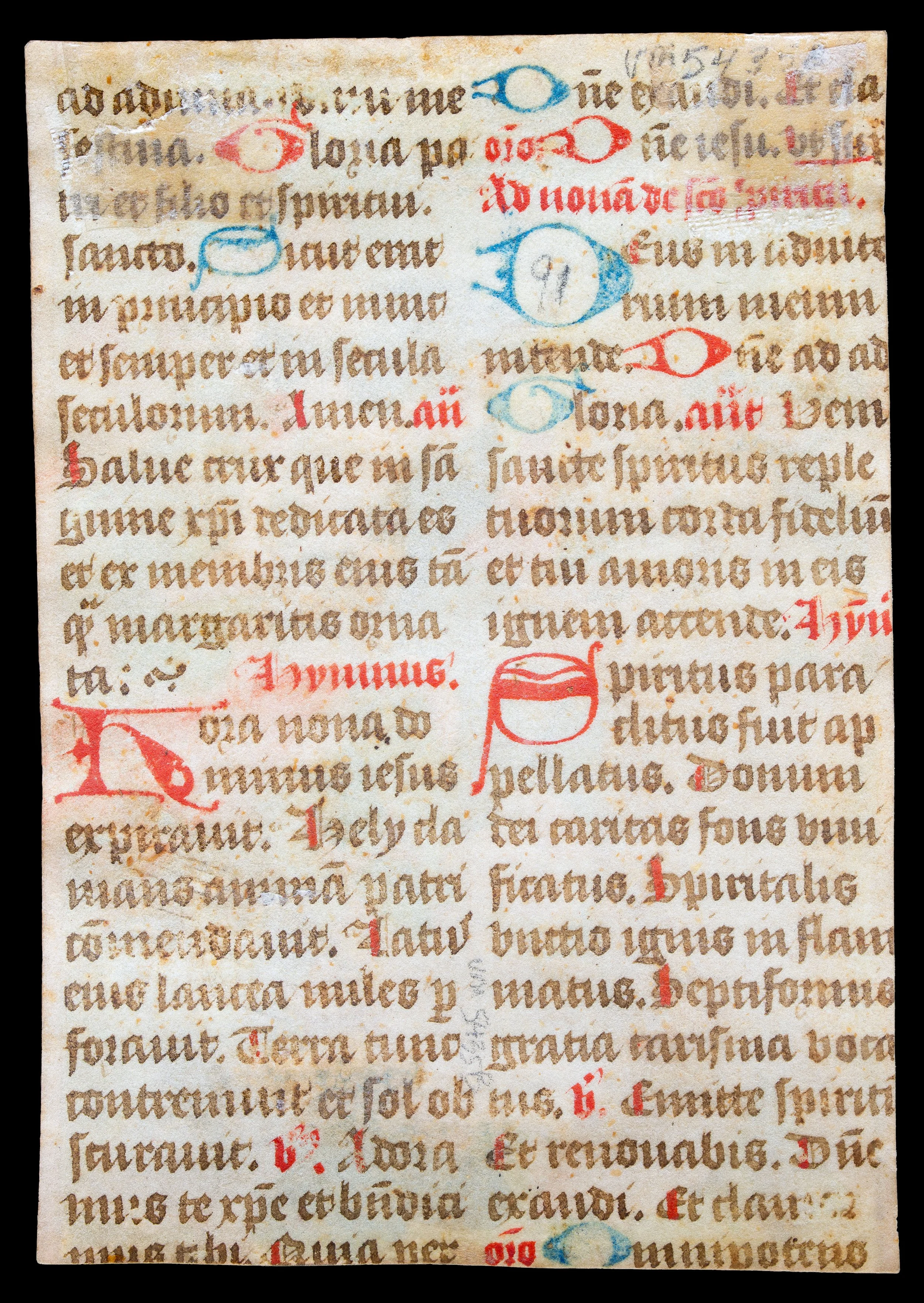
Written in Latin, a miniature from a Book of Hours, recto with text from None in the Hours of the Virgin, while the verso, Massacre of the Innocents likely introduces Vespers in the Hours of the Virgin
Flanders, probably eastern Flanders, circa 1500
Overall dimensions, 103 x 72 mm.
Tempera and ink on parchment
Price: $15,000
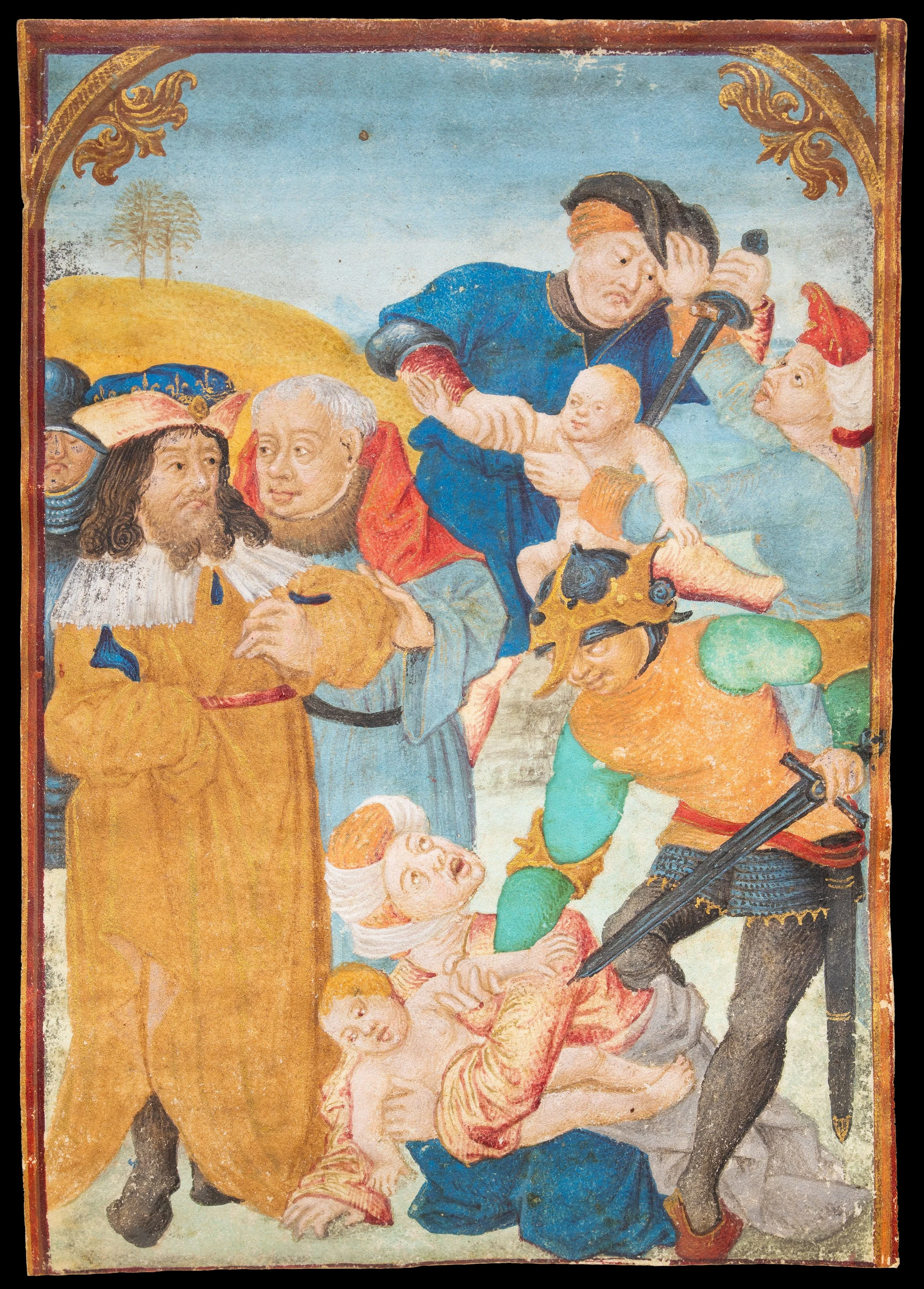
An accomplished and dramatic example of late medieval Flemish manuscript illumination, this miniature depicting the Massacre of the Innocents comes from a Book of Hours produced around 1500. Formerly in the celebrated collection of Mortimer Brandt, the painting has attracted scholarly attention for more than sixty years, with its precise artistic origins remaining a subject of discussion.
The Massacre of the Innocents was among the most frequently represented episodes from the infancy of Christ in medieval and Renaissance art. The subject appears in liturgical and devotional manuscripts, panel paintings, frescoes, and, increasingly during the fifteenth and early sixteenth century, prints. The subject became particularly familiar through its inclusion in the Hours of the Virgin, where it traditionally introduced Vespers. From the emergence and growing popularity of Books of Hours in the thirteenth century, illuminators returned repeatedly to the episode, developing compositions that ranged from highly expressive scenes of violence and maternal anguish to more restrained and carefully orchestrated narratives.
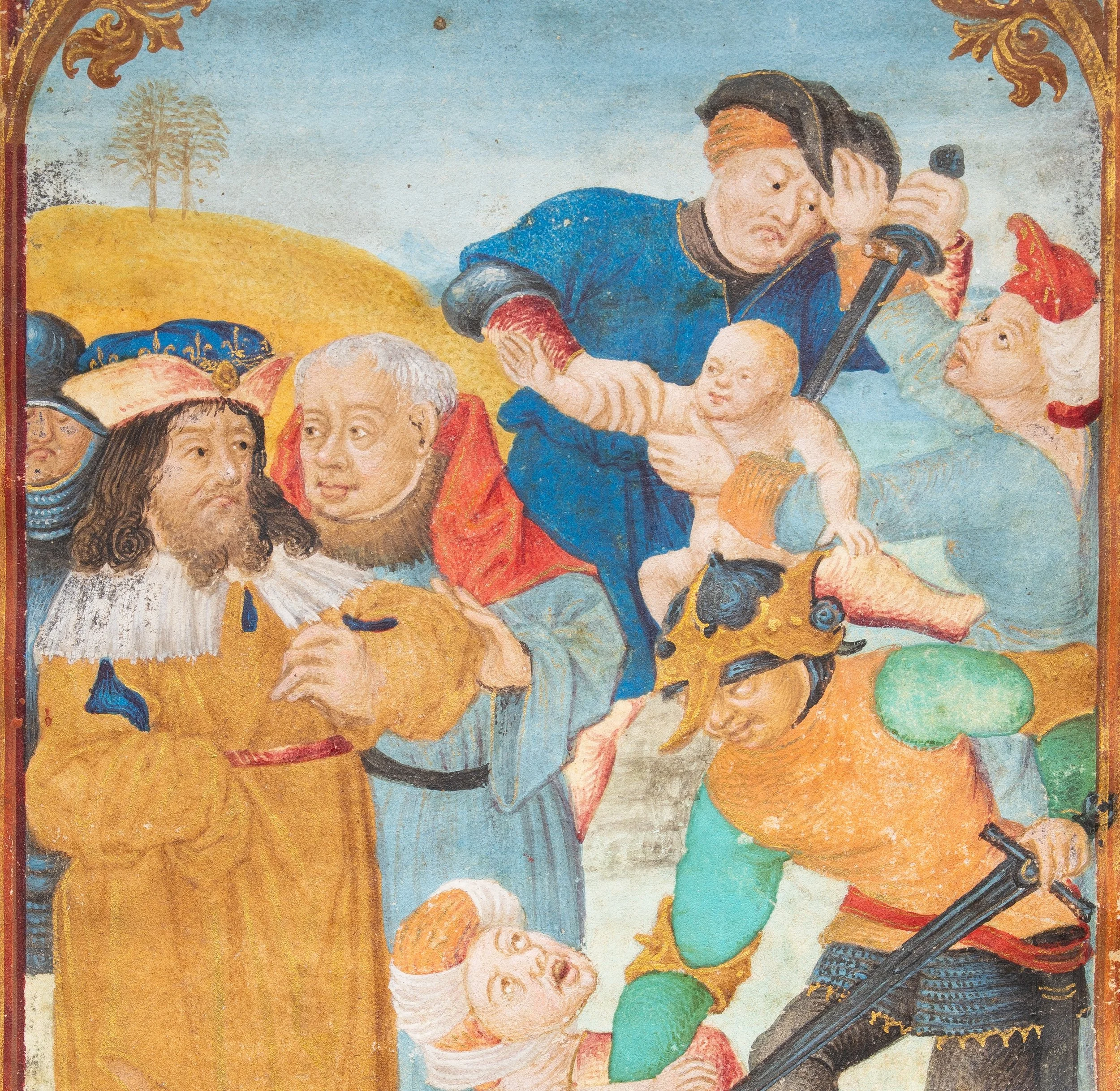
The present miniature offers a particularly sophisticated interpretation of this familiar subject. Rather than emphasizing the brutality of the massacre through explicit bloodshed, the artist concentrates on the dramatic relationships between the figures and the carefully controlled movement of the composition. Herod, dressed in a voluminous golden robe and crowned with an elaborate headdress, occupies the left foreground, accompanied by an elderly attendant and a partially concealed soldier. His composed appearance contrasts with the violent action unfolding beside him. At the upper center, a soldier raises his sword against an infant held aloft by a woman, while another soldier, dressed in brightly colored armor, advances upon a mother struggling to protect her children in the foreground. The figures are closely grouped, overlapping one another and filling nearly the entire pictorial field, leaving only a narrow glimpse of landscape and sky.
The miniature has an interesting scholarly history, beginning with its publication by scholar Harry Bober in his 1966 catalogue of the Mortimer Brandt collection (no. 9), where he attributed it to the Northern Netherlandish School, considering connections with Utrecht, Ghent-Bruges, and Germany, the latter suggested by fellow art historian Charles Sterling. When published by Sam Fogg and Bruce Ferrini in Medieval & Renaissance Miniature Painting (1989, no. 11), it was reassigned to a Flemish master around 1500, possibly working in eastern Flanders or along the Franco-Flemish border. These differing opinions reflect the difficulty of localizing an artist working within the interconnected artistic traditions of the Low Countries and neighboring German territories, where the exchange of pictorial models, increasingly facilitated by the flourishing culture of printmaking, encouraged the development of compositions drawing upon diverse regional influences.
The painting’s relationship to the Ghent-Bruges tradition is suggested in part by its unusual ornamental framing, particularly the gilded foliate scrolls occupying the upper corners of the composition, emerging from curved bands against the blue sky. Painted with a subtle trompe-l’œil effect, the gilded framing creates the impression of a small devotional altarpiece, lending the miniature an architectural character. These decorative elements recall the ornamental vocabulary of Flemish manuscript illumination in the closing decades of the fifteenth century, particularly the artistic milieu associated with Alexander Bening, the Master of the Dresden Prayer Book, the Master of the Prayer Books of around 1500, and Gerard Horenbout (often identified with the Master of James IV of Scotland), a tradition subsequently developed by Simon Bening in the early sixteenth century. Although the framing does not establish a connection with any particular workshop, it offers a useful point of comparison for considering the miniature’s artistic origins.
Equally intriguing are the miniature’s affinities with contemporary engraving, which played an increasingly important role in the transmission of pictorial models between artists during the later fifteenth century. Its compressed arrangement of figures, expressive gestures, and carefully orchestrated movement invite comparison with the crowded narrative compositions of engravers such as the Monogrammist P.M. and Israhel van Meckenem, particularly their treatments of the Massacre of the Innocents. While no direct relationship with these printed compositions has been established, the similarities suggest an artist conversant with a broader pictorial language shared by illuminators, painters, and printmakers. Such exchanges may help explain the miniature’s distinctive character and the difficulty of assigning it to a more narrowly defined artistic milieu.
Distinguished by its ambitious composition, expressive characterization, and unusual ornamental framing, the present miniature exemplifies the richness and diversity of Flemish manuscript illumination at the turn of the sixteenth century. Its combination of established devotional imagery with a dynamic pictorial language reflects a period in which manuscript painters increasingly engaged with artistic developments beyond the traditional confines of book illumination.
Exhibitions:
This miniature formed part of Mortimer Brandt’s collection of twenty-nine manuscript illuminations, catalogued by Harry Bober in 1966 and circulated in a traveling exhibition that visited seventeen venues across the United States between 1964 and 1986.
The Mortimer Brandt Collection of Medieval Manuscript Illuminations, traveling exhibition, 1964–1986, comprising twenty-nine manuscript illuminations catalogued by Harry Bober (1966). The exhibition traveled to seventeen venues throughout the United States, including the Cummer Gallery of Art, Jacksonville, FL (1964); J. B. Speed Art Museum, Louisville, KY (1965); Brooks Memorial Art Gallery, Memphis, TN (1966); Marquette University, Milwaukee, WI (1966); Wichita Art Museum, Wichita, KS (1968); New York State University Art Gallery, Binghamton, NY (1969); Sterling and Francine Clark Art Institute, Williamstown, MA (1970); Georgia Museum of Art, Athens, GA (1970–71); University of Kentucky, Lexington, KY; Owensboro, KY; Ashland Community College, Ashland, KY; Morehead State University, Morehead, KY; and Market House Gallery, Paducah, KY (all 1971); Clark Art Institute, Williamstown, MA (1974); Williams College, Williamstown, MA (1979); Memorial Art Gallery, Rochester, NY (1982–84); and Williams College, Williamstown, MA (1984–86).
Inscriptions:
A handwritten number, possibly “91” or “9,” appears within one of the large blue initials of the word Deus and may correspond to the miniature’s identification as no. 9 in Harry Bober’s 1966 catalogue of the Mortimer Brandt Collection. The inventory number “VM 5435B,” inscribed twice, may be associated with the inventory systems used by Sam Fogg and Bruce Ferrini or Les Enluminures during the late 1980s and early 1990s, although this identification remains unconfirmed.
Provenance:
Vittorio Forti (1881–c. 1980), Rome; documented among photographs of manuscript illuminations formerly in his collection, probably dating from the late 1940s or early 1950s (Rome, ICCD, Gabinetto Fotografico Nazionale, inv. E86455/A; see Manzari, 2024, appendix no. 24).
Mortimer Brandt (1905–1993), New York and Baltimore, by 1963; included in his collection of twenty-nine manuscript illuminations, subsequently exhibited throughout the United States between 1964 and 1986; the collection placed on deposit at the Walters Art Gallery, Baltimore, in 1988.
Sam Fogg and Bruce Ferrini, Medieval and Renaissance Miniature Painting (1989), no. 11.
Les Enluminures, Paris, Catalogue 5 (1996), no. 28.
Private Collection, USA
Literature:
Harry Bober, The Mortimer Brandt Collection of Medieval Manuscript Illuminations (Hatfield: Stellar Press, 1966), no. 9, illustrated.
Sam Fogg and Bruce Ferrini, Medieval & Renaissance Miniature Painting (1989), no. 11, illustrated in color.
Les Enluminures, Catalogue 5: Illuminations, Gouaches, Drawings from the 13th to the 18th Centuries (Paris: Les Enluminures, 1996), p. 74, no. 28, illustrated in color on p. 75.
Roger S. Wieck, “Folia Fugitiva: The Pursuit of the Illuminated Manuscript Leaf,” Journal of the Walters Art Gallery 54, Essays in Honor of Lilian M. C. Randall (1996), pp. 233–254, esp. discussion of the Mortimer Brandt collection and its traveling exhibition, no. 80–82.
Francesca Manzari, “Illuminations from Northern and Central Italy in the Collection of the Dealer Vittorio Forti,” in The Pre-Modern Manuscript Trade and Its Consequences, ca. 1890–1945, ed. Laura Cleaver, Danielle Magnusson, Hannah Morcos, and Angéline Rais (Leeds: Arc Humanities Press, 2024), pp. 117–144, appendix no. 24, p. 140.
View our selection of illuminated miniatures and manuscript leaves for sale →