Following the Fragments: Reconstructing a Lost Choirbook by Giovanni Pietro Birago
The survival of a single illuminated manuscript leaf is often an accident of history. Removed from the book for which it was made, separated from neighboring leaves, and dispersed through collections over generations, it can retain little obvious evidence of its original context. Occasionally, however, enough fragments survive to allow something of the lost manuscript to be reconstructed.
Such is the case with a remarkable group of illuminated choirbook leaves and cuttings attributed to Giovanni Pietro Birago (active c. 1471–1513), one of the leading illuminators of Renaissance Lombardy. While researching a recently acquired leaf from this dispersed manuscript, I began to reconsider not only its date but also the question of the Olivetan monastery for which the original choirbook might have been made.
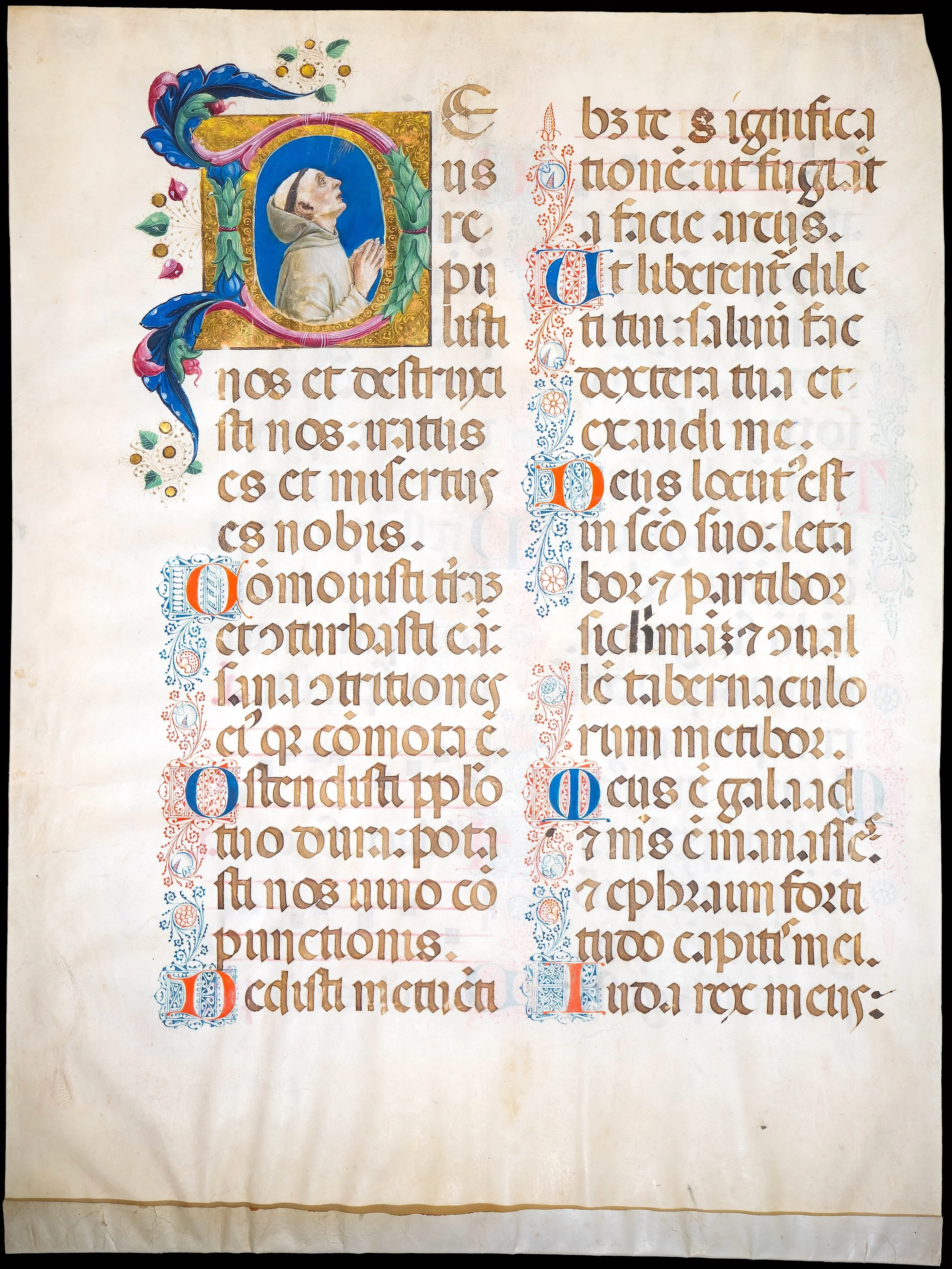
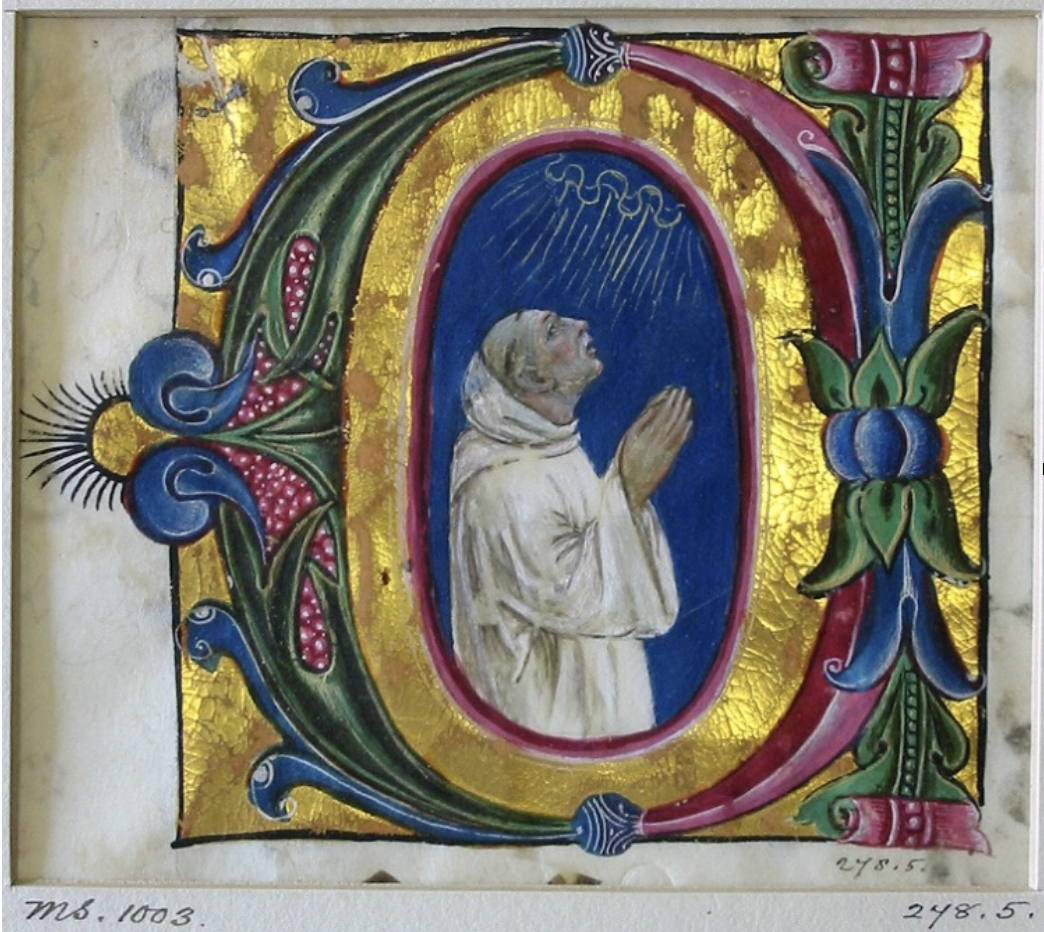
The leaf opens Psalm 59 (60), Deus, repulisti nos, et destruxisti nos; iratus es, et misertus es nostri (“O God, you have rejected us and broken us down; you have been angry, and yet you have had mercy upon us”). A monumental historiated initial D encloses the bust of a tonsured Olivetan monk in a white habit. His hands are joined in supplication, but his mouth is open and his head is raised toward rays of divine light. He appears not simply to be praying, but singing the Psalm.
At approximately 600 × 450 mm, the leaf belonged to a monumental liturgical book intended to be read communally in choir. Its original context can be recovered through a remarkable body of surviving fragments.
Reconstructing the Lost Manuscript
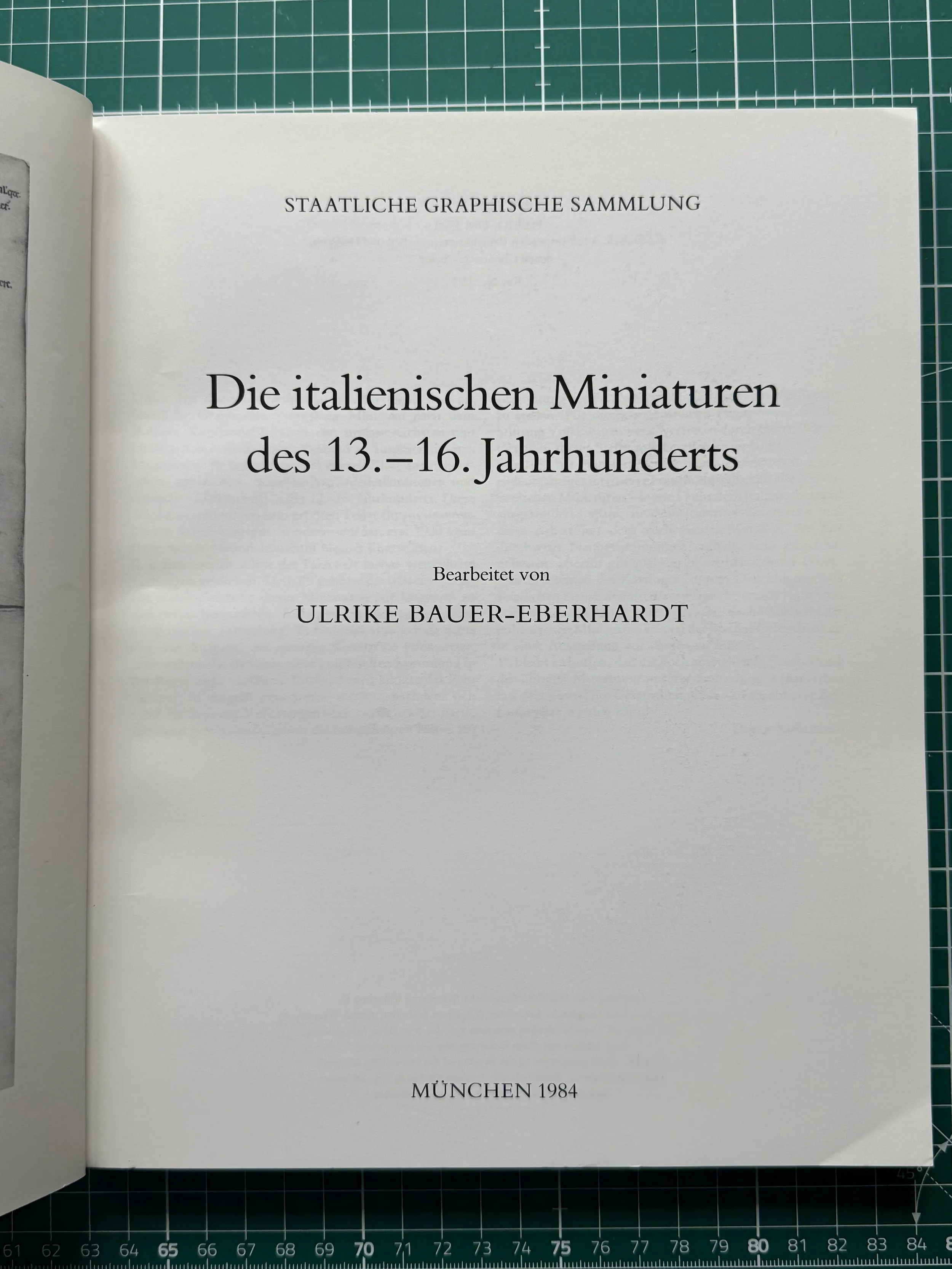
The foundation for any reconstruction of the manuscript remains Ulrike Bauer-Eberhardt’s 1984 catalogue of Italian miniatures in the Staatliche Graphische Sammlung, Munich. Bauer-Eberhardt brought together sixteen leaves and cuttings (cat. 18/1–18/16), attributing them to Birago through comparison with his documented illumination of the choirbooks of Brescia Cathedral. More importantly, she recognized that these apparently independent fragments belonged to one manuscript.
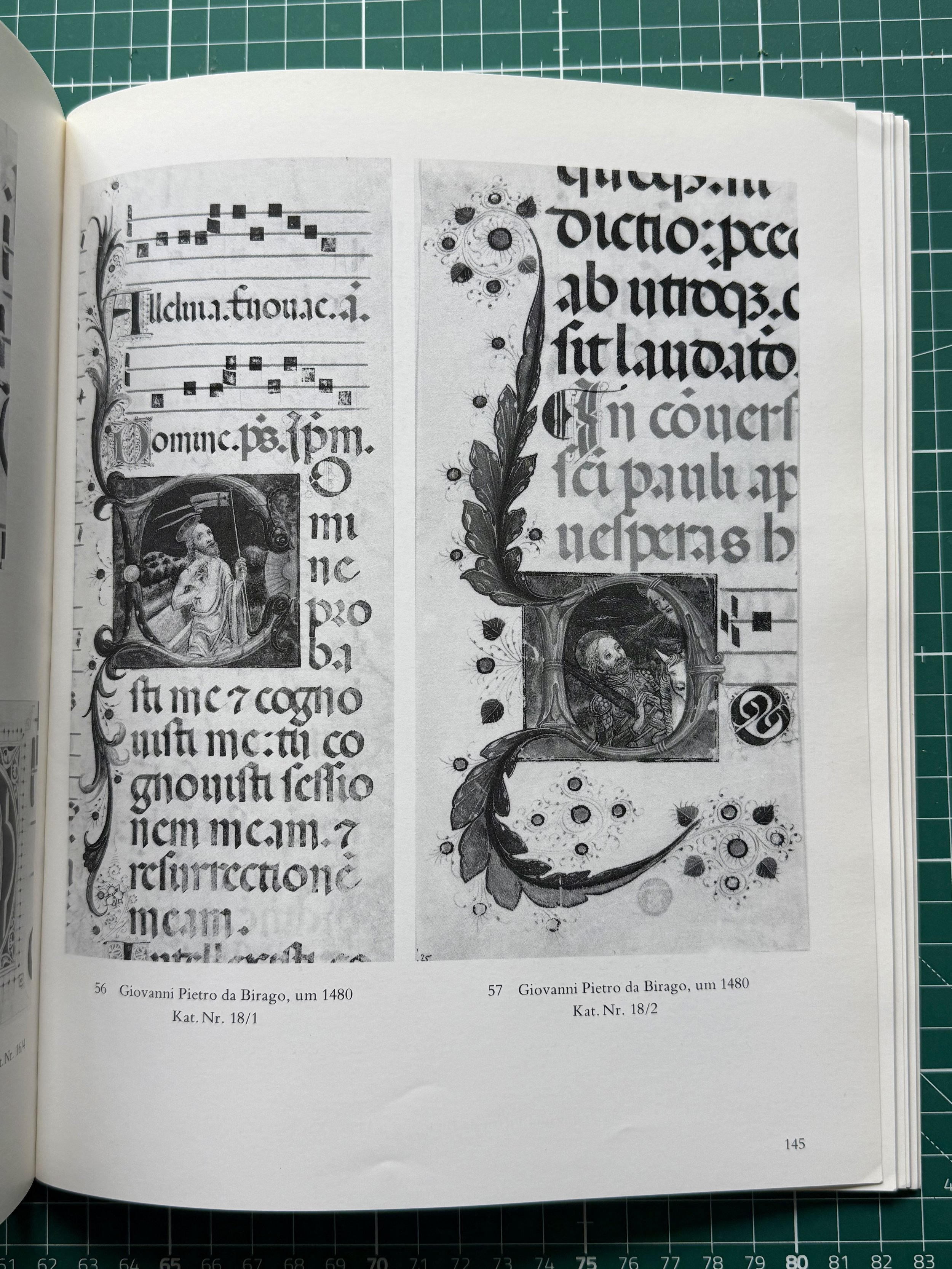
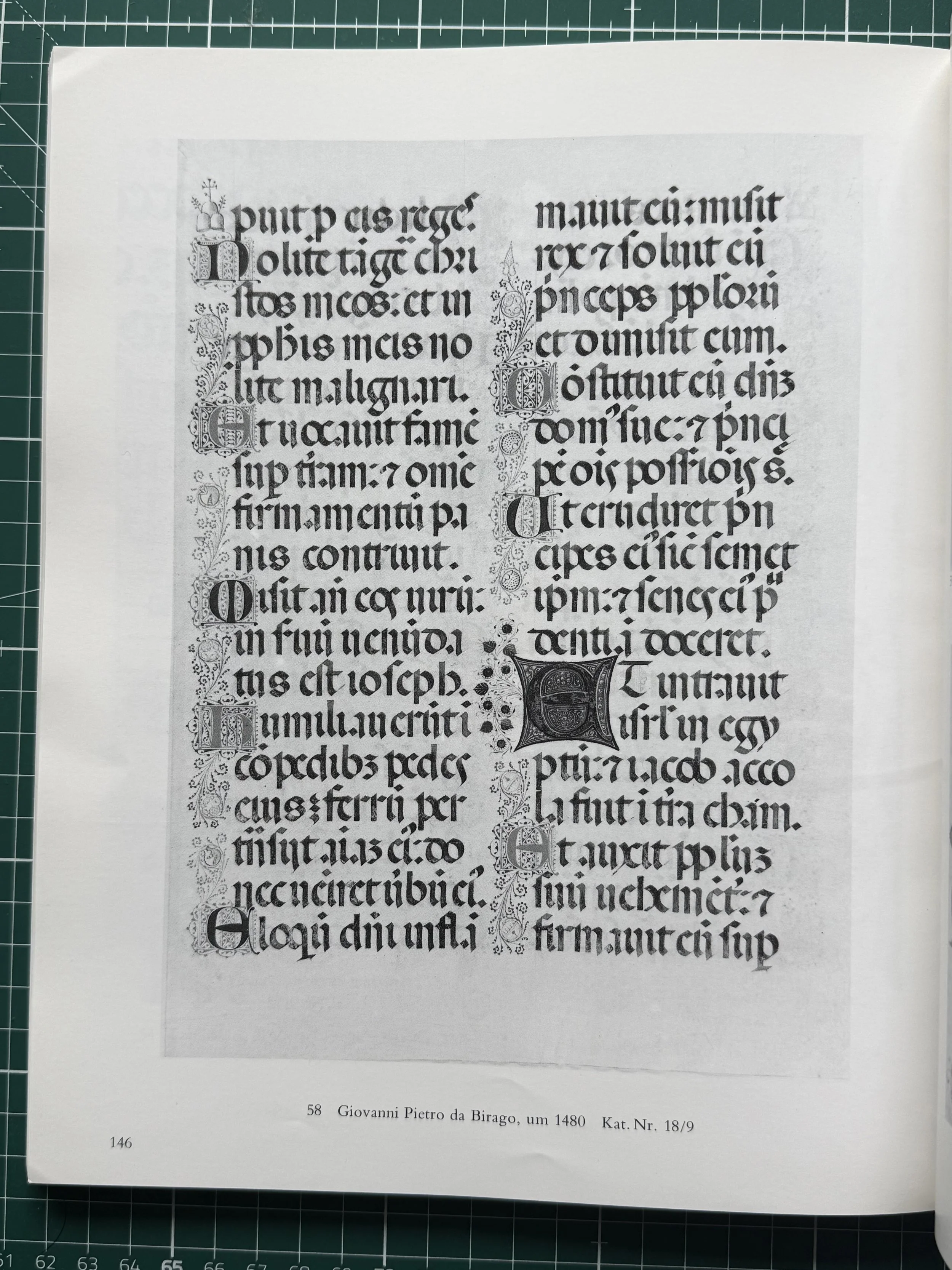
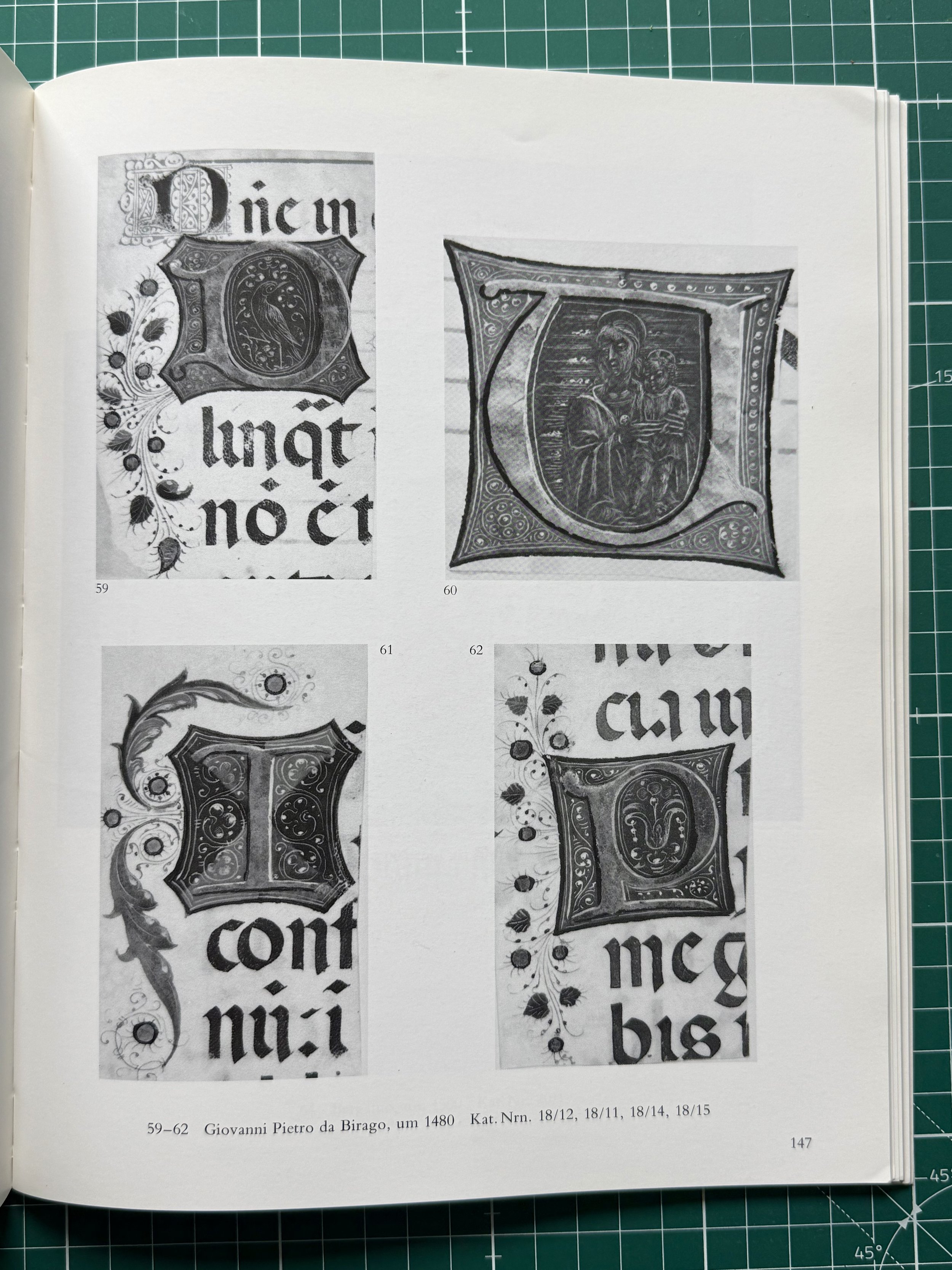
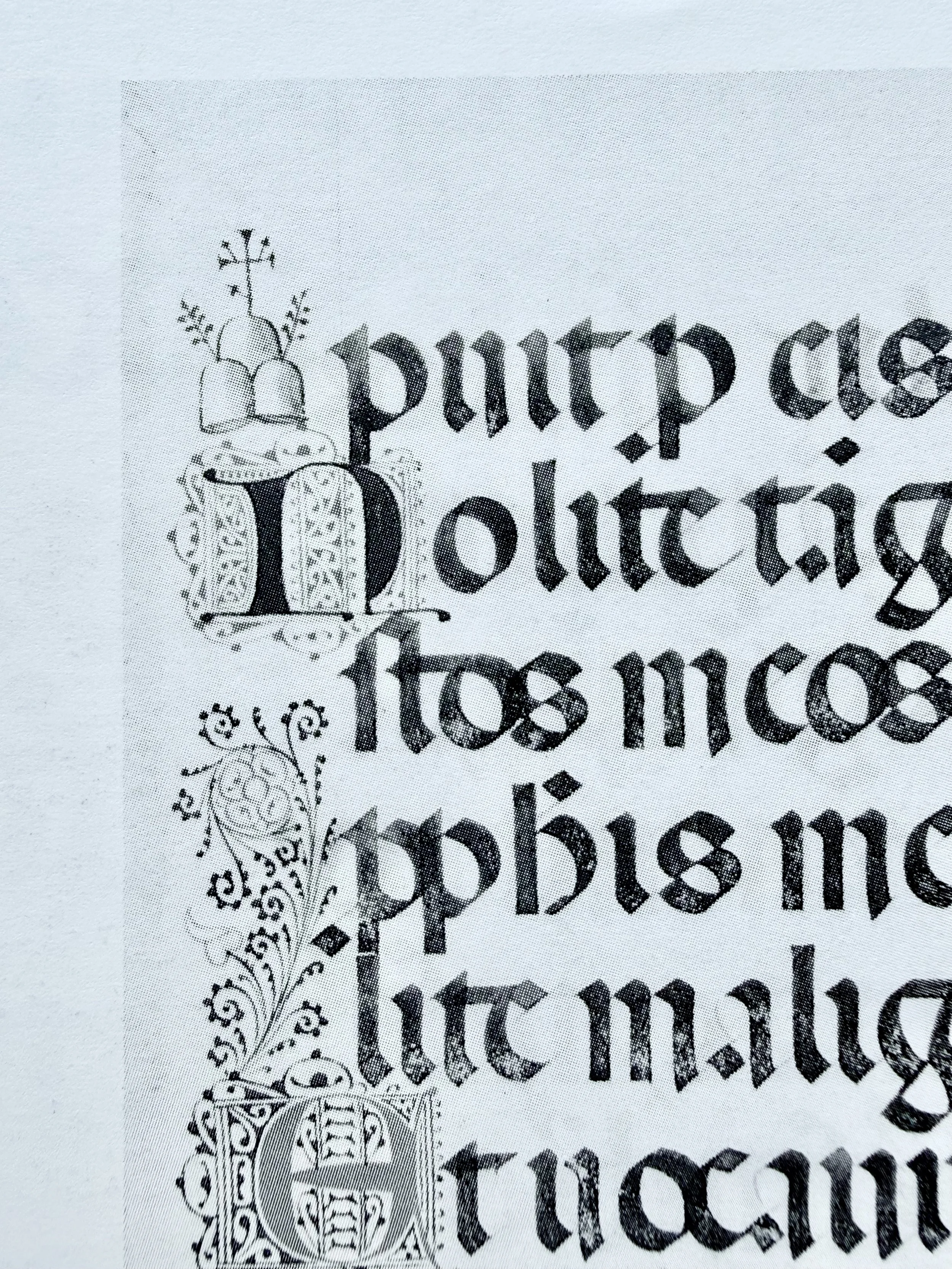
Detail showing the symbol of the Olivetan Order on 18/9 in Munich, Staatliche Graphische Sammlung
The evidence was not merely stylistic. The script, decoration, penwork, and illumination correspond across the group, while an especially revealing symbol recurs within the marginal decoration: three hills surmounted by a cross, the emblem of the Olivetan congregation. Bauer-Eberhardt therefore concluded that the lost Antiphonary had been made for an Olivetan monastery.
Among the most important witnesses to the original appearance of the manuscript is a complete leaf now in the Kupferstichkabinett in Berlin (Inv. 12930).
![giovanni-pietro-birago-berlin-choirbook-leaf-12930]3.jpeg](https://images.squarespace-cdn.com/content/v1/658f779f0adca0579ba4fc34/1789389220476-V8GF6BWJTW6N36J2JWOK/giovanni-pietro-birago-berlin-choirbook-leaf-12930%5D3.jpeg)
![giovanni-pietro-birago-berlin-choirbook-leaf-12930]1.jpeg](https://images.squarespace-cdn.com/content/v1/658f779f0adca0579ba4fc34/1789389219400-2IH47NYF2II39VUU78RY/giovanni-pietro-birago-berlin-choirbook-leaf-12930%5D1.jpeg)
![giovanni-pietro-birago-berlin-choirbook-leaf-12930]2.jpeg](https://images.squarespace-cdn.com/content/v1/658f779f0adca0579ba4fc34/1789389218899-PZB6CQBMZ9EUF38WOJBI/giovanni-pietro-birago-berlin-choirbook-leaf-12930%5D2.jpeg)
Its dimensions—598 × 444 mm—are strikingly close to the 600 × 450 mm dimensions of the present leaf. The Berlin leaf contains the Corpus Christi hymn Sacris solemniis and a historiated initial S with a pope holding a pyx containing the Host. Bauer-Eberhardt associated it with the same manuscript, and the relationship is apparent not only in Birago’s illumination but in the organization and physical proportions of the page.
Birago in Brescia
The manuscript belongs to the formative period of Birago’s career. His earliest securely documented activity is associated with the extraordinary series of eighteen choirbooks produced for the Duomo Vecchio in Brescia. Work on these books had begun before Birago’s documented participation, but his presence is securely established from 1471. The latest dates associated with his hand occur in 1474; in 1475 two choirbooks were entrusted to another Milanese illuminator, Dominico da Milano.
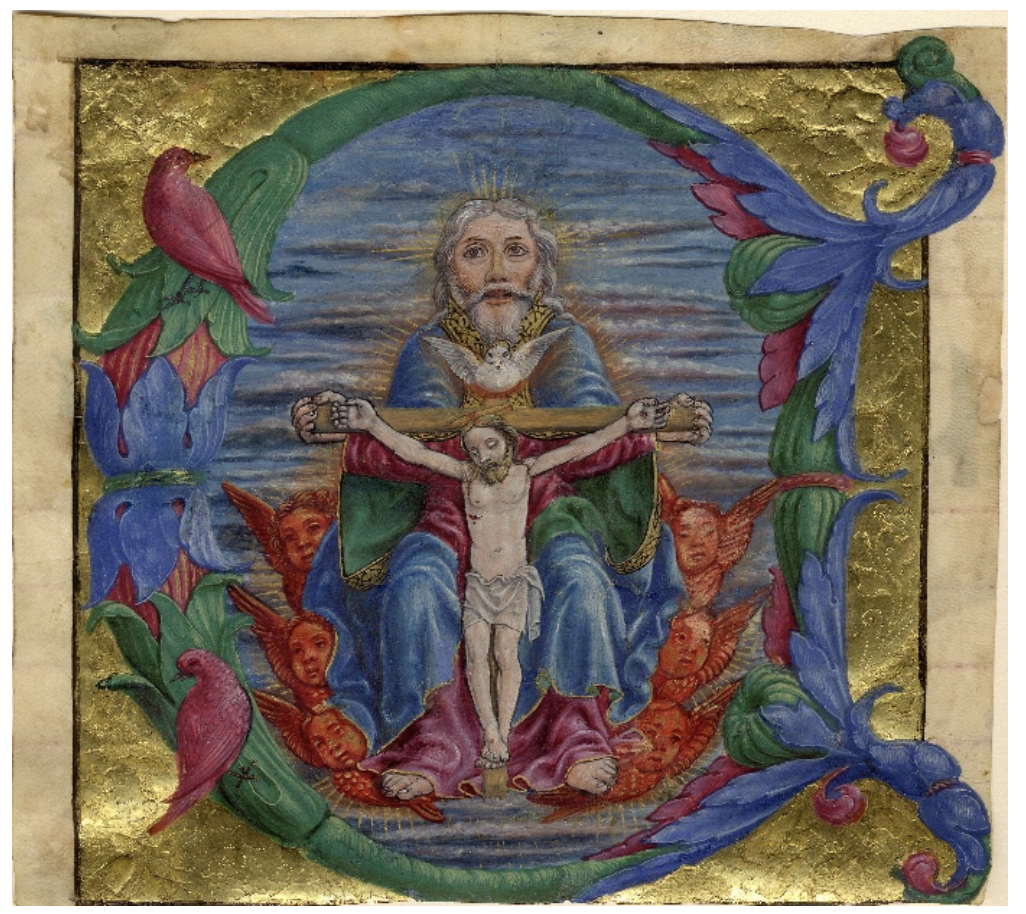
Giovanni Pietro da Birago, initial 'C': The 'Throne of Mercy' Trinity, c. 1471-1472, Italy, Brescia, Private Collection
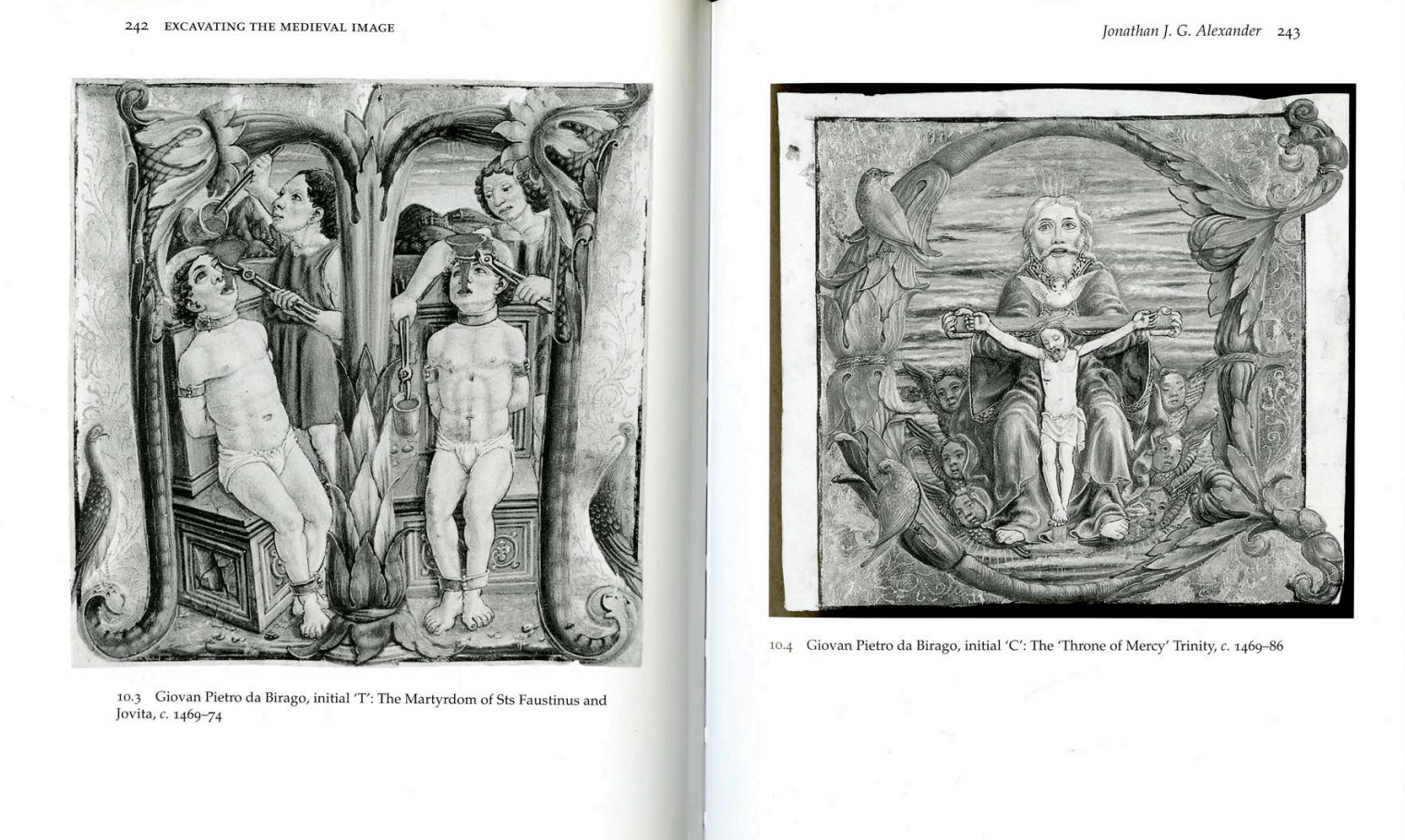
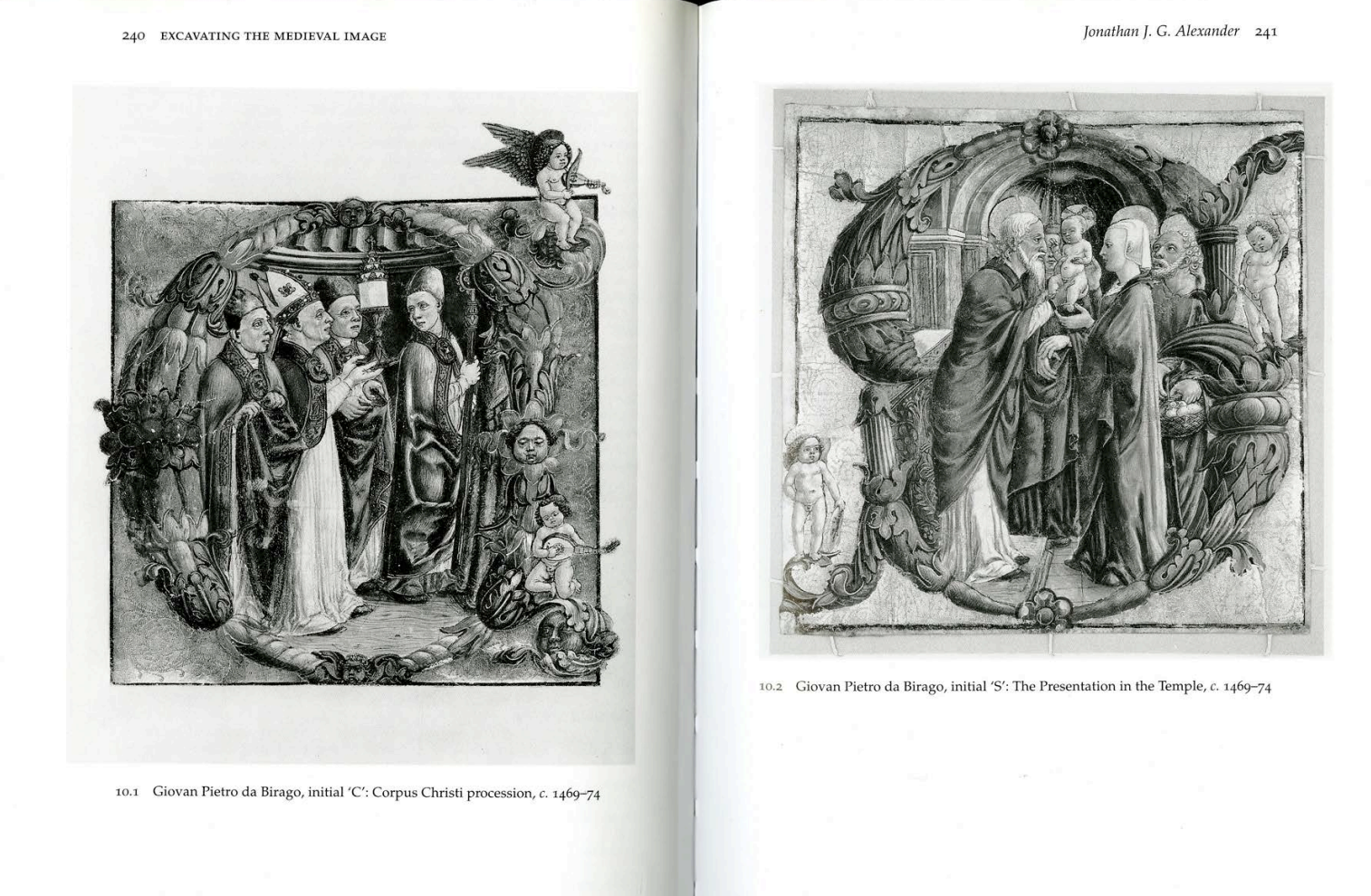
The relationship between the dispersed fragments and this Brescian activity has long been recognized. In 2004, Jonathan J. G. Alexander returned to Bauer-Eberhardt’s group and proposed that the fragments “probably” came from the Cathedral corali. More recently, Beatrice Alai dated the Berlin leaf to the early 1470s, while Laura Paola Gnaccolini’s research has considerably refined our understanding of Birago’s activity in Brescia.
Yet, one problem remains. The Cathedral hypothesis explains the style, date, and Brescian character of the fragments. It does not explain their Olivetan identity. Brescia Cathedral was not an Olivetan institution.
Another proposed destination, the Dominican convent of San Domenico in Brescia, presents the same difficulty. Whatever the precise relationship between the dispersed fragments and Birago’s other early Brescian choirbooks, the recurring Olivetan emblem identified by Bauer-Eberhardt indicates that this particular manuscript was intended for an Olivetan community.
Where, then, was that community?
I believe I have identified it as San Nicolò di Rodengo, an Olivetan monastery, approximately fifteen kilometers west of Brescia.
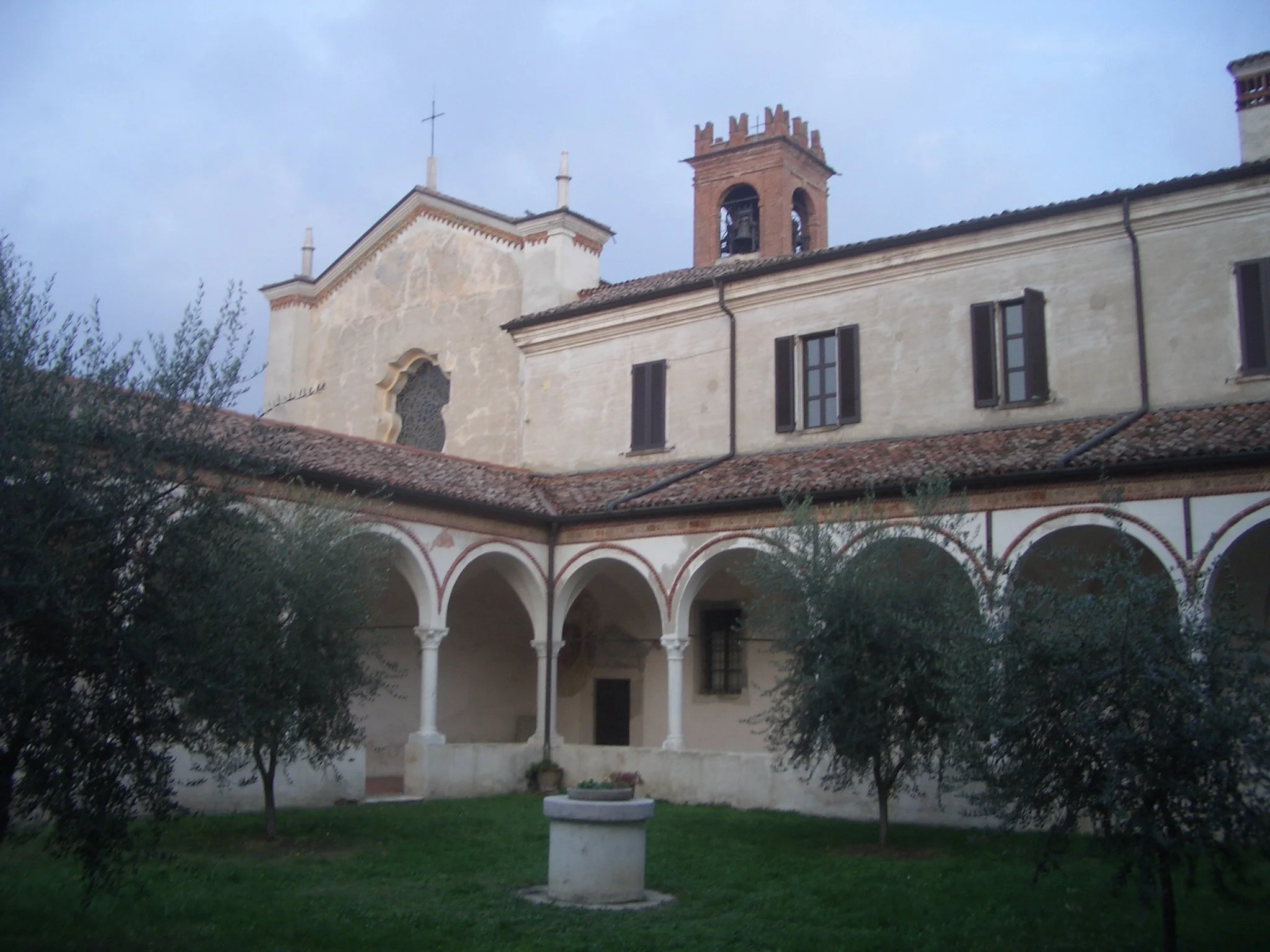
A view of San Nicolò di Rodengo
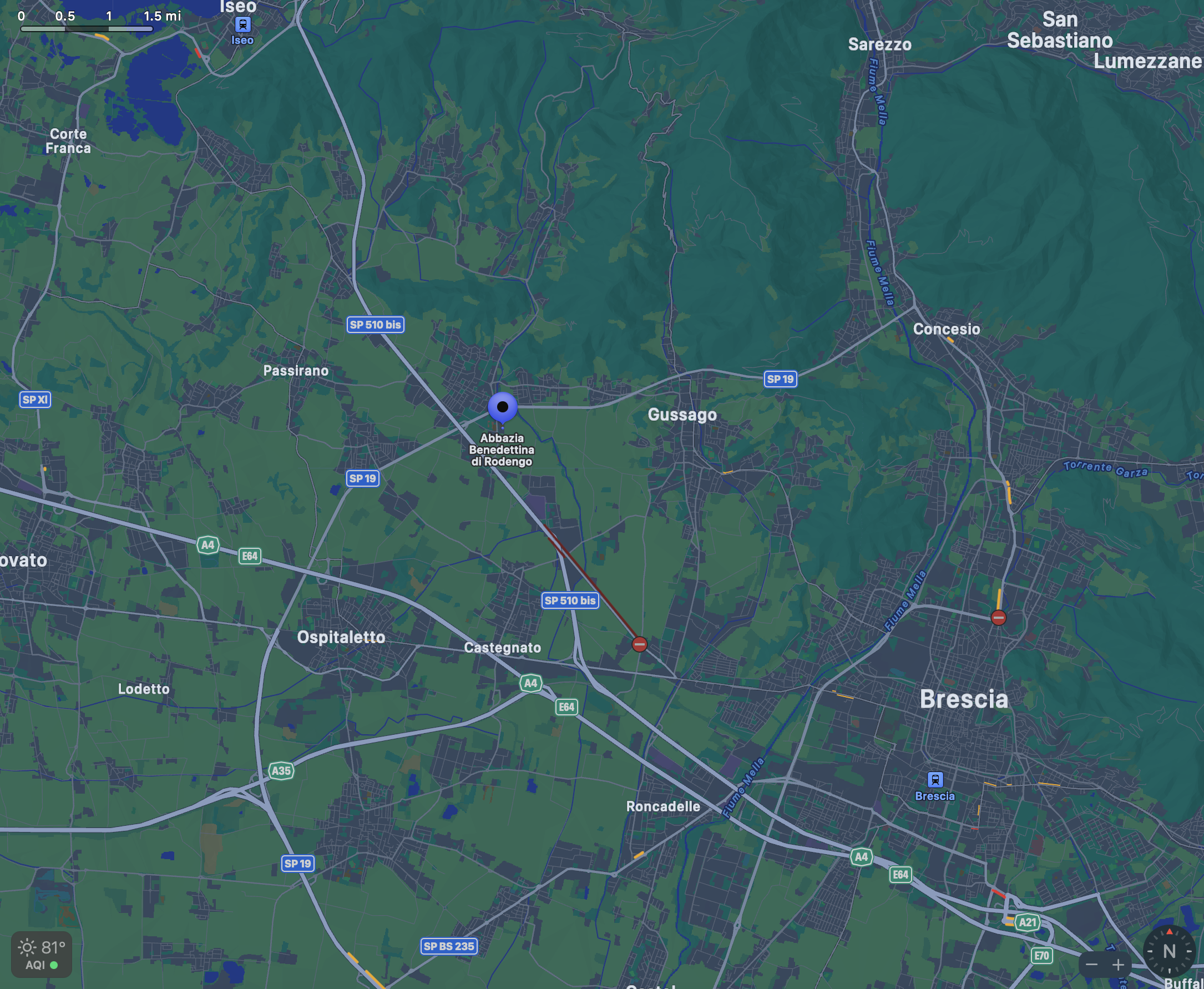
Originally a Cluniac foundation, San Nicolò was entrusted to the Olivetan congregation under Pope Eugenius IV in the mid-1440s. The Olivetans took possession in 1446 and brought with them the renewed monastic observance characteristic of the fifteenth-century Benedictine reform.
The distinction matters because liturgical books were fundamental to that observance. The Olivetan day was structured around the Opus Dei, the cycle of services sung communally in choir. Psalms and their accompanying antiphons were therefore not simply texts for private devotion. A monumental Psalter-Antiphonary was an instrument of the monastery’s daily worship.
San Nicolò consequently offers an intriguing solution to the problem presented by the dispersed Birago manuscript. It was an established Olivetan community in the immediate Brescian territory at precisely the period in which Birago was active there.
This does not prove that the manuscript was made for Rodengo. No document has yet been discovered connecting Birago with San Nicolò, and no ownership inscription presently known in the surviving fragments identifies the monastery. The proposed provenance must therefore remain a hypothesis.
But the surviving records of San Nicolò make the possibility particularly compelling.
Building a Monastery—and Its Liturgical Life
The later 1470s and 1480s were a period of considerable activity at San Nicolò. Major work on the monastery was underway by 1478. In 1480, the monks commissioned a new wooden choir from Cristoforo Rocchi, and a lectern for the choir followed in 1481.
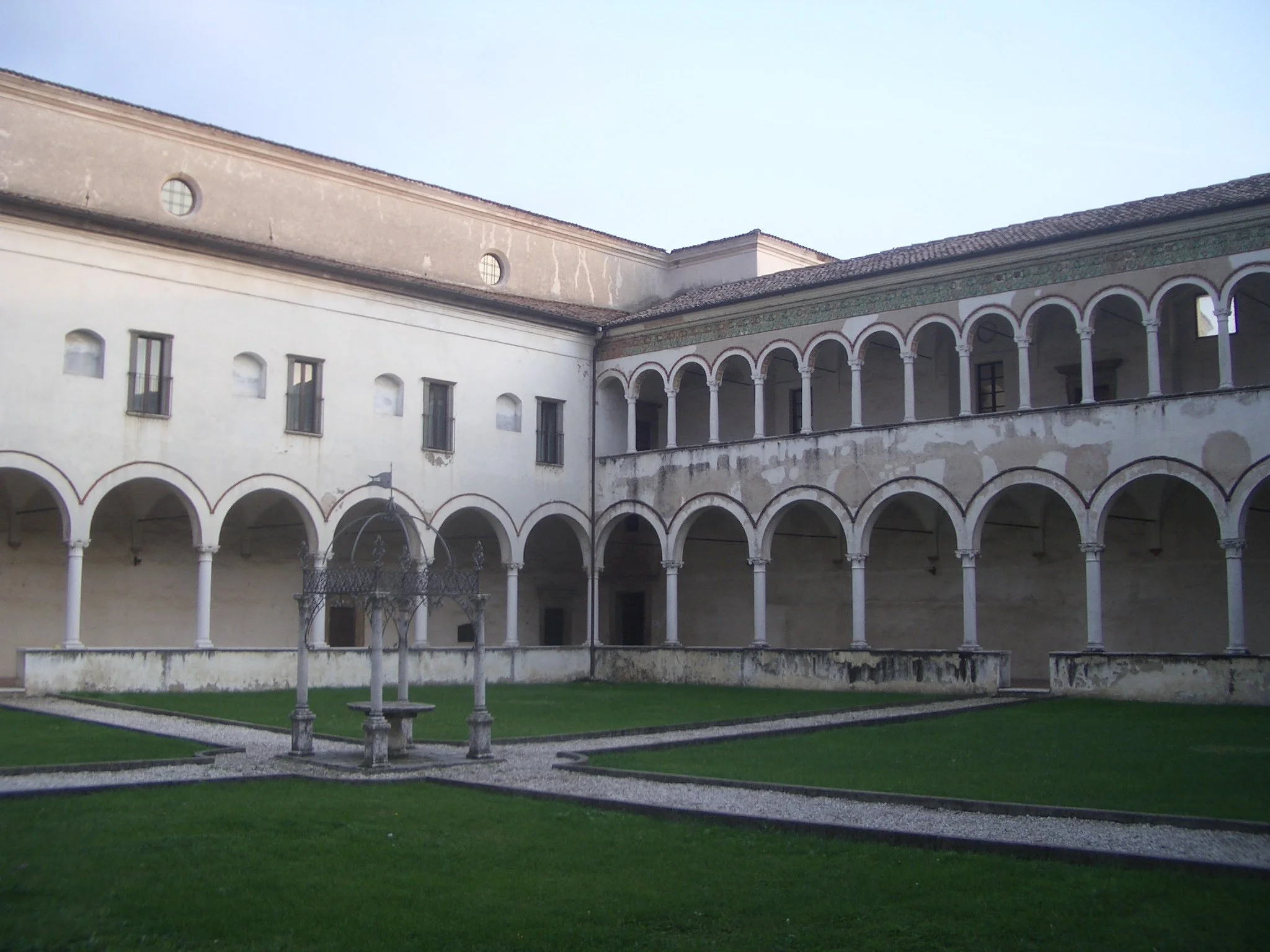
The cloister of San Nicolò di Rodengo
The sequence is especially suggestive in relation to the lost manuscript. A choir and its lectern formed the physical setting in which monumental liturgical manuscripts were used.
And in 1485, the documentary evidence becomes explicit. Angelo Maria Camassei, the eighteenth-century historian of San Nicolò, working from the monastery’s archives, records that in March of that year the monks employed Ambrogio da Milano to ornament their choirbooks with nobili ed eccellenti miniature—“noble and excellent miniatures”—for which he received thirty ducats. Simona Iaria suggested that the books themselves were probably written by monks of San Nicolò.
These cannot presently be identified with the dispersed Birago manuscript. Indeed, the Birago leaves were probably produced earlier. But the record is important because it establishes that the illumination of monumental choirbooks formed part of the artistic and liturgical life of San Nicolò during precisely this period of renewal.
Birago could have worked on the Olivetan manuscript while engaged with the Brescia Cathedral choirbooks in the early 1470s. It could have followed his documented Cathedral activity after 1474, or the project might have extended toward the end of the decade.
For this reason, I believe a date of approximately 1470–1480 best accommodates the evidence presently available.
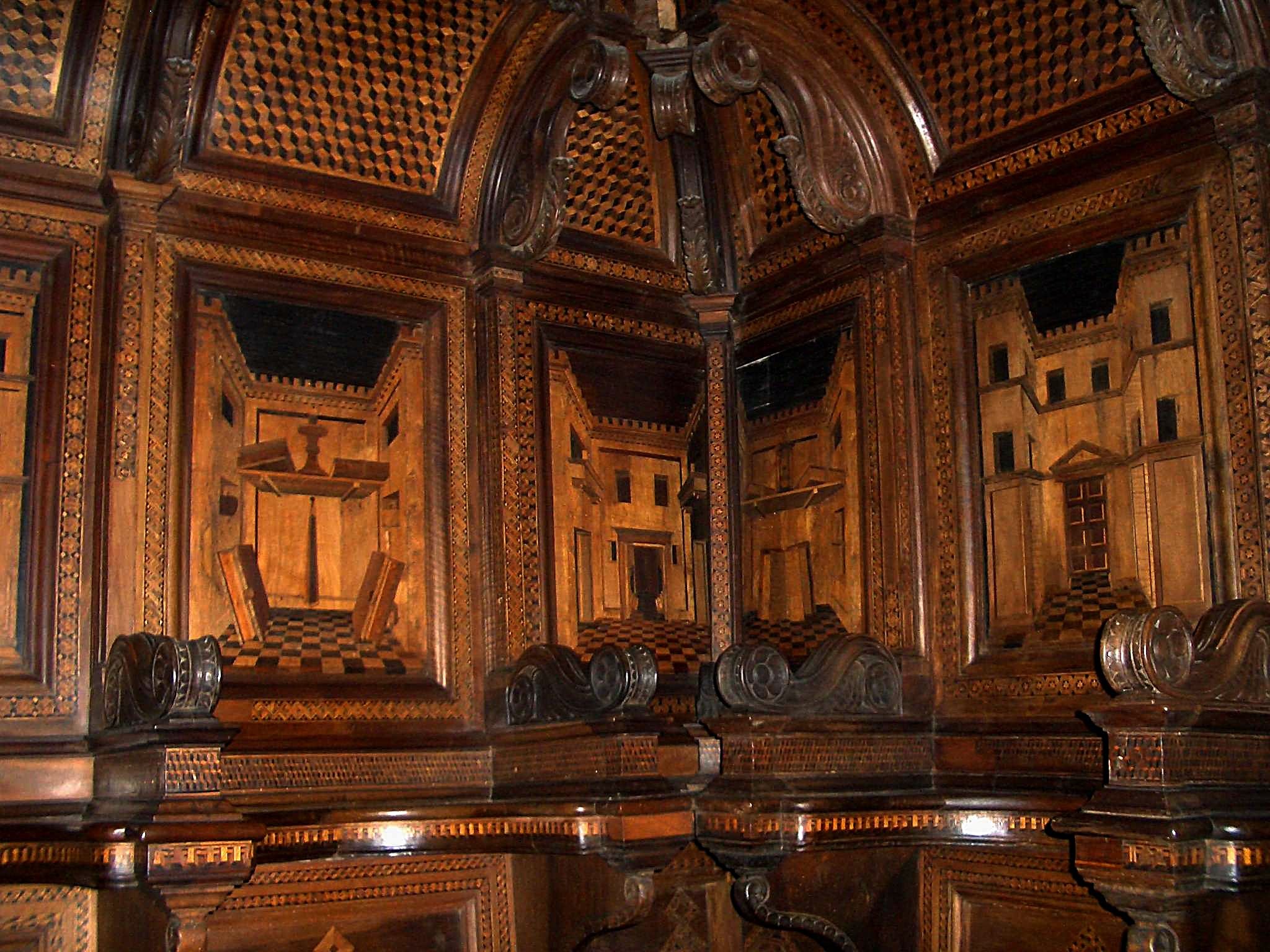
Choir at San Nicolò di Rodengo
Following the Fragments
The reconstruction remains unfinished.
Surviving leaves and cuttings preserve only a fraction of what must once have been an imposing manuscript. Some remain in institutional collections; others have passed through the art market or remain in private hands. Their present dispersal makes the original book difficult to visualize, yet each newly identified fragment has the potential to restore another part of its history.
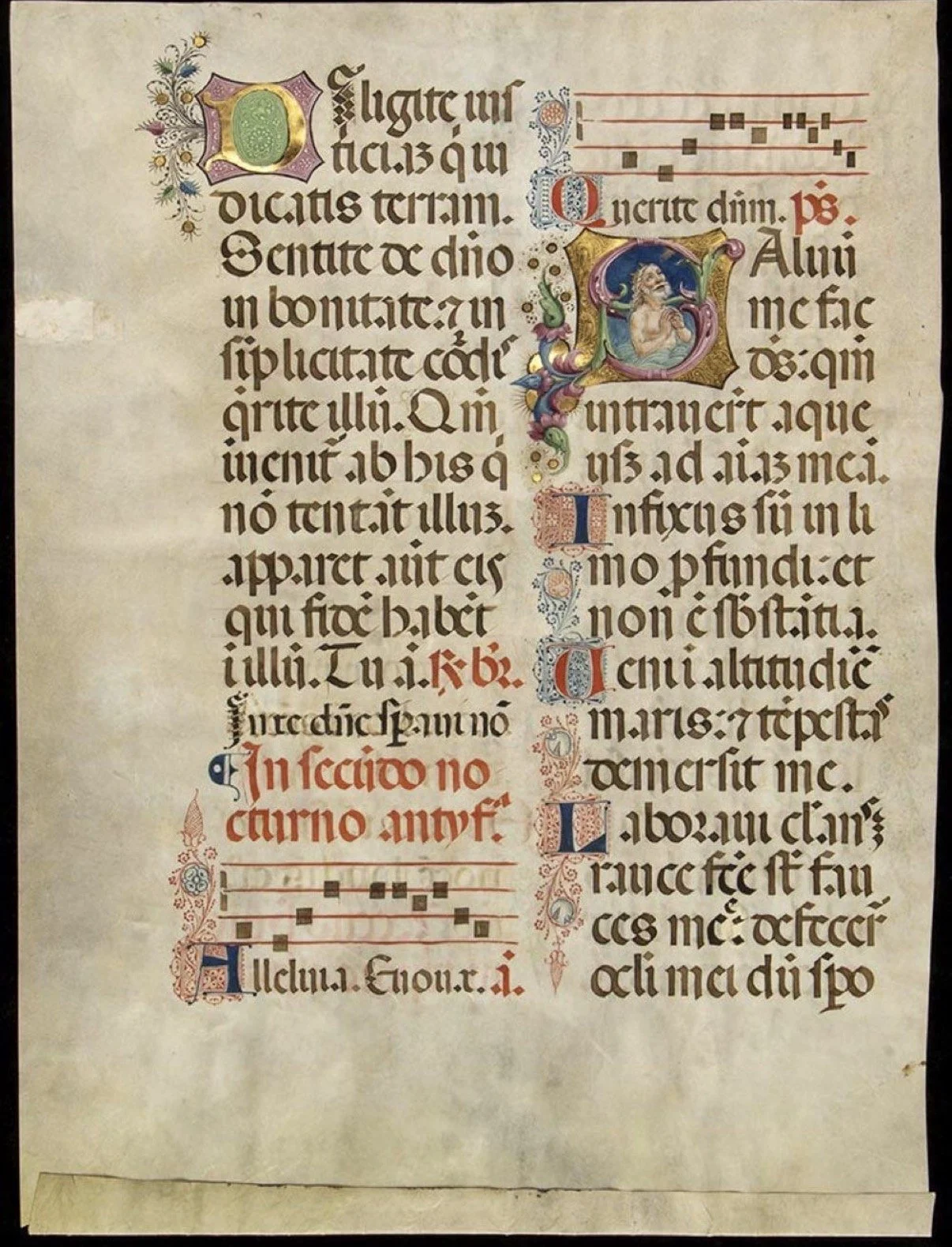
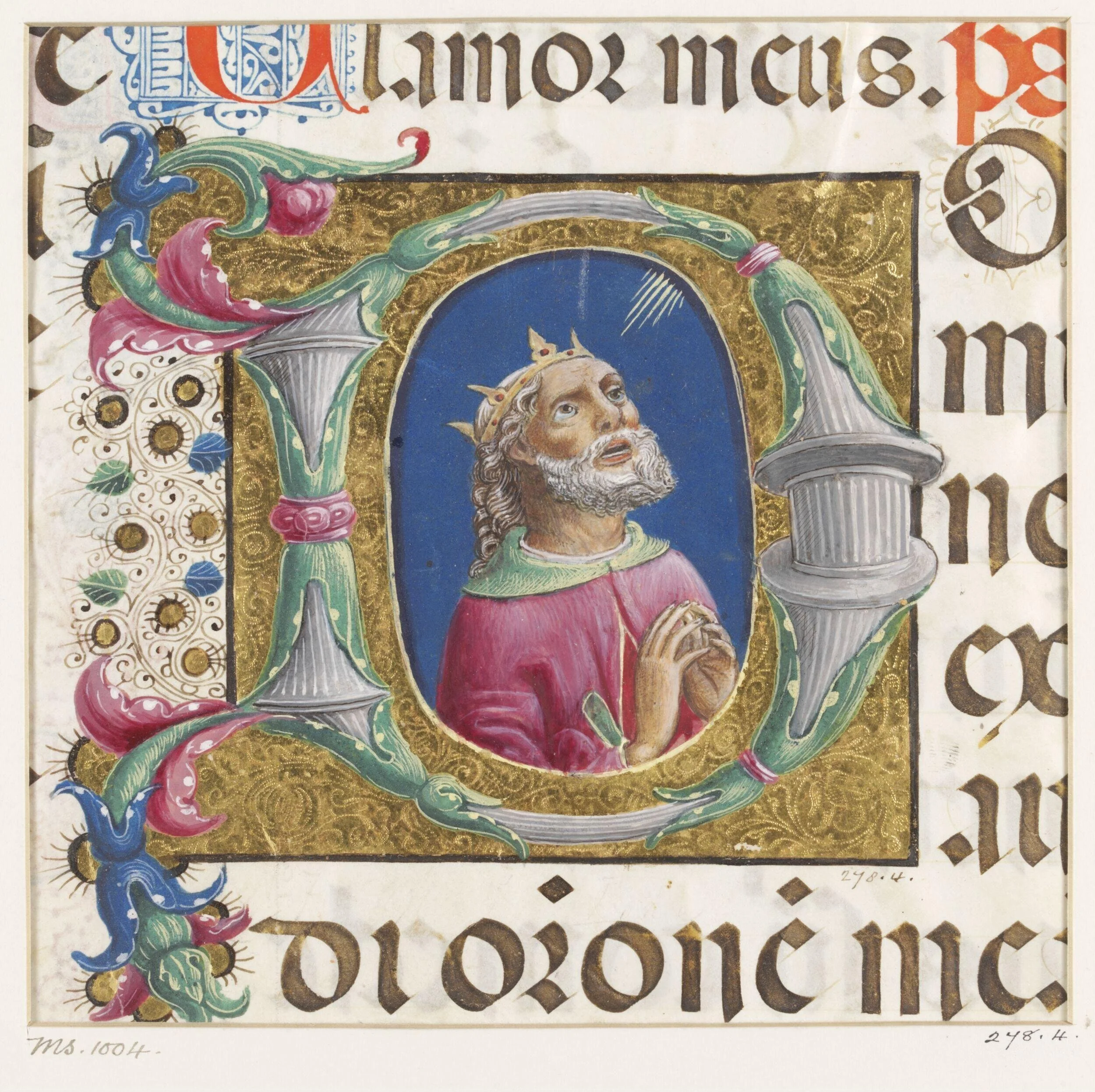
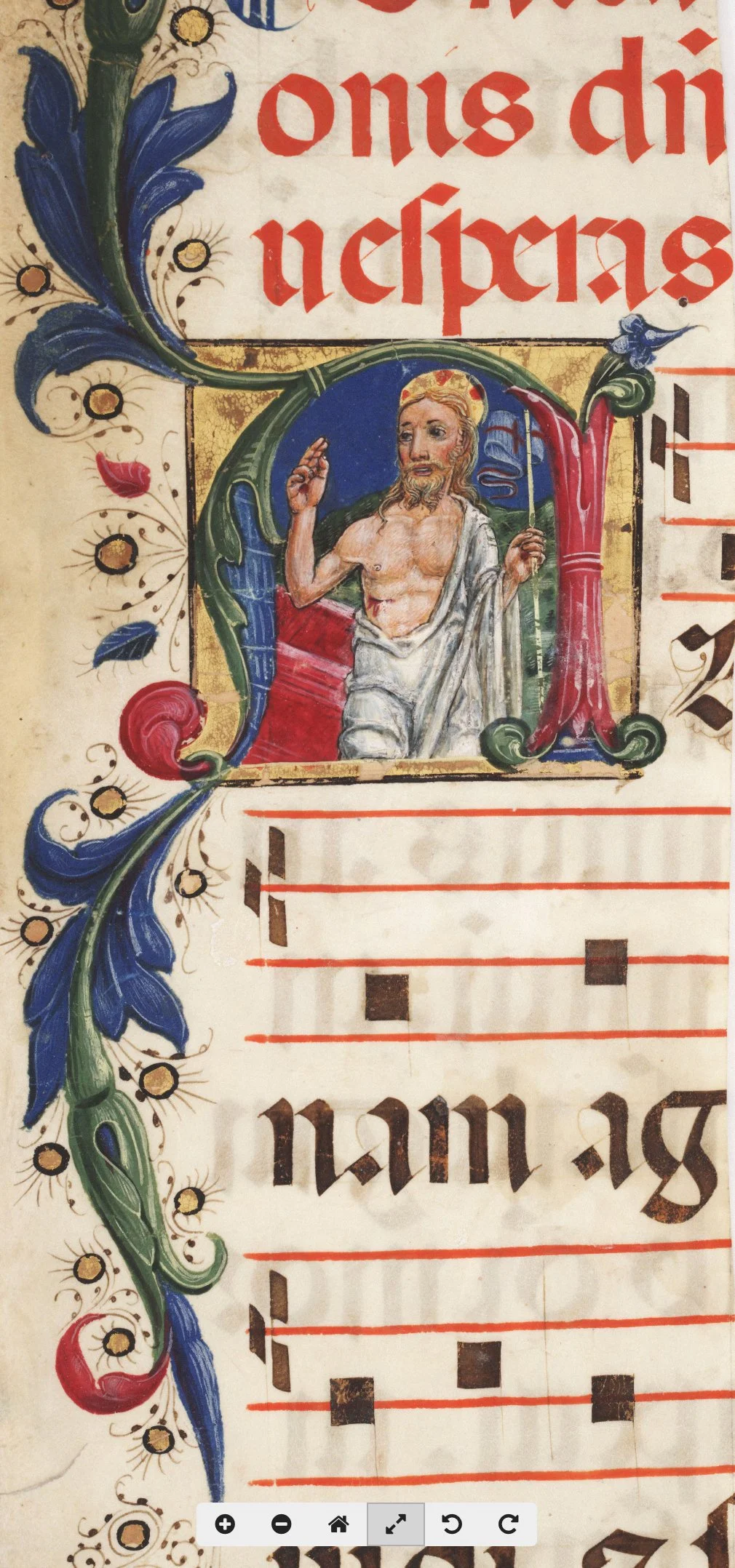
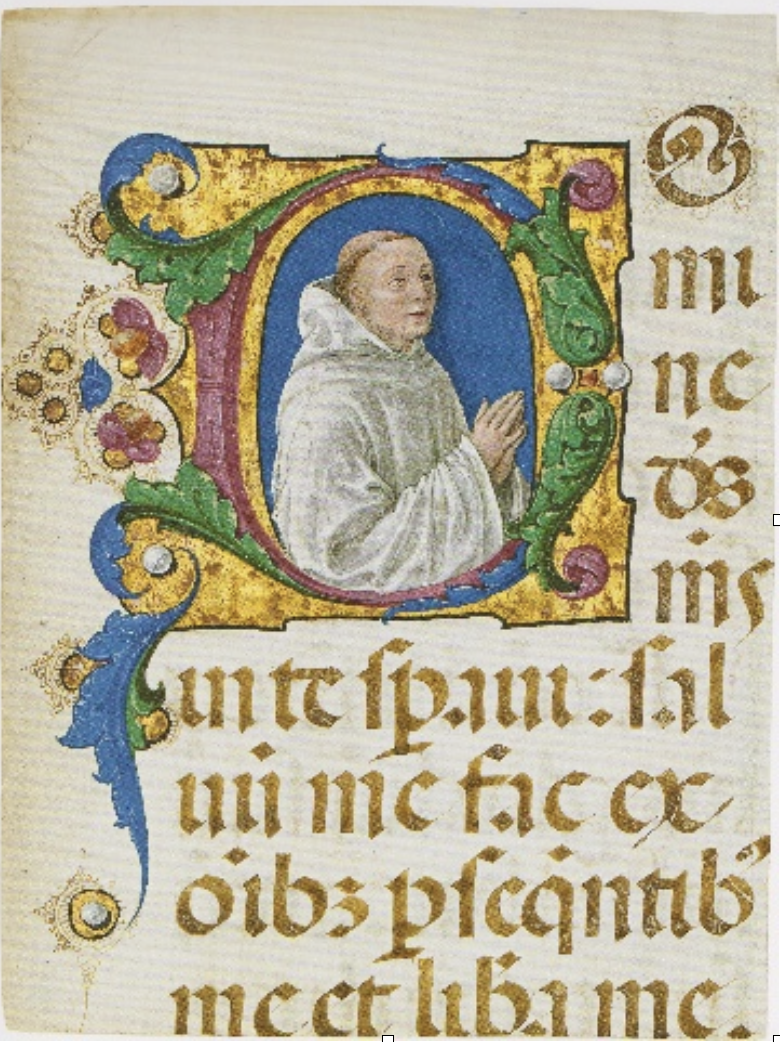
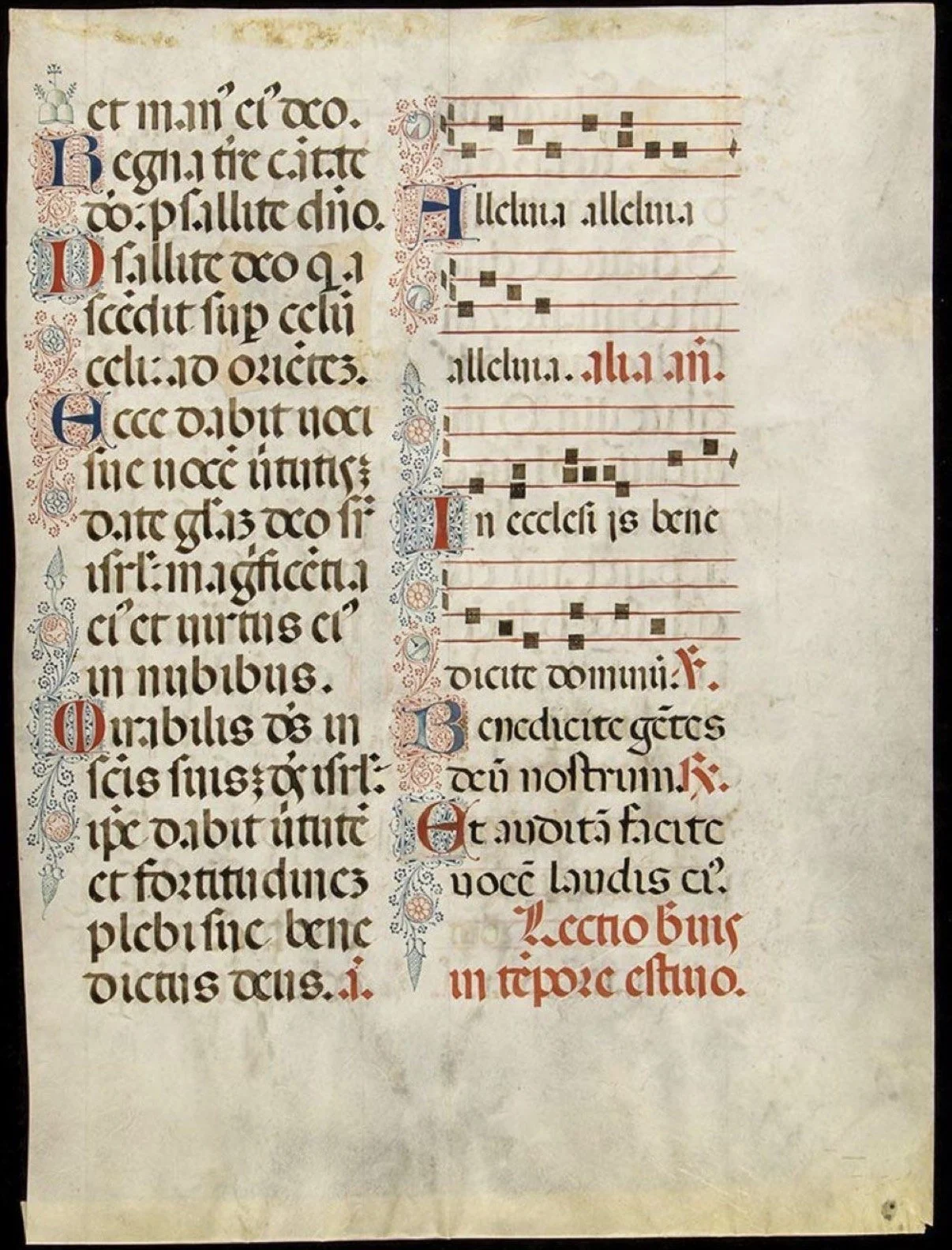
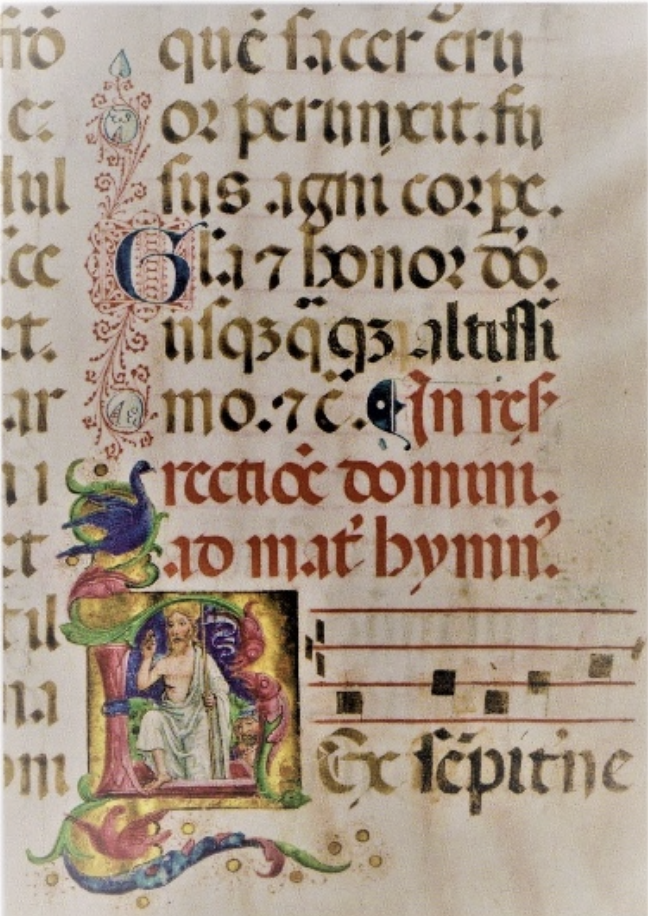
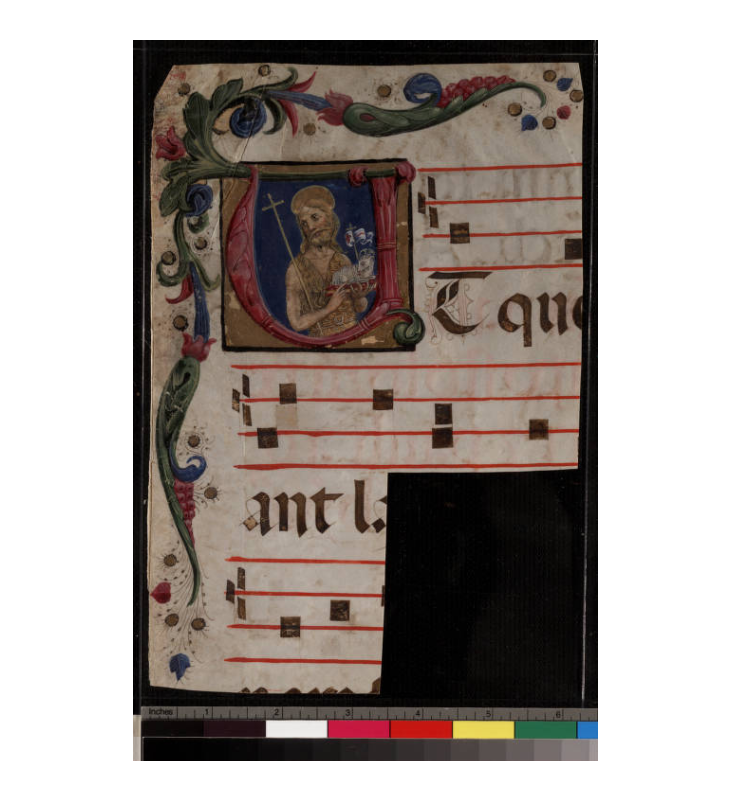
The evidence presently allows several conclusions. The manuscript was Olivetan. It belongs to Birago’s early activity and is closely connected stylistically with his work in Brescia. It was monumental in scale and richly illuminated to have included numerous historiated initials. Its original monastery, however, has remained unidentified.
San Nicolò di Rodengo offers, I believe, a plausible historical setting in which these pieces of evidence can for the first time be understood together: an Olivetan monastery near Brescia, undergoing substantial renewal during the 1470s and 1480s, at a moment when Birago was establishing himself as an illuminator of monumental choirbooks in the same region.
For now, the attribution of the lost Psalter-Antiphonary to San Nicolò must remain hypothetical, but it provides a direction for further research.
I am very grateful to Professor Gaudenz Freuler for his generosity, insight and careful attention throughout the course of my research on this illuminated leaf.
For the full catalogue description of the Singing Olivetan Monk, including a census of known sister leaves and fragments, provenance, and the complete bibliography underlying this research, see the catalogue entry here.